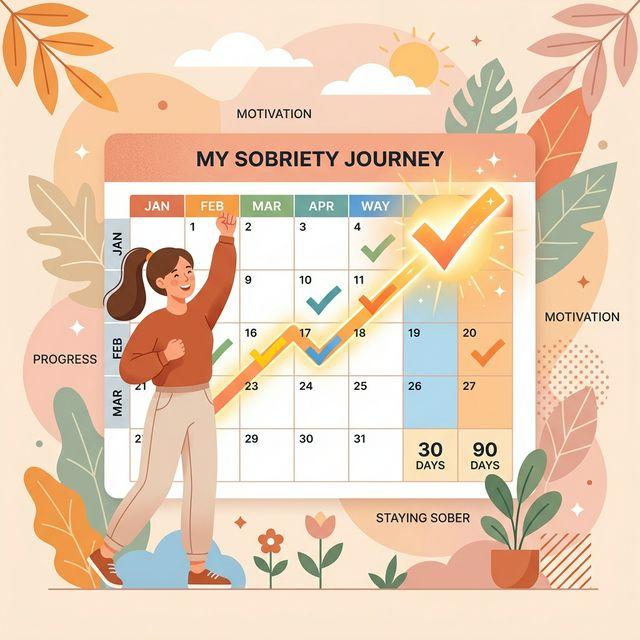
Most people quit drinking in their head days before they quit on paper. They decide, they mean it, they white-knuckle a Thursday and a Friday, and by Sunday night the count is already fuzzy. Was Wednesday the last drink, or Thursday lunch? Did the sip at the wedding reset everything? Without a visible number, the whole attempt dissolves back into a mood.
Tracking sobriety days is how you stop negotiating with a ghost. A streak is not a personality upgrade and it is not a moral score. It is a date plus a rule, shown somewhere you will actually look. This article is the practical side of that: how to start the counter, how to keep it growing through the windows that usually break people, and what to do when the number goes back to one. For the science of why a visible chain works on your brain, see the psychology of streaks.
If you're still choosing a tracking app, our guide to the best sobriety apps compares the top options side by side.
Use the sobriety calculator to count the calendar days since your start date and see when your next milestone falls.
Start With a Date, Not a Feeling
A streak that is not anchored to a clock will drift. Pick the moment alcohol last left your system as a decision, not as a vibe.
Write the quit timestamp down once. Date and, if you remember it, approximate time. "Saturday 10 August, after the last beer at 11pm" is enough. That stamp is the only source of truth. Memory will try to move it later, especially after a hard week, so the written version wins.
Decide what day 1 means. Two conventions are both fine, as long as you pick one and stay with it. Some people start the clock at the last drink, so the next calendar morning is day 1. Others wait until they have completed a full 24 hours. The number is a few hours apart. The damage comes from switching conventions mid-streak because the bigger number felt nicer.
Define a break in one sentence. The clean rule: any alcoholic drink resets the counter. Not a sip of someone else's wine, not "just the champagne toast," not a beer you did not finish. Non-alcoholic beer is a separate question; decide in advance whether 0.5% counts for you, then stop reopening the case at 9pm. A rule you rewrite under craving is not a rule.
Do not wait for a perfect Monday. The best quit date is the one you can timestamp today. Waiting for the first of the month, or for Sober September, or for after the wedding, is how attempts stay imaginary. Challenge months are useful later, as extra scaffolding. They are a poor reason to delay the first counted day.
Pick a Counter You Will Still Open in Week Three
The method matters less than whether it is still in your hand when the novelty wears off. Three options cover almost everyone.
A wall calendar or a notebook. Jerry Seinfeld's "don't break the chain" trick still works because it is ugly and unavoidable: a red X on a paper square you walk past every morning. No login, no battery, no social feed. The downside is the same as the upside. It lives in one room, it does not travel, and it cannot show you money saved or sleep recovered at a glance.
A notes app or a spreadsheet. Fine for the first week. Most people abandon it because incrementing a cell is a chore with no payoff. If you go this route, put the note on your home screen and keep three fields only: quit date, current day count, last check-in.
A dedicated sobriety tracker. This is the option that survives month two, because the number is the product, not a side effect. Open the app, see the day count, close it. A private counter like Sober Tracker is built around that loop: no account, no social feed, just the date you set and the number that grows from it. Extra features only help if they stay optional.
Whatever you pick, use one counter. Two apps plus a calendar plus a screenshot folder is how the official number becomes a debate.
Make Check-In a Ritual, Not a Dashboard
A streak dies from missed days more often than from drinks. The drink is usually the last step. The first step is that you stopped looking at the number, so the chain stopped feeling real.
Same time, same place, thirty seconds. Morning coffee, or locking the phone at night. Open the counter, confirm the day ticked over, close it. That is the whole ritual. If your app asks for a mood, a journal, and three badges before it will show the number, you will skip it on the mornings you most need it.
Let the number do the arguing. The point of a system is that today's you does not get a fresh debate. Yesterday's you already decided. The counter is the record of that decision. When a craving shows up, you are not asking "do I feel like being sober." You are asking "do I want to throw away a 19-day chain for a drink I will not remember." That is a worse offer, which is the whole trick.
Protect the streak in the calendar, not in your character. Mark the known danger windows before they arrive: Friday night, the Sunday that used to be a session, the work trip, the wedding. Put a specific replacement in the slot, a walk, a film, an early train home, a non-alcoholic drink you actually like. A streak does not grow because you became stronger. It grows because fewer evenings are left unstructured.
Look at the number on the days you want to hide from it. Usually day 3, day 7, and the first weekend. Streaks belong to the people who open the counter when they feel nothing.
How a Streak Actually Grows
The number goes up by one every night you do nothing. Almost every quit attempt dies in the same few windows.
Days 1 to 3: withdrawal and logistics. If you have been a daily drinker, this is a medical window first. Read the day-by-day withdrawal timeline, and talk to a doctor before you stop if you drink heavily. Get the date into the counter and do not renegotiate it. Sleep, water, food. Day 3 looks unimpressive. It still counts.
Days 4 to 14: boredom and temper. The emergency fades and irritability, broken sleep, and empty evenings move in. This is where people decide the tracker was a cute idea. Keep the ritual. A 10-day chain is the first number that starts to feel like property, which is when "don't break the chain" stops being a slogan.
Days 15 to 30: social tests. Someone offers a drink without malice. A Friday looks normal. The pink cloud may tell you that you have this handled, which is how day 22 becomes a reset. Treat invitations as scheduled events: one prepared sentence, one exit, one look at the number before you leave the house.
Days 31 to 90: the streak becomes identity. The counter stops being a project and starts being a fact about you. Useful, because you spend less willpower on the daily yes. Dangerous, because a slip now feels like a demolition. Keep the ritual small. The number can get big. The process should not.
Past 90 days the job is maintenance: same check-in, a plan for holidays and travel. A year is 365 of the same night.
When the Streak Breaks
It might. Plenty of long sober lives include a reset. The streak is a tool. It is not the recovery.
The damage is rarely the drink. The damage is the story that follows it: "I threw away 45 days, so the next six do not matter." That is the what-the-hell effect, and perfectionism feeds it. Forty-five days of sleep, liver repair, and practice are still in your body. The counter going to 1 does not uninstall them.
Restart the same day, not on Monday. Write the new timestamp. Open the same counter. Do not delete the old screenshot if you have one. The previous best is data, not a verdict. Plenty of people beat their record on the attempt after the one that hurt.
Do not switch apps as a punishment. A new tracker will not make you a new person. The old number was honest. A fresh install that hides the history is how you lose the lesson.
Change one condition, not your entire personality. If the slip had a shape, a place, a time, a person, a hunger, fix that one input. A different Friday plan is a better response than a vow to become disciplined.
A streak is a chain of ordinary nights. You do not need a better character to add the next link. You need a date, a rule, and a number you refuse to stop looking at.
Frequently Asked Questions
How do I start tracking sobriety days?
Write down the date and approximate time of your last drink, pick a single counter, and decide in one sentence what counts as a reset. Day 1 is either the next calendar morning or the first full 24 hours, your choice, then leave the convention alone. Open the counter once a day at the same time. That is the whole setup.
What is the best way to track sober days?
The best way is the one you will still open in week three. A wall calendar works if you see it every morning. A notes app works if the note sits on your home screen and stays tiny. A dedicated sobriety tracker works for most people after the first month, because the day count is the first thing on the screen and it does not depend on you remembering to increment a cell.
Does a sip of alcohol break a sobriety streak?
If your rule is no alcohol, yes. Bargaining over volume is how streaks become debates. Decide in advance whether non-alcoholic drinks are allowed, then apply the same sentence on the night it is inconvenient. A streak you can lawyer is not protecting you.
How do I keep a sobriety streak going?
Protect the evenings, not the identity. Check the number daily, put a specific plan on the nights that used to be drinking nights, and look at the counter on the days you least want to. Streaks grow in the boring windows: day 4, day 11, the first normal Friday. Motivation is optional. The ritual is not.
What should I do if I break my sobriety streak?
Restart the same day. Set a new timestamp in the same counter. Do not wait for Monday and do not throw away the previous total as if those days did not happen. Then change one condition that made the slip easy. The record you beat next time is allowed to include this one.
A private day count is the smallest daily habit that still tells the truth. Sober Tracker is a no-account counter that turns the night you just finished into a number you can see tomorrow morning.
This article is educational and not a substitute for medical advice. Alcohol withdrawal can be serious, especially for long-term heavy drinkers, so talk to a doctor before quitting if you drink heavily every day.