Choosing to quit or cut back on alcohol is one of the most significant decisions you can make for your health, relationships, and future. But the decision is only the beginning. What comes next is the daily work of staying committed, and that is where a good sobriety app can make a real difference.
Research in behavioral psychology consistently shows that tracking a habit increases the likelihood of maintaining it. The simple act of recording your progress creates a feedback loop: you see your streak grow, you feel a sense of accomplishment, and that feeling reinforces your commitment.
But with dozens of sobriety apps available in 2026, how do you choose the right one? We installed, tested, and compared the top 8 options to help you find the best fit.
Quick Comparison: All 8 Apps at a Glance
| App | Price | Best For | Privacy | Our Rating |
|---|---|---|---|---|
| Sober Tracker | Freemium | Privacy and focused tracking | No account, on-device only | 4.8/5 |
| I Am Sober | Free / $49.99/yr | Community and daily pledges | Account required, cloud sync | 4.5/5 |
| Reframe | $12.99/mo or $99.99/yr | Science-based behavior change | Account required | 4.3/5 |
| Loosid | Free | Sober social life and dating | Account required | 4.2/5 |
| Nomo | Free / $4.99/mo | 12-step programs and accountability | Optional account | 4.0/5 |
| Sober Grid | Free | Peer support and location-based community | Account required, location data | 3.9/5 |
| Try Dry | Free | Drink tracking and moderation | Minimal data collection | 4.1/5 |
| EasyQuit Drinking | Free / $7.99 one-time | Health timeline on a budget | No account required | 3.8/5 |
How We Tested These Apps
Every app on this list was installed and used for at least two weeks. We evaluated each one on six criteria:
- Core tracking quality: How reliably does it count your sober days, and how useful is the information it presents?
- Motivation tools: Does the app give you reasons to keep going when things get hard?
- Privacy and data handling: Where does your data go? Is an account required? Could your recovery information be exposed?
- Design and usability: You will open this app every day for months or years. It needs to feel good.
- Pricing fairness: Are the core recovery features accessible for free, or is the useful stuff locked behind a paywall?
- Long-term value: Is this app built for sustained use, or does it lose its appeal after the first month?
We also drew on community feedback, app store reviews, and our own experience building and using sobriety tools daily.
The 8 Best Sobriety Apps in 2026
1. Sober Tracker
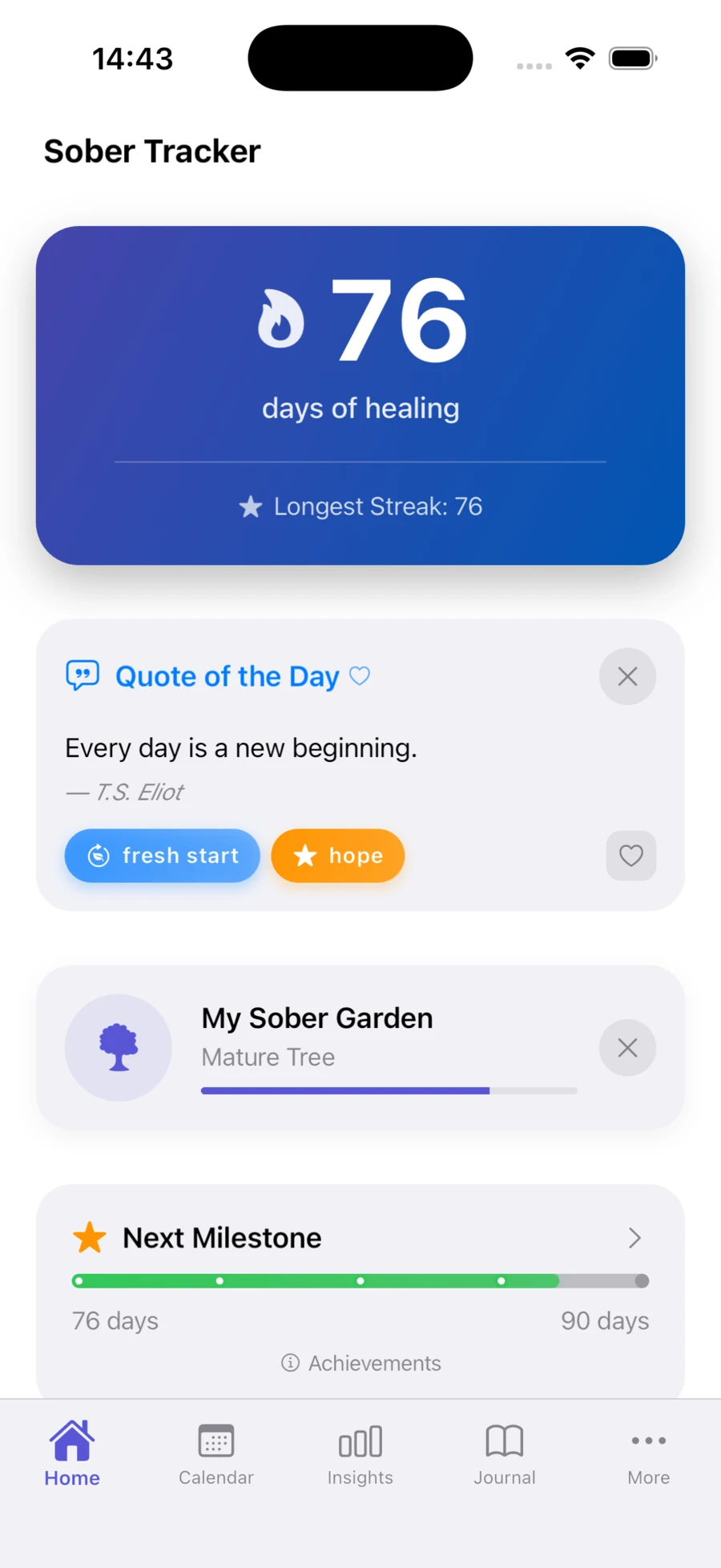
Sober Tracker takes a fundamentally different approach to sobriety apps. Built on the principle that recovery is deeply personal, it focuses on providing a clean, private, and focused tracking experience without requiring you to share anything with anyone.
Key Features:
- Precise sobriety streak counter with time-zone-resilient tracking
- Sobriety Garden: a visual representation of your progress where plants grow as your streak extends
- Health recovery timeline showing how your body heals over time
- Money saved calculator based on your drinking habits
- Achievement system with meaningful milestones
- Private journal for reflections
- Widget support for at-a-glance progress on your home screen
Pricing: Core features are free. Premium subscription unlocks advanced analytics, the full Sobriety Garden experience, additional customization, and detailed health tracking. See our free vs paid breakdown.
Privacy: No account required. All data stays on your device. No cloud sync, no social feeds, no data collection beyond anonymous analytics. Your recovery journey remains entirely yours.
Pros:
- Privacy-first design: no account, no cloud, no sharing
- Clean, focused interface that reduces cognitive load
- The Sobriety Garden provides meaningful visual motivation
- Works fully offline
- Lightweight and fast
Cons:
- No built-in community or social features
- No cross-device sync (since data stays on-device)
- Smaller user base compared to I Am Sober
Best for: People who value privacy, want a focused tool without social pressure, and prefer a clean interface that gets out of the way.
Our rating: 4.8/5
2. I Am Sober
I Am Sober is one of the most well-known sobriety apps, and for good reason. It has built a massive, active community of people supporting each other through recovery. For a detailed head-to-head, see our Sober Tracker vs I Am Sober comparison.
Key Features:
- Daily pledge system where you commit to staying sober each morning
- Community feeds connecting you with others on the same day of their journey
- End-of-day reviews to reflect on how things went
- Milestone tracking and sharing
- Mood and motivation logging
- Money saved calculator
Pricing: Free with basic features. Premium subscription (around $9.99/month or $49.99/year) unlocks advanced analytics, unlimited pledges for multiple addictions, and an ad-free experience.
Privacy: Requires account creation and syncs data to the cloud. Community features mean some of your journey data is shared with other users by design.
Pros:
- Large, supportive community that makes you feel less alone
- The daily pledge ritual is psychologically powerful
- Polished, mature app with years of refinement
- Tracks multiple addictions simultaneously
Cons:
- Social features can feel overwhelming if you prefer privacy
- Account required even for basic use
- Free version includes ads
- The sheer number of features can be distracting in early sobriety
Best for: People who thrive on community support and daily rituals.
Our rating: 4.5/5
3. Reframe
Reframe takes a different approach entirely. It is less about counting days and more about rewiring your relationship with alcohol through neuroscience and cognitive behavioral therapy.
Key Features:
- Daily lessons and tasks based on neuroscience research
- Reduction track for people who want to cut back rather than quit entirely
- Access to certified coaches on paid tiers
- Drink tracking with unit and calorie calculations
- Community forums organized by topic
- Progress insights based on your behavior patterns
Pricing: Subscription-based, around $12.99/month or $99.99/year. Limited free trial available. This is the most expensive app on the list, but it offers the most structured educational content.
Privacy: Account required. Data is stored in the cloud. The app collects behavioral data to personalize your experience.
Pros:
- Feels like a course rather than just a timer
- Science-backed approach builds understanding of why you drink
- Supports cutting back, not just quitting cold turkey
- Coaching access adds a human element
Cons:
- Most expensive option by a significant margin
- Requires consistent daily engagement to get value
- The educational approach may not suit people who just want a simple counter
- Subscription required for most useful features
Best for: People who want a structured, science-based program and are willing to invest time and money in understanding their relationship with alcohol.
Our rating: 4.3/5
4. Loosid
Loosid goes beyond tracking sober days to support every part of a sober lifestyle. It is the most comprehensive free sobriety app available, combining community, dating, and wellness resources in one platform.
Key Features:
- Sober community with 300,000+ members and topic-based chat groups
- Sober dating feature to meet people who live alcohol-free
- Sober marketplace with discounts on wellness products and non-alcoholic beverages
- Event listings for sober social activities
- Daily motivation and sobriety support content
Pricing: Free. This is Loosid's biggest differentiator: the full platform is available at no cost.
Privacy: Account required. As a social platform, your profile and activity are visible to other members. More exposure than a private tracker, but the community is specifically designed for people in recovery.
Pros:
- Completely free with no premium paywall
- Addresses the social isolation that often comes with sobriety
- Sober dating feature is unique and fills a real need
- Large, active community that understands the journey
Cons:
- Tracking features are less detailed than dedicated trackers
- Social platform means your sobriety status is shared
- The dating and social features may not appeal to everyone
- Less focused on the daily tracking experience
Best for: People who want a sober social network, are interested in sober dating, or want to connect with a large recovery community at no cost.
Our rating: 4.2/5
5. Nomo
Nomo started as a straightforward sobriety clock and has evolved into a feature-rich recovery tool. Its distinctive clock-face design and AA-inspired chip system make it a natural fit for people in traditional recovery programs.
Key Features:
- Multiple sobriety clocks running simultaneously
- Accountability partner system (share your clock with a trusted person)
- Built-in emergency call feature for crisis moments
- Relapse tracking with pattern analysis
- Custom milestone settings
- Chip system inspired by AA traditions
Pricing: Free version available. Premium (around $4.99/month) adds unlimited clocks, advanced features, and removes ads.
Privacy: Optional account creation. Accountability partner feature requires sharing with a specific person, but broader community features are limited.
Pros:
- Accountability partner feature is genuinely useful for recovery
- Emergency button for crisis moments is a thoughtful touch
- Relapse logging helps identify patterns without judgment
- The AA-inspired chip system resonates with people in 12-step programs
Cons:
- Interface can feel dated compared to newer apps
- Some features are locked behind the paywall
- Less community support than I Am Sober or Loosid
- Clock-face design takes up a lot of screen space
Best for: People in 12-step programs or those who have a specific accountability partner they want to connect with.
Our rating: 4.0/5
6. Sober Grid
Sober Grid is a peer support network that uses location-based features to connect you with sober people nearby. Think of it as a social network built specifically for the recovery community.
Key Features:
- GPS-based feed showing sober people near you
- "Burning Desire" button for moments when you urgently need support
- Peer coaching from trained volunteers
- Sobriety counter and milestone tracking
- Community newsfeed and direct messaging
- Group discussions organized by topic
Pricing: Free to use. Optional peer coaching services available.
Privacy: Account required. Location data is used for the proximity feature, which is the app's core value proposition. This is the most data-intensive app on the list in terms of personal information collected.
Pros:
- Location-based support means you can find sober people nearby
- The Burning Desire button provides immediate help during cravings
- Peer coaching adds a human support element
- Active community with real-time engagement
Cons:
- Location sharing raises significant privacy concerns
- The social feed can feel noisy and unfocused
- Tracking features are basic compared to dedicated trackers
- Requires consistent internet connection for core features
Best for: People who want location-based peer support and the ability to connect with sober people in their area.
Our rating: 3.9/5
7. Try Dry
Try Dry is the official app from Alcohol Change UK, the charity behind Dry January. It takes a unique approach by focusing on drink tracking and moderation rather than complete abstinence.
Key Features:
- Drink diary to log what and how much you consume
- Unit calculator showing exactly how much alcohol you are drinking
- Calorie counter for alcoholic beverages
- Money saved tracker
- Goal setting for reduction or abstinence
- Progress charts showing your drinking patterns over time
Pricing: Completely free. Developed by a registered charity, not a commercial company.
Privacy: Minimal data collection. No account required for basic use. As a charity-developed app, there is no commercial incentive to monetize your data.
Pros:
- Excellent for people who want to reduce rather than quit entirely
- Developed by a reputable charity with no commercial agenda
- Unit and calorie tracking provides eye-opening awareness
- Clean, straightforward interface
- Completely free with no upsells
Cons:
- Limited features for people committed to full sobriety
- No community or social features
- Primarily designed for the UK market (units may not match local standards)
- Less motivational depth than dedicated sobriety apps
Best for: People who want to cut back on drinking rather than quit entirely, or anyone doing Dry January who wants a simple, trustworthy tracking tool.
Our rating: 4.1/5
8. EasyQuit Drinking
EasyQuit Drinking focuses on the health benefits of quitting, providing detailed timelines of how your body recovers after you stop drinking.
Key Features:
- Detailed health recovery timeline with scientific explanations
- Money saved tracker
- Motivational achievements
- Craving management tools
- Daily tips and health facts
- Simple, colorful interface
Pricing: Free with ads. Premium one-time purchase (around $7.99) removes ads and unlocks all features. No subscription required.
Privacy: Minimal data collection. No account required for basic use.
Pros:
- One-time purchase option (no recurring subscription)
- Health recovery timeline is detailed and well-researched
- Simple to use from day one
- Craving management tools provide immediate help
Cons:
- Less polished design than some competitors
- Limited tracking depth beyond basics
- No community features
- Feature updates are less frequent
Best for: People motivated primarily by health improvements who want a simple, affordable tool with no subscription.
Our rating: 3.8/5
Best App for Every Situation
Not sure which app fits your situation? Here is a quick guide.
Best Free Sobriety App
Loosid. While many apps offer free tiers, Loosid gives you the full platform at no cost, including community, dating, and marketplace features. For a free tracker with privacy, Sober Tracker's free tier covers streak tracking, milestones, and a money saved calculator.
Best App for Privacy
Sober Tracker. No account, no cloud, no social sharing. Your data stays on your device, period. If privacy is your top concern, this is the only app on the list that makes it a core design principle rather than an afterthought.
Best App for Women
Reframe. Its science-based approach, coaching access, and structured daily program resonate strongly with women looking for a thoughtful, educational path to changing their relationship with alcohol. Loosid's sober dating feature is also uniquely valuable.
Best App for Community Support
I Am Sober. The largest, most active recovery community of any sobriety app. Daily pledges, milestone sharing, and feeds organized by sober day create a genuine sense of connection with people who understand exactly what you are going through.
Best App for Heavy Drinkers
Reframe if you want a structured program with professional coaching. Sober Tracker if you need a private, judgment-free space to track your recovery without anyone knowing.
Best App for Daily Tracking
Sober Tracker. Clean interface, fast loading, home screen widget, and a focused experience designed for daily use without friction. Open it, see your progress, feel good, close it.
Best App for Science-Based Recovery
Reframe. Daily neuroscience lessons, CBT-based exercises, and access to coaches make this the most educationally rich option available. Understanding how your brain heals adds powerful motivation to your daily tracking.
What to Look for When Choosing a Sobriety App
Privacy
This is arguably the most important and most overlooked factor. Your sobriety data is among the most sensitive personal information imaginable. It reveals a health condition, a personal struggle, and a timeline of vulnerability.
When an app stores this data in the cloud, it becomes subject to data breaches, subpoenas, and advertising profiling. If privacy matters to you, look for apps that keep data on your device and do not require accounts.
Features vs. Simplicity
More features are not always better. In early sobriety especially, cognitive load is a real concern. You are already spending enormous mental energy resisting cravings and rebuilding habits. An app with 30 different screens can actually work against you.
Consider whether you need a full recovery platform or a focused tracking tool. If you already have a therapist or sponsor, a simple tracker might be all you need from an app.
Community vs. Solo
Some people find enormous strength in community. Others find social features stressful or performative. I Am Sober and Loosid excel at community. Sober Tracker excels at providing a private, solo experience. Know which type of person you are before choosing.
Cost
Recovery tools should be accessible. Most sobriety apps offer free versions with enough functionality to be genuinely useful. Compare pricing models: subscriptions add up over time, while one-time purchases offer long-term value. See our full guide on free vs paid sobriety apps.
Design and Usability
You will open this app every single day for months or years. It needs to feel good to use. Spend a few minutes with an app before committing. Does it load fast? Is the navigation intuitive? These small friction points matter enormously over time.
Frequently Asked Questions
What is the best free sobriety app in 2026?
Loosid is the most feature-complete free option, offering community, dating, and wellness resources at no cost. For a free private tracker, Sober Tracker's free tier provides streak counting, milestones, health information, and a money saved calculator with no account required.
Which sobriety app is best for privacy?
Sober Tracker is the clear winner for privacy. It requires no account, stores all data exclusively on your device, has no cloud sync, and collects no personal information. Your recovery journey remains completely private and cannot be exposed in a data breach.
Is I Am Sober or Sober Tracker better?
It depends on what you value most. I Am Sober is better for community support, daily pledges, and connecting with others on the same journey. Sober Tracker is better for privacy, simplicity, and a focused tracking experience without social features. See our detailed comparison.
Do sobriety apps actually help you stay sober?
Yes. Research in behavioral psychology shows that habit tracking increases the likelihood of maintaining behavior change. The feedback loop of seeing your streak grow, celebrating milestones, and visualizing your progress creates accountability. Apps do not replace professional help when needed, but they are a powerful supplemental tool.
Can I use a sobriety app without creating an account?
Yes. Sober Tracker, EasyQuit Drinking, and Try Dry all work without requiring an account. Sober Tracker specifically was designed around this principle, keeping all data on your device with no sign-up process.
What is the best sobriety app for iPhone?
All eight apps on this list are available for iPhone. For the best iOS experience, Sober Tracker and I Am Sober both offer polished, native apps with widget support for your home screen. Sober Tracker's widget lets you see your streak and health recovery progress at a glance.
Are sobriety apps safe for my personal data?
It varies significantly. Apps that require accounts and store data in the cloud introduce risk. Sober Tracker eliminates this concern entirely by keeping everything on-device. If you use a cloud-based app, review its privacy policy carefully and consider what would happen if that data were exposed.
Which sobriety app has the best community?
I Am Sober has the largest and most active built-in community, with feeds organized by sober day and daily pledge sharing. Loosid offers a broader sober lifestyle community including dating and events. Sober Grid provides location-based peer support for finding sober people nearby.
The Verdict: Our Recommendation
There is no single "best" sobriety app. The right choice depends on your personality, privacy needs, budget, and recovery style. But here is our honest recommendation:
Start with Sober Tracker if you want a private, focused tool that respects your data and gets out of the way. It does the core job, tracking your sobriety and keeping you motivated, better than anything else on this list.
Add I Am Sober if you crave community connection and daily rituals. The two apps complement each other well.
Consider Reframe if you want to understand the science behind your drinking habits and are willing to invest in a structured program.
Try Loosid if social connection and sober lifestyle support matter most to you, especially at no cost.
The important thing is not which app you choose. The important thing is that you take the step. Download one today, set your quit date, and let the tracking begin. Whether you are 30 days in or just starting your first 24 hours, every day you record is a day you own.