Five years ago, the alcohol-free section of a normal supermarket was one sad shelf: a couple of dusty NA beers and a bottle of sparkling grape juice pretending to be champagne. If you wanted something interesting to drink without alcohol, you made it yourself or you drank soda all night.
That has changed completely. There is now a genuine, well-made, fast-growing category of adult drinks with no alcohol in them, and it is one of the most useful tools a person not drinking can have. Not because the drink itself does anything, but because of what it removes: the empty hand, the constant questions, the feeling of being the odd one out at a table.
Here is the honest, practical guide to what is out there, what is actually good, what to skip, and the one real caveat nobody mentions.
Why the Category Exploded
The non-alcoholic drinks market did not grow because of people in long-term recovery. It grew because of a much larger group: people who still drink sometimes but want to drink less. The sober-curious, the dry-January-every-year crowd, the parents who want one good drink in their hand instead of three.
That shift in demand changed everything about quality. When the only customers were a small group of people who would buy whatever was available, there was no reason to make it taste good. Now that the customer is anyone deciding round by round, the products have to compete on flavor alone. Competition made them better, fast.
For someone not drinking, this is pure upside. You get to benefit from a category built for a mass market, with all the investment and refinement that brings, even though your reasons for being there are more serious than theirs.
A free sobriety tracker app makes progress like this much easier to see, and our comparison guide breaks down which ones do it best.
Non-Alcoholic Beer
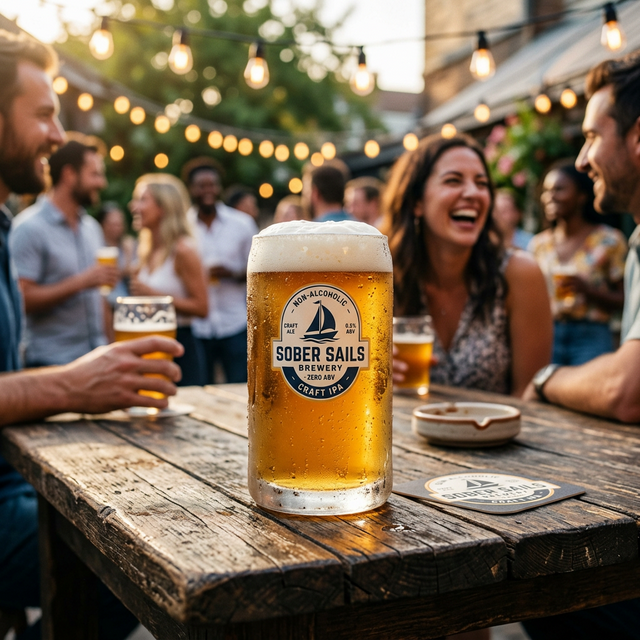
NA beer is the most mature part of the category and the easiest win. Modern alcohol-free beers are made by either brewing normally and then removing the alcohol, or by controlling fermentation so very little forms in the first place. The good ones are close enough to the real thing that most people cannot reliably tell in a blind taste.
What makes NA beer work socially is that it looks completely ordinary. A bottle or can of beer in your hand ends the conversation before it starts. Nobody studies your drink. You are just a person having a beer.
There are two things worth knowing. First, "alcohol-free" beer is usually not literally zero. In most countries the label allows up to 0.5 percent alcohol by volume, which is a trace amount, lower than what is in a ripe banana or a glass of orange juice, and not enough to have any physical effect. For the vast majority of people that is irrelevant. For a small number it matters, and we will come back to that. Second, NA beer still has calories and carbohydrates, so it is not a free drink in a nutritional sense, just an alcohol-free one.
We go deeper on the trade-offs in the post on non-alcoholic beer and whether it helps or hurts your sobriety. It is worth reading if NA beer is going to be a regular part of your routine.
Non-Alcoholic Wine
NA wine is harder to get right than NA beer, and the category is more uneven. Alcohol carries a lot of what makes wine feel like wine: body, warmth, and the way flavors spread across the palate. Remove it carefully and you get something pleasant. Remove it carelessly and you get grape juice that has lost its sweetness without gaining anything in return.
A few practical notes. Sparkling alcohol-free wine is consistently the strongest sub-category, because the bubbles and acidity carry the experience and you miss the alcohol less. For a toast, a celebration, or a wedding, a good NA sparkling wine is genuinely satisfying. Still NA reds are the hardest to make convincing and the most disappointing on average. NA whites and rosés land somewhere in between.
If you are buying NA wine for the first time, start with a sparkling option and treat still reds as a category to approach cautiously. Chilling NA wine slightly more than you would the alcoholic version also helps, since cold mutes the gap.
Zero-Proof Spirits
This is the newest and strangest part of the category. Zero-proof spirits are bottles designed to stand in for gin, whiskey, aperitifs, and agave spirits in a cocktail. On their own, poured neat, most of them are not enjoyable, and that is expected. They are not built to be sipped alone. They are built to be mixed.
The point of a zero-proof spirit is to let you make a real cocktail: a proper gin and tonic, a negroni-style drink, a margarita-shaped thing, with the botanical complexity and bitterness that a simple juice cannot provide. A good alcohol-free gin in tonic water with a slice of lime is a legitimately good drink, and it looks and behaves exactly like the alcoholic version.
Two honest caveats. Zero-proof spirits are expensive for what they are, often as much as the real bottle. And quality varies wildly between brands, more than in any other part of the category. This is the one area where it pays to read reviews before buying, rather than grabbing whatever the shop stocks.
Mocktails: The Skill That Outlasts Any Bottle
You can spend a lot of money on the products above, or you can learn to build a good drink from ordinary ingredients. The second skill is more valuable, because it works anywhere, costs almost nothing, and never depends on a shop stocking the right brand.
A bad mocktail is just sugar: sweet juice over ice, finished in three minutes, leaving you wanting something else. A good mocktail copies what makes a real cocktail satisfying, and almost none of that is the alcohol.
The structure of a good alcohol-free drink:
- Acid. This is the single most important element. Fresh lime or lemon juice gives a drink the sharpness and snap that stops it tasting like flat juice. Most weak mocktails fail here.
- Bitterness or depth. Tonic water, a splash of strong cold tea, grapefruit, a few drops of non-alcoholic bitters, or a herbal element. This is what makes a drink taste adult rather than like something for a child's birthday.
- Low sweetness. A little sweetness balances the acid. A lot of it makes the drink cloying and tiring. Aim for balanced, not sweet.
- Length and texture. Plenty of ice, and a long pour of soda water or tonic. A drink you sip slowly over twenty minutes does the social job. A small sweet drink gone in two minutes does not.
- A real garnish. A wedge of citrus, fresh herbs, a few berries. It sounds trivial. It is not. A drink that looks considered changes how the evening feels, and how other people treat your glass.
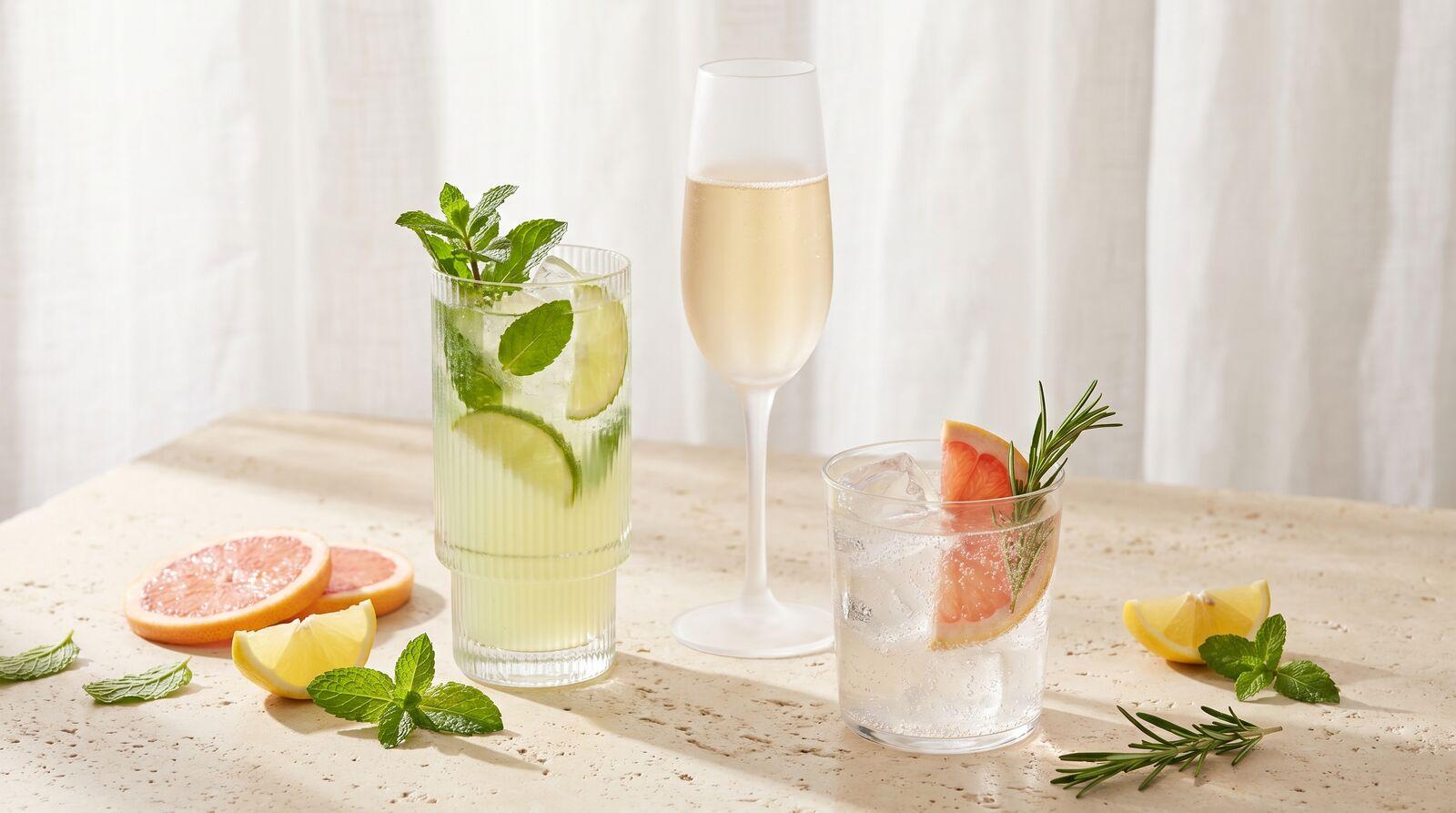
Three reliable starting points: soda water with fresh lime and a large sprig of mint over a lot of ice; cold strong tea with citrus and a splash of soda, which is closer to a real aperitif than most people expect; or grapefruit juice cut heavily with tonic water and a pinch of salt. Tea in particular is an underrated base, and we cover why in the piece on tea as an alcohol alternative.
Once you understand acid, bitterness, restraint on sugar, and length, you can build a good drink in any kitchen or any bar in the world. That is a skill worth more than any single bottle.
The One Real Caveat
For most people, alcohol-free drinks are a clear help. They make social situations easier, they remove the constant low-level negotiation about why you are not drinking, and they let you keep a ritual you enjoyed without the substance that harmed you.
But for some people, drinks that closely imitate alcohol do the opposite. If a non-alcoholic beer recreates the taste, the smell, the cold bottle, and the exact ritual of the thing you are trying to leave behind, it can keep the craving alive instead of satisfying it. For a smaller group, the trace 0.5 percent alcohol is a line they have decided not to cross, and that decision deserves respect rather than debate.
The honest test is to watch your own response. After an NA beer, do you feel settled and done, or do you feel the pull of wanting the real thing? If it closes the loop, it is a tool. If it opens one, it is a trigger, and a plain mocktail or a soda with lime is the safer choice. This is very individual, and it can also change over time, so it is worth checking in with yourself rather than assuming.
If you are early in this and finding cravings intense, the post on the science of alcohol cravings explains why imitation drinks affect different people so differently.
What to Order When You Are Out
You will not always have a curated fridge. For the times you are handed a normal menu in a normal bar, a short mental list helps:
- Soda water with fresh lime and bitters, or just lime, served in a proper glass.
- Tonic water with lime. It looks identical to a gin and tonic and nobody looks twice.
- An NA beer if the venue stocks one, which more and more do.
- Ginger beer, ideally a dry one rather than a sweet one.
- An espresso or a coffee late in the evening, which is a completely normal thing for an adult to be holding.
The bigger point: order with the same confidence you would order a real drink. Hesitation invites questions. A clear, easy "soda water, lime, in a tall glass please" ends the topic. For the wider social side of this, the survival guide to social drinking situations covers the conversations around the glass, not just the glass itself.
The Bottom Line
Non-alcoholic drinks are not the point of not drinking. The point is everything that gets better when alcohol is gone: sleep, mood, money, mornings, memory. But these drinks are a genuinely useful support tool, because they solve the small, repeated, surprisingly draining problem of being the only person at the table without a glass.
Use NA beer when you want something effortless and ordinary. Reach for sparkling NA wine for celebrations. Treat zero-proof spirits as a mixer, not a sipper. And above all, learn to build a balanced mocktail, because that skill belongs to you and works everywhere.
Then watch your own reaction honestly. If imitation drinks help you stay the course, they have earned their place. If they keep the craving warm, set them aside without guilt. The drink in your hand is a detail. The streak is the thing that matters.
That streak is also the thing worth watching grow. Many people pair a switch to alcohol-free drinks with Sober Tracker, a private, no-account day counter, so that every easy social evening with a good mocktail in hand is also another day added to a number that keeps climbing.
Building a new relationship with what is in your glass? Sober Tracker quietly counts your alcohol-free days while you experiment with the drinks above. No account, no feed, no pressure: just a streak that proves the change is real.
This article is educational and not a substitute for medical advice. If you are dependent on alcohol, stopping suddenly can be dangerous and should be medically supervised. Talk with a healthcare provider about the safest path for you.