4.8 from 1,600+ ratings on the App Store and Google Play
Everything You Need to Succeed
Recovery Garden
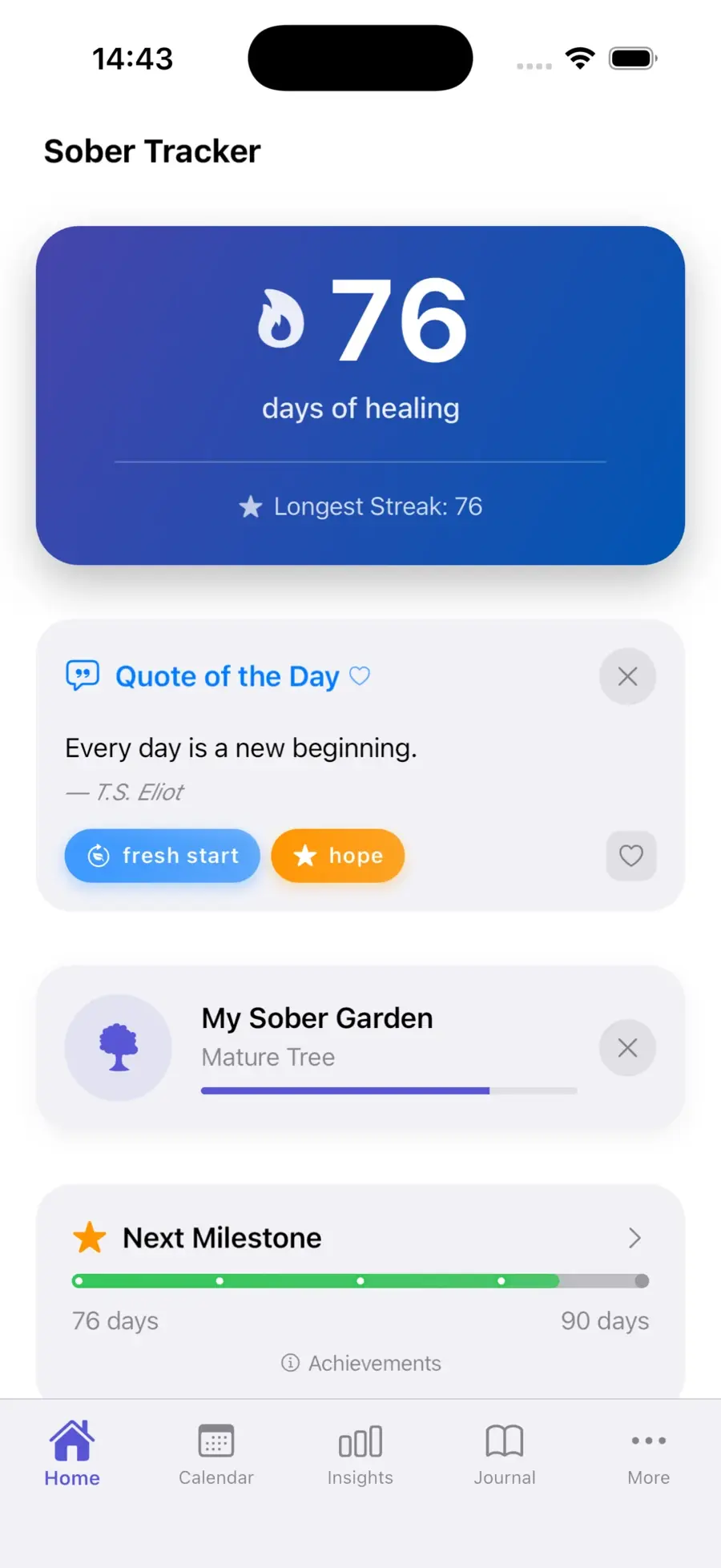
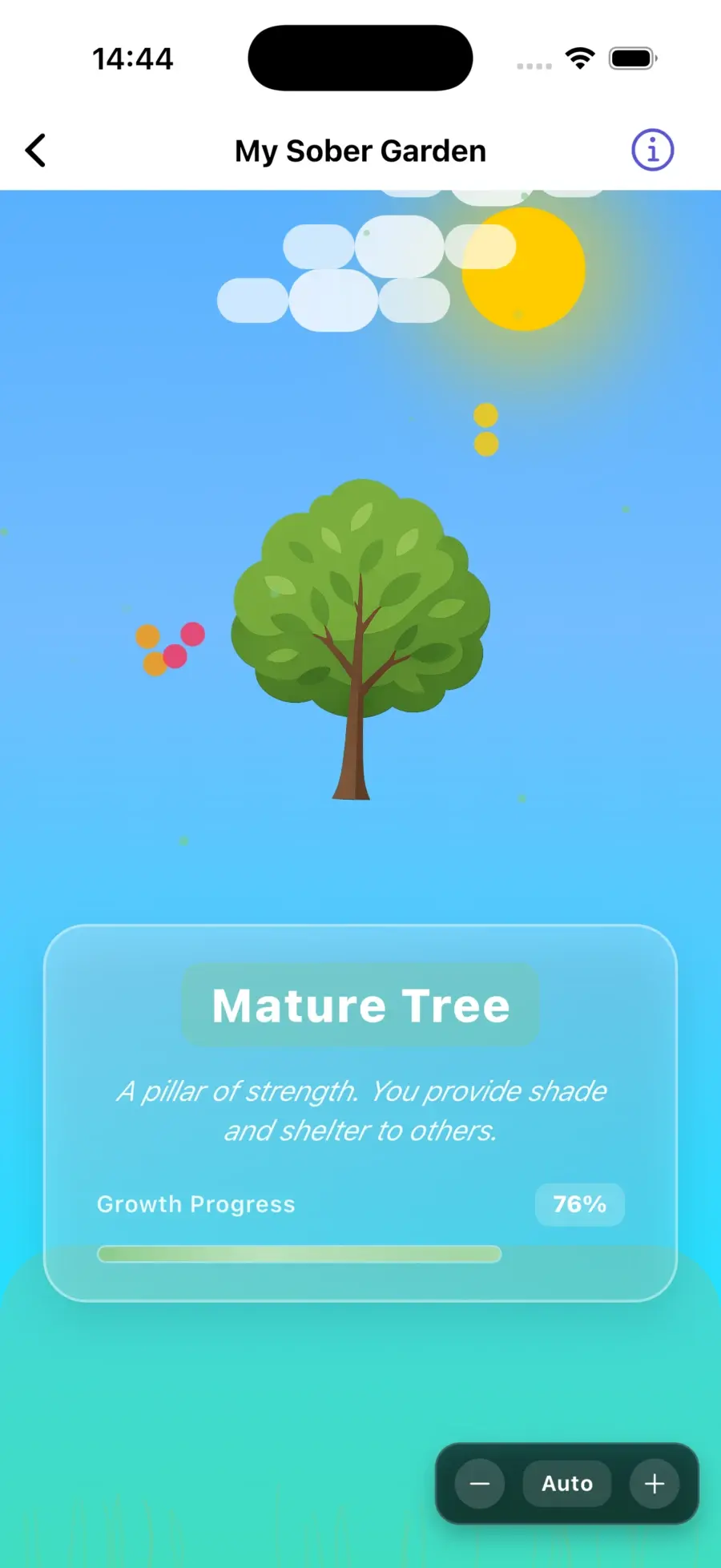
Watch your recovery grow from a tiny seed to a magical tree. A beautiful visual metaphor for your journey.
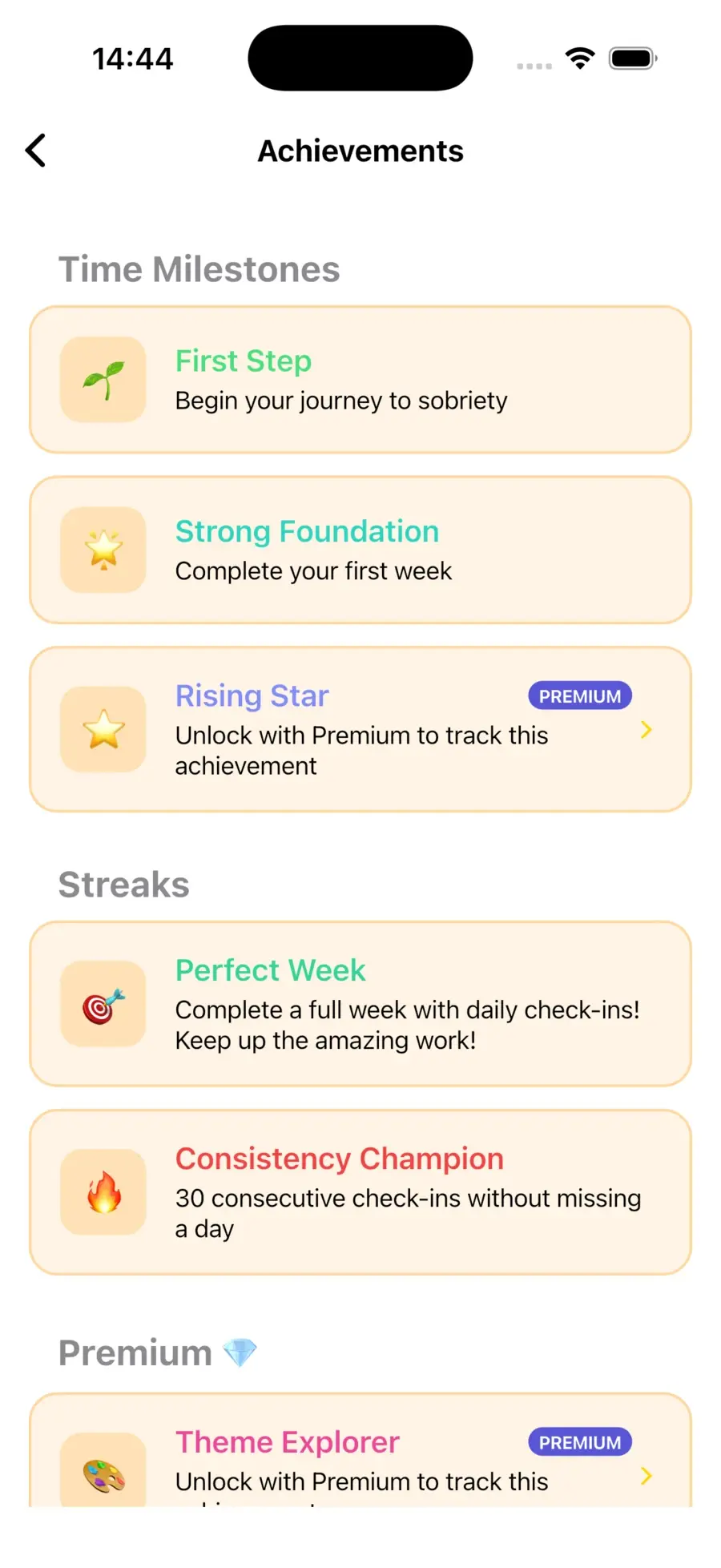
30+ Achievements
Unlock time-based milestones, secret badges, and behavioral achievements as you progress.
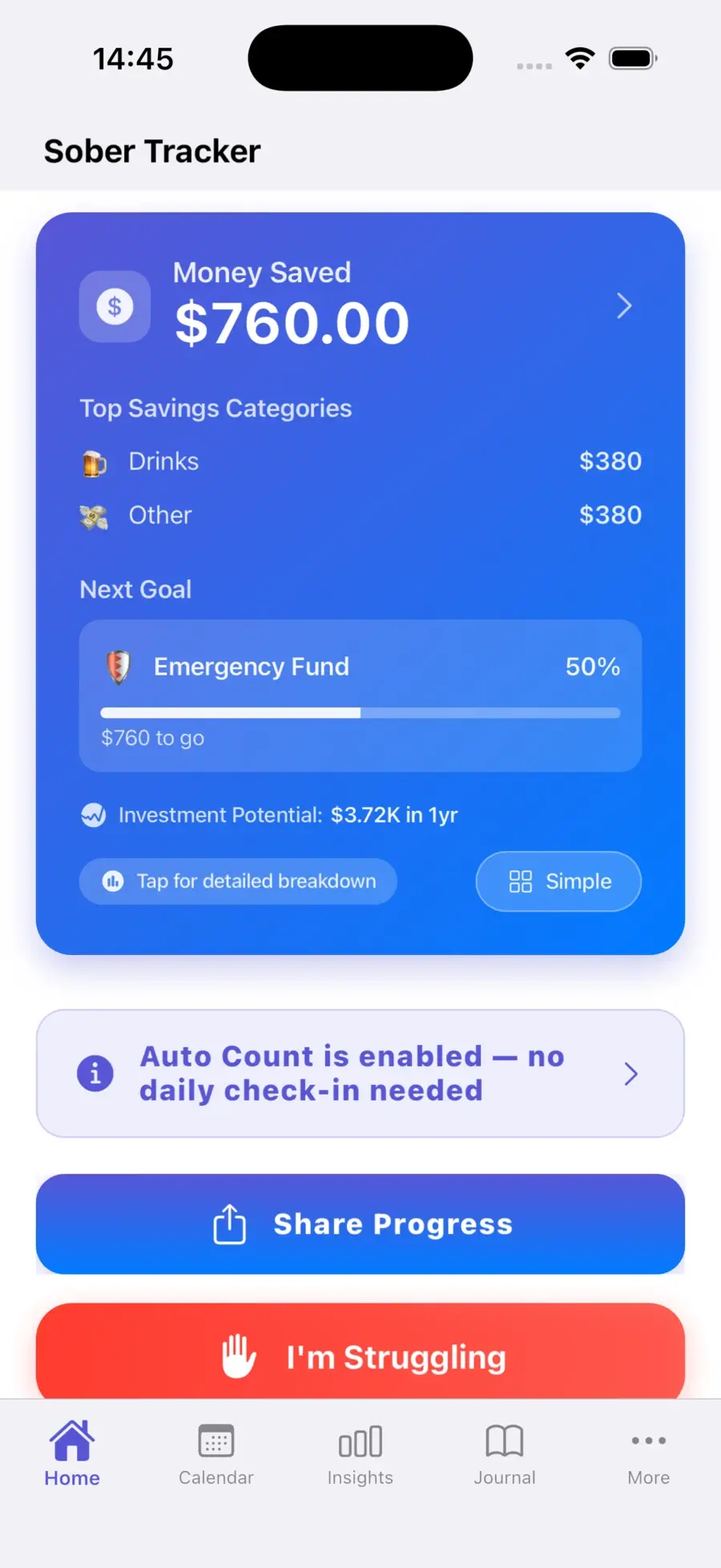
Financial Tracker
See how much money you're saving with category breakdowns and investment growth projections.
Mood Journal
Record daily feelings, track mood patterns, and identify triggers affecting your journey.
Coping Toolkit
11 evidence-based strategies for when cravings hit. Breathing exercises, urge surfing, and more.
Complete Privacy
No accounts, no cloud. Your sobriety data stays on your device. Only anonymous usage analytics are collected.
See It In Action
Beautiful Design, Powerful Features
Take a look inside Sober Tracker. Every screen is designed to support and motivate you.
Home - Your Daily Dashboard
Unique Feature
Watch Your Recovery Grow
Every sober day grows your garden. Start as a seed on day one, become a magical tree after a year. It's a simple idea — but seeing your plant evolve makes progress feel real.
Your plant grows automatically as your sober days increase. No watering needed — just keep going.
I'm a programmer who struggled with alcohol. I tried other addiction tracker apps, but they wanted me to create accounts, sync to clouds, join communities. I just wanted something simple that worked — something private that focused on alcohol and nothing else.
Building Sober Tracker became part of my own recovery. Every feature exists because I needed it myself.
No social features. No data leaving your phone. Just a tool that works the way I wished others did.
— Ivan Terekhin
Honest comparison
Still comparing sobriety apps?
Compare seven sobriety apps by private tracking, community, guided lessons and drink logging, with links to official product information.
Yes. Your sobriety data, journal entries, and personal information are stored only on your device. There are no accounts and no cloud sync. The app collects only anonymous usage analytics to help us improve the experience. Your recovery journey stays private.
Is the app free to use?
Yes! Sober Tracker's free version includes all essential features: streak tracking, the recovery garden, achievements, and more. Premium unlocks advanced tools to take your recovery to the next level.
What makes this app different from others?
Sober Tracker combines beautiful design (like the growth garden), comprehensive features (30+ achievements, financial tracking, coping toolkit), and privacy-first design (no accounts, sobriety data stays on-device). Most apps lack this combination.
Can I use the app for tracking sobriety from substances other than alcohol?
Yes! While designed for alcohol sobriety, the app works great for tracking any sobriety journey or habit change.
What if I relapse?
Recovery isn't always linear - we understand that. You can reset your counter while keeping your history. Plus, if you rise again after a setback, you earn the special Phoenix badge. Getting back up is what matters most.
What happens to your body when you stop drinking alcohol?
Within 24 hours, blood sugar and hydration begin stabilizing. After 48-72 hours, the body starts clearing toxins and sleep may improve. By one week, skin hydration increases and blood pressure begins dropping. After one month, liver fat can start decreasing and energy levels typically rise. By three months, many people report clearer thinking, better immune function, and noticeable weight changes. The timeline varies by person and drinking history.
How long does it take for your liver to recover after quitting alcohol?
The liver begins healing within days of stopping alcohol. Fatty liver (steatosis) can start improving within 2-4 weeks. More significant recovery takes longer: liver enzymes often normalize within 1-3 months, and inflammation reduces over 3-6 months. For heavy or long-term drinkers, full recovery may take 6-12 months. The liver is remarkably resilient, but the timeline depends on the extent of damage. Consult a healthcare provider for personalized guidance.
What is the best app to track sobriety?
Sober Tracker is a private sober streak app: alcohol-free days, money saved, and milestones, with all data on your phone. No account, not a social network. Free on iOS and Android, with optional premium features.
How does alcohol affect your brain?
Alcohol disrupts the brain's communication pathways by affecting neurotransmitters like GABA and glutamate. Short-term, it impairs judgment, coordination, and memory. Long-term heavy drinking can shrink brain volume, damage the prefrontal cortex (responsible for decision-making), and reduce neuroplasticity. The good news: the brain begins recovering once you stop drinking. Studies show measurable improvements in cognitive function within weeks, with significant recovery at 90 days as new neural pathways form.
What are the stages of alcohol withdrawal?
Mild withdrawal (6-24 hours) may include anxiety, insomnia, nausea, and tremors. Moderate withdrawal (24-72 hours) can bring increased blood pressure, confusion, and mood swings. Severe withdrawal is rare but can include seizures or delirium tremens (DTs) and requires medical attention. Most people with moderate drinking habits experience only mild symptoms. Post-acute withdrawal (PAWS) can include mood swings and sleep issues for weeks or months. Always consult a doctor before stopping if you drink heavily.
Why do I get sugar cravings after quitting alcohol?
Alcohol is metabolized similarly to sugar, and your body is used to receiving quick energy from it. When you stop, your brain seeks alternative sources of the same glucose and dopamine hit, which often manifests as sugar cravings. This is normal and typically strongest in the first 1-3 months. Eating regular balanced meals, staying hydrated, and keeping healthy snacks available can help. The cravings usually diminish as your blood sugar regulation and brain chemistry stabilize.
Can you lose weight by quitting alcohol?
Many people do. Alcohol contains 7 calories per gram (almost as much as fat), and a typical night of drinking can add 500-1000+ empty calories. Beyond calories, alcohol disrupts metabolism, increases cortisol (which promotes belly fat storage), and often leads to poor food choices. After quitting, many people lose 5-15 pounds in the first few months simply from the calorie reduction. Better sleep and increased energy also make exercise easier, compounding the effect.
How do I tell people I'm not drinking?
You do not owe anyone an explanation, but having a few responses ready helps. Simple options: 'I'm taking a break from alcohol,' 'I'm driving,' 'I'm on a health kick,' or just 'No thanks.' Most people care less than you think. If pressed, 'It just doesn't agree with me anymore' usually ends the conversation. The people who matter will support your decision, and the ones who pressure you may be reflecting their own relationship with alcohol.
Is non-alcoholic beer safe during sobriety?
It depends on the individual. Some people find non-alcoholic beer helps them socialize without feeling left out. Others find that the taste, smell, and ritual can trigger cravings or normalize drinking behavior. Non-alcoholic beers may contain up to 0.5% ABV, which is negligible physiologically but could matter psychologically. If you are in early recovery, consider trying it cautiously and being honest with yourself about whether it helps or hinders your journey.
Why does anxiety spike after quitting alcohol?
Alcohol suppresses your nervous system by boosting GABA (a calming neurotransmitter) and reducing glutamate (an excitatory one). When you stop, your brain is left in a hyperexcitable state as it readjusts. This rebound anxiety is sometimes called 'hangxiety' in the acute phase and can persist as part of post-acute withdrawal. It typically peaks in the first 1-2 weeks and gradually improves over 1-3 months as your brain chemistry rebalances. Exercise, good sleep, and relaxation techniques can help during this transition.
What is the pink cloud in sobriety?
The 'pink cloud' is a period of euphoria that some people experience in early sobriety, usually around weeks 2-8. You might feel invincible, overly optimistic, and wonder why you ever drank. While this phase feels wonderful, it is important to use it productively by building habits and support systems. The pink cloud eventually fades, and some people feel a dip in mood when it does. Knowing it is normal helps you prepare and maintain your commitment when the initial excitement settles into everyday life.
How does quitting alcohol improve your sleep?
Even though alcohol may help you fall asleep faster, it severely disrupts sleep quality. It reduces REM sleep (vital for memory and learning), causes frequent nighttime awakenings, and worsens sleep apnea. After quitting, sleep often gets worse for the first 1-2 weeks as your body adjusts. By weeks 3-4, most people notice dramatically improved sleep quality: deeper sleep, more vivid dreams (REM rebound), and waking up genuinely refreshed. Within 2-3 months, full sleep architecture typically normalizes.
What is PAWS (Post-Acute Withdrawal Syndrome)?
PAWS refers to withdrawal symptoms that persist weeks or months after the acute phase ends. Common symptoms include mood swings, anxiety, irritability, fatigue, difficulty concentrating, and disturbed sleep. PAWS occurs because the brain takes time to restore normal neurotransmitter function. Symptoms often come in waves, with good days and difficult days. Most people find PAWS symptoms gradually decrease over 3-6 months. Staying physically active, maintaining good nutrition, and having a support system are important during this period.
How do I deal with boredom in sobriety?
Boredom is one of the most common challenges in early sobriety. Drinking likely consumed significant time and served as a default activity. The solution is building a new repertoire: exercise, cooking, reading, creative projects, learning new skills, volunteering, or reconnecting with old hobbies. Start small and do not pressure yourself to find a passion immediately. Boredom itself is not the real problem: it is the discomfort of sitting with unoccupied time without a numbing agent. That discomfort fades as your brain adjusts.
How does the financial tracking in Sober Tracker work?
You set your average weekly spending on alcohol, and the app calculates how much you have saved since your sobriety start date. It updates in real time as your streak grows, turning an abstract benefit into a concrete number. Many users are surprised to see how quickly the savings add up: even moderate drinkers typically save $200-400 per month. The financial tracker helps reinforce your motivation with tangible proof of progress beyond just counting days.
What is the recovery garden in Sober Tracker?
The recovery garden is a virtual garden that grows alongside your sobriety journey. As you accumulate sober days, your garden evolves from bare soil to a flourishing landscape with new plants, flowers, and features unlocking at different milestones. It provides a beautiful, visual representation of your progress that feels rewarding to watch develop. The garden is unique to Sober Tracker and is one of the most loved features by our community.
How does alcohol affect your skin and appearance?
Alcohol dehydrates your skin, dilates blood vessels (causing redness and broken capillaries), triggers inflammation (worsening conditions like rosacea and acne), and disrupts collagen production (accelerating aging). After quitting, improvements often become visible within 1-2 weeks as hydration returns. By one month, many people notice reduced puffiness, clearer complexion, and brighter eyes. Over 3-6 months, skin elasticity and tone continue improving as collagen production normalizes.
Can I do Dry January with Sober Tracker?
Absolutely! Sober Tracker is perfect for Dry January, Sober October, or any timed challenge. Set your start date, and the app tracks your streak, shows health benefits unlocked along the way, and celebrates milestones at 1 week, 2 weeks, and the full 31 days. Many of our users start with Dry January and decide to keep going after seeing the benefits. The app's achievement system and recovery garden make the challenge more engaging than just white-knuckling through the month.
What are the signs of high-functioning alcoholism?
High-functioning alcoholism is characterized by maintaining responsibilities (job, relationships, daily life) while drinking excessively. Signs include: needing alcohol to relax or celebrate, drinking more than intended regularly, feeling irritable without alcohol, hiding consumption from others, experiencing memory gaps, using drinking as your primary social activity, and feeling that you 'deserve' a drink after tough days. High-functioning does not mean there is no harm: health, relationships, and mental well-being are often quietly deteriorating.
How many achievements can I unlock in Sober Tracker?
Sober Tracker has over 30 achievement badges that you unlock at various milestones throughout your journey. These range from early wins (first 24 hours, first week) to major milestones (90 days, 6 months, 1 year). There are also special badges like the Phoenix badge (earned by restarting after a setback) and the Clarity badge. Each achievement comes with a unique design and motivational message. The achievement system is designed to give you regular dopamine hits of accomplishment to replace the ones alcohol used to provide.
Start Your Journey Today
Join thousands who've transformed their lives with Sober Tracker. Complete privacy, beautiful design.
4.8 from 1,600+ ratings on the App Store and Google Play