Kombucha can contain alcohol. It is a fermented drink, and fermentation can produce ethanol. The amount is not fixed by the word "kombucha" on a bottle: products, batches, and storage conditions differ. If your plan depends on avoiding alcohol, the useful question is what this specific drink states, what it does not state, and where you draw your own line.
There is also a legal distinction that is easy to misread. In the United States, the Alcohol and Tobacco Tax and Trade Bureau (TTB) regulates kombucha as an alcohol beverage if it reaches 0.5% alcohol by volume (ABV) or more at any point during production, at bottling, or afterward in the container. That is a US federal regulatory threshold. It is not a worldwide definition of "alcohol-free," and it does not tell you what amount fits your personal rule. The TTB's kombucha overview states the scope explicitly.
Why kombucha can contain alcohol
Kombucha is generally made from sweetened tea combined with yeast and bacteria. As the mixture ferments, yeast can produce ethanol. The TTB's kombucha FAQ says the amount can be affected by time and temperature and that fermentation can continue after bottling, depending on how the drink is made and stored.
This is why a category label cannot give you an exact number. A bottle of regular kombucha, a deliberately alcoholic hard kombucha, and a home batch all share a name but need different decisions. Even within a category, a recipe or a taste description does not measure ABV. Sourness, bubbles, and "live cultures" are not a percentage.
Measured products also vary, and the middle of a real market sample is not a trace amount. In one British Columbia study, researchers measured ethanol in 684 kombucha samples from processors and retail venues. Results ranged from below their detection limit to 3.62% ABV, with a median of 0.62% and a mean of 0.77% ABV, and 31.5% of the samples were above 1% ABV, the provincial limit for a non-alcoholic beverage. The median sample in that study sat above the 0.5% US threshold rather than below it. Those results describe that sample in British Columbia; they cannot tell you the ABV of a bottle on a different shelf today. They do show why a universal "kombucha is always under X" rule is unreliable.
Regular, hard, and explicitly alcohol-free drinks
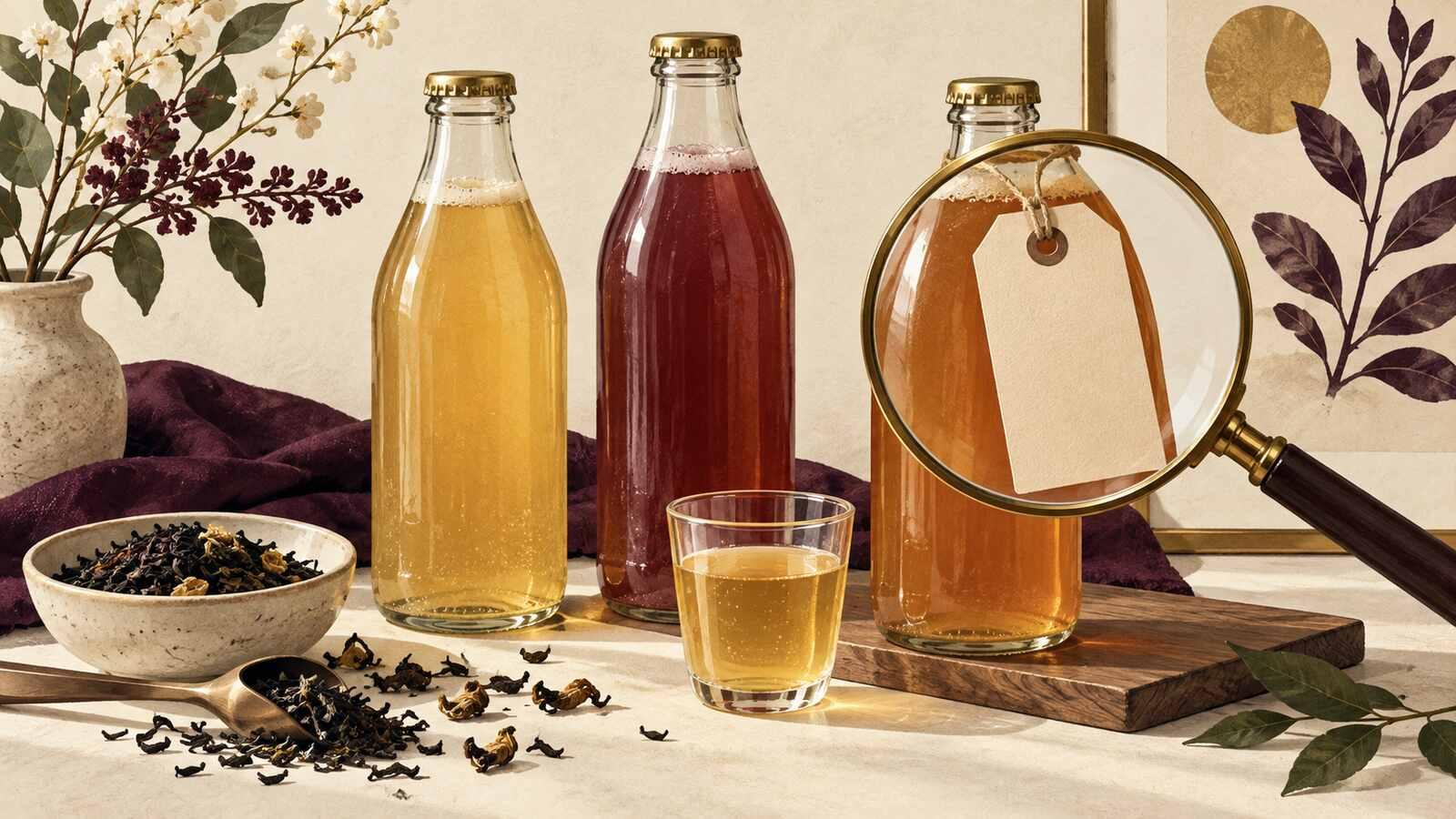
Regular kombucha is often sold alongside non-alcoholic drinks. That placement tells you how it is marketed, not an independently verified ABV for every bottle. Read any statement such as "less than 0.5% ABV" as a claim about that product, in the context of the country where it is sold. Less than 0.5% is not the same as 0.0%.
Hard kombucha is presented as an alcoholic drink. Look for the ABV and the applicable alcohol warning or age restriction on the package or store listing. The word "hard" is a useful signal, but the actual label matters more than an assumed typical range. If your rule is no alcoholic beverages, a hard kombucha does not fit it.
A product that explicitly says 0.0% ABV gives you a different statement from one that says "non-alcoholic" or "contains less than 0.5%." Read the full label rather than inferring that every similar word means exactly zero. Label conventions differ by country and product classification. A 0.0% claim is still a product claim, not a laboratory measurement you have performed on that bottle.
An unlabeled pour or a home batch gives you less information. Neither the maker's confidence nor a short fermentation time establishes an exact ABV. If your rule requires a known value, an unknown value remains unknown. Pick a packaged drink with a clear statement or choose something unfermented.
A label-reading decision table
Use this table when the bottle is in your hand. It separates what you can read from what you would have to assume.
| What you see | What it tells you | Practical next step |
|---|---|---|
| "Hard kombucha" with a stated ABV | It is presented as an alcoholic beverage; the label gives the stated percentage | Compare that percentage with your rule; if your rule excludes alcohol, choose another drink |
| "Less than 0.5% ABV" | The producer claims a value below that threshold, not zero | Decide whether trace alcohol fits your rule; do not read it as 0.0% |
| "0.0% ABV" | The producer explicitly claims zero to the displayed precision | Read the rest of the label and decide whether that claim meets your needs |
| "Non-alcoholic" with no clear ABV statement | The wording alone does not give an exact percentage across countries | Check the producer's specific information or choose a clearer label |
| No label, a bar pour, or a home batch | You do not have a reliable number from the name, taste, or recipe | Treat ABV as unknown; if a known limit matters, choose another option |
The US 0.5% rule belongs to US federal alcohol regulation. It should not be copied onto a drink bought in another country as if it were that country's labeling rule. Even in the US, a missing health warning is not proof of zero alcohol. The TTB FAQ's labeling section explains that requirements depend on whether the product meets the alcohol threshold and on its classification.
For comparison, the same habit helps with non-alcoholic beer: read the actual ABV statement, then apply your own rule rather than deciding from a shelf label alone.
Storage and homemade batches: what you cannot assume
The TTB says kombucha may keep fermenting in the original container after it leaves the producer. Time and temperature influence that process. It also says refrigeration alone is not an adequate guarantee that the alcohol content will not rise after bottling, because storage cannot be controlled throughout distribution. Those are production and regulatory points, but they matter to a reader who assumes a refrigerated shelf fixes the percentage forever.
Follow the package's storage instructions for the product you bought. Do not turn that into a claim that chilling proves its current ABV. An unopened bottle's exact ethanol level cannot be read from the outside if the label does not provide enough information, and a label does not replace a test of that particular bottle.
Pennsylvania's guidance for kombucha brewers is more direct about packaged product: alcohol in bottled or canned unpasteurized kombucha will most likely exceed 0.5%, because yeast keeps converting sugar while the carbon dioxide trapped in a closed container blocks the conversion of alcohol into acetic acid. Pasteurization is the step that stops it, which is one reason a pasteurized bottle and a live, unpasteurized one are not the same purchase.
Home brewing has still more variables: ingredients, culture, vessel, temperature, time, and any second fermentation. Pennsylvania's brewing and bottling guidance describes ways alcohol may continue to increase, especially with extended or bottled fermentation. It does not give a dependable ABV for the jar on your counter.
If you make kombucha and need to know its alcohol level, use an appropriate validated test rather than estimating from taste or days elapsed. The TTB lists scientifically valid testing methods for producers. For a drink decision at home, choosing a different beverage can be simpler than trying to prove an untested batch meets a strict limit.
Decide what fits your own alcohol-free plan
There is no single sobriety rule that applies to everyone. One person avoids alcoholic beverages but is comfortable with a product labeled below a stated trace threshold. Another wants a clearly stated 0.0% ABV. Someone else avoids fermented drinks altogether because the taste or ritual does not help them. A medical, legal, or other external restriction may set a stricter rule. The right comparison is between the information you have and the rule that applies to you.
Write your rule in plain language before shopping, especially if you are early in an alcohol-free break: "No drinks marketed as alcoholic," "only drinks labeled 0.0% ABV," or "no fermented drinks." Then a label becomes a decision tool instead of an argument you have with yourself at a party. If the label leaves a critical point unanswered, choose a drink with clearer information.
You are not limited to drinks that imitate beer or wine. Our complete guide to non-alcoholic drinks includes simple mixed drinks, tea, and other choices. Soda water with citrus, cold tea, or a favorite soft drink can solve the immediate question without guessing what a home-fermented bottle contains.
If you use Sober Tracker, you can keep your day count private while making the drink rule yours. The app need not decide whether a particular bottle qualifies. Write a short note about what you chose and why if that helps you be consistent next time.
Frequently Asked Questions
Is regular kombucha always below 0.5% ABV?
No universal guarantee follows from the word "regular." In the British Columbia study the median of the 684 teas was 0.62% ABV, the mean 0.77%, and 31.5% of samples were above 1% ABV, so the typical sample there sat above the US 0.5% threshold rather than below it. That threshold governs when TTB alcohol-beverage rules apply; products can differ and can change after bottling. Read the specific package, and do not assume a broad category is a test result.
Does "non-alcoholic" mean 0.0% ABV?
Do not assume so. Read the accompanying percentage or producer statement and account for the country where the drink is sold. "Less than 0.5%" and "0.0%" are different claims.
Can I tell the alcohol content of homemade kombucha by taste?
No. Sourness, sweetness, and bubbles are not reliable ABV measurements. If you need a known limit, use appropriate testing or choose a drink with clearer information.
Is hard kombucha the same as regular kombucha?
Both use the kombucha name, but hard kombucha is sold as an alcoholic beverage. Read its stated ABV. If you are avoiding alcoholic drinks, choose another option.
Can I drink kombucha while sober?
That depends on the rule you chose and any medical or legal instruction that applies to you. Read the particular label. If its information does not answer the question you need answered, you can choose an unfermented alternative without making a universal rule for anyone else.
Choosing drinks for an alcohol-free routine? Sober Tracker keeps your day count private while you decide which products fit the rule you set for yourself.
This article explains labels and US regulation; it is not individual medical or legal advice. If a clinician or legal requirement tells you to avoid alcohol, follow that instruction and ask the relevant professional about an uncertain product.