The labs look "almost normal," but you do not. You are cold in a warm room. Your hair is thinner. The scale will not move. The 3 p.m. crash feels chemical, not motivational. Someone mentions thyroid. Someone else mentions drinking. Both feel plausible, and neither conversation usually names the other.
Alcohol and the thyroid do interact, but not in the tidy way internet summaries imply. Drinking does not simply "cause hypothyroidism." It also does not leave the gland alone. Chronic use can suppress thyroid hormone, blunt the brain's signal to the gland, and make an existing hypo picture feel worse: more fatigue, more weight stickiness, more mood fog. A 2013 clinical review in the Indian Journal of Endocrinology and Metabolism is still the most useful map of that mess: direct toxicity to thyroid cells, a quieter TSH response to TRH, and a moderate drop in circulating T3 and T4 in many heavy drinkers, especially in withdrawal.
This article separates the gland from the lab printout, explains what alcohol actually does, and is honest about two findings people misuse: some observational studies associate moderate drinking with a lower risk of autoimmune thyroid disease, and quitting does not instantly rewrite Hashimoto's. The practical question underneath the search is simpler. If you stop drinking, what happens to TSH, to your pills, and to how you feel?
The Thyroid Is a Thermostat, Not a Mood App
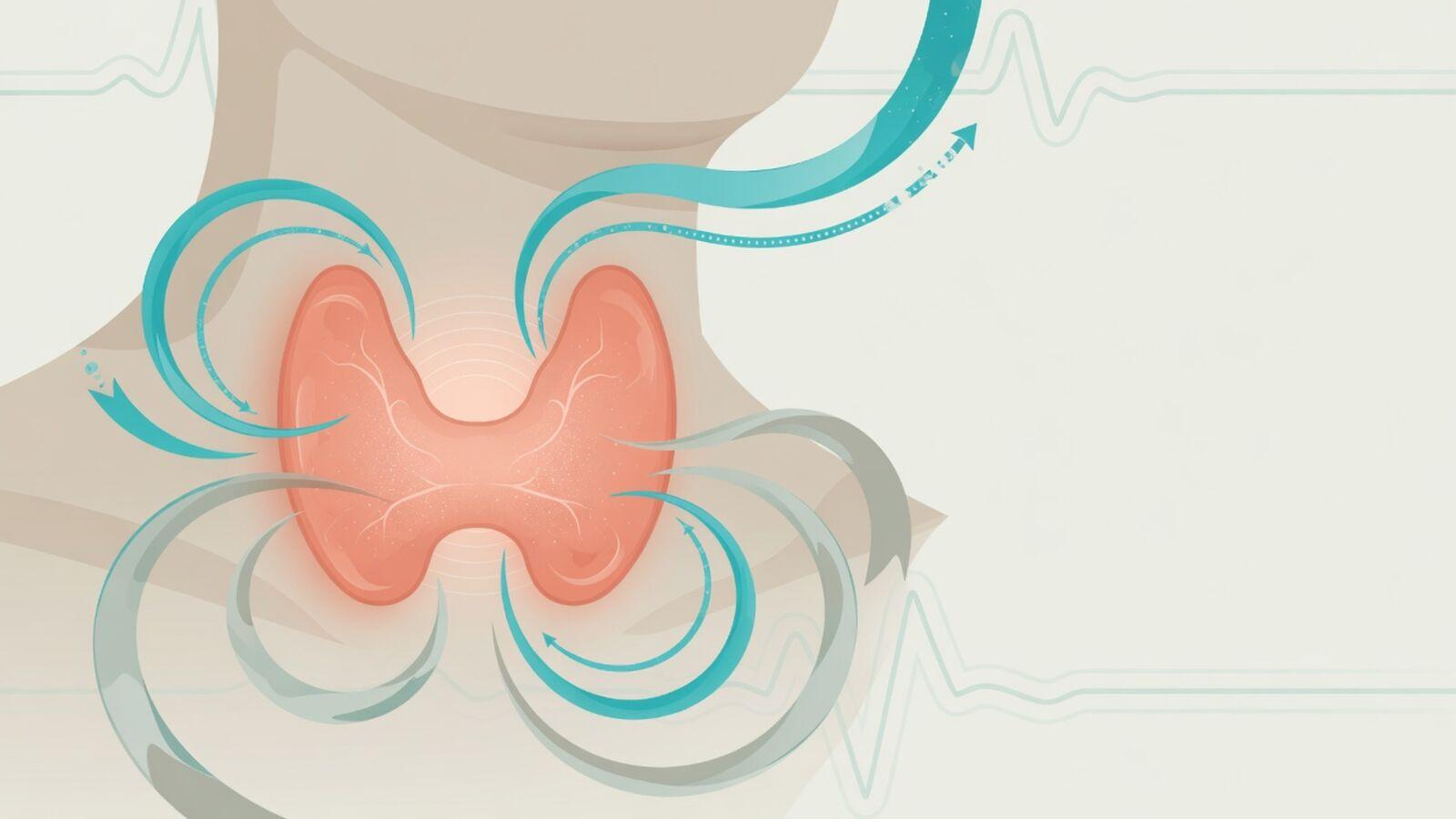
The thyroid sits at the base of the neck and releases two main hormones: T4 (thyroxine), which is mostly a circulating reservoir, and T3 (triiodothyronine), the more active form. Most T3 is not made in the gland. The liver and other tissues convert T4 into T3. That conversion step is why thyroid symptoms and liver recovery keep showing up in the same people.
TSH, thyroid-stimulating hormone, is the pituitary's volume knob. When circulating thyroid hormone is low, TSH usually rises. When hormone is high, TSH usually falls. Primary hypothyroidism (the gland itself is underproducing, often from Hashimoto's) classically shows high TSH and low free T4. Hyperthyroidism (the gland is overproducing, often from Graves' disease) shows the reverse.
Two caveats wreck casual interpretation. First, TSH can look "normal" while T3 is low, which is one reason people with a drinking history feel hypo without a textbook panel. Second, the brain's TRH-to-TSH signal can itself be blunted, so the knob does not turn as far as it should. Alcohol works on both the gland and that signal. Our hormone recovery guide puts thyroid in that wider endocrine picture: cortisol, insulin, sex hormones, and thyroid are not separate hobbies.
If you're still choosing a tracking app, our guide to the best sobriety apps compares the top options side by side.
Three Ways Alcohol Hits the Axis
1. Direct toxicity to thyroid cells
Ethanol is used on purpose in interventional radiology to destroy thyroid nodules. That is not a metaphor. The same cellular toxicity shows up in alcohol-dependent patients as a smaller gland on ultrasound, with more fibrosis in long-term daily drinkers than in people who binge occasionally. Hegedüs and colleagues showed that this volume reduction happens even without alcoholic cirrhosis, so you cannot blame the liver for the entire thyroid picture.
Smaller volume, lower T3, and often normal TSH is a recurring pattern in those studies. The gland is quieter. The pituitary is not necessarily screaming.
2. A blunted TSH response to TRH
The more consistent lab finding in alcohol dependence is not a wildly high TSH. It is a muted TSH rise after a TRH stimulation test. That blunting shows up most often in the first three weeks of abstinence, and in some people it lingers longer. It correlated with withdrawal severity in early abstinence in one of the studies the 2013 review pulled together.
Only about 20 to 35 percent of assessed patients showed the blunting. It is real, and it is not universal. The working explanation is unglamorous: chronically low peripheral hormone can keep TRH a little high, pituitary TRH receptors down-regulate, and the TSH response then looks lazy. That is one reason the question "can alcohol increase TSH?" does not have a one-word answer. Alcohol more often dampens the response than it drives a Hashimoto-style TSH spike.
3. The liver's T4-to-T3 conversion
T4 has to become T3 to do most of its job. The liver does a large share of that conversion. Alcohol is already a metabolic disruptor: it yanks glucose around, builds insulin resistance, and injures the organ that activates thyroid hormone. A panel drawn during a heavy-drinking stretch can therefore show a "sick euthyroid" looking pattern (low T3, relatively preserved T4) that is as much a liver-and-illness signature as a primary thyroid disease.
The 2013 review is careful here. Classic euthyroid sick syndrome also raises reverse T3. Reverse T3 is often normal in alcohol-dependent patients, so that label does not fully fit. The useful clinical point remains: you cannot read a thyroid panel in isolation from drinking, withdrawal, and liver status.
Hypothyroidism, Hashimoto's, Graves: What Alcohol Does and Does Not Cause
This is where search results get sloppy. People type "alcohol hypothyroidism" and get told that drinking wrecks the gland, or that a glass of wine protects it. Both headlines are incomplete.
Existing hypo often feels worse with drinking. Fatigue, cold intolerance, weight gain, constipation, dry skin, hair shedding, and low mood are the textbook list. Alcohol independently produces several of those, and it adds sleep debt and next-day inflammation. If you already take levothyroxine, a drinking week can make a previously tolerable dose feel inadequate without the pills having "stopped working." That overlap is why fatigue after quitting deserves a thyroid check if it is still crushing you months in, rather than being filed forever under "early recovery."
Alcohol is not a proven cause of Hashimoto's. Hashimoto's thyroiditis is an autoimmune attack on the gland. Genes, iodine, sex hormones, and other immune triggers dominate that story. The 2013 review does not treat alcohol as the thing that turns the immune system against the thyroid.
Some observational data run the other way. A Danish prospective study found that modest to high intake (about 1 to 20 units a week) was associated with a lower incidence of overt autoimmune hypothyroidism; the association disappeared at 21 or more units a week. A later Danish analysis, summarized for patients by the American Thyroid Association, reported that even low weekly alcohol intake was associated with a lower risk of Graves' disease, with a slightly stronger signal at moderate intake, independent of age, sex, and smoking.
Those papers are not a prescription. They are observational, they cannot prove protection, and alcohol's harms on the liver, cancer risk, sleep, blood pressure, and dependence swamp any autoimmune curiosity. No endocrinology guideline tells you to start drinking for your thyroid. The honest use of this data is narrower: quitting will not "give you Hashimoto's," and "I drink for my Graves' risk" is not a medical plan.
Hyperthyroidism is a different disease. If you have Graves' or another overactive-thyroid state, alcohol can still worsen sleep, heart rate, anxiety, and nutrition. It does not treat the antibodies. Do not use the ATA summary as permission to drink through palpitations.
Levothyroxine, Synthroid, and a Glass of Wine
The medication question is the other half of the search: can you drink on thyroid pills?
There is no classic "do not mix" chemical contraindication between levothyroxine and alcohol in the way there is for some sedatives. Medical News Today states there are no known direct interactions. That is not the same as "timing does not matter."
Levothyroxine is finicky about absorption. The NHS levothyroxine page tells people to take it on an empty stomach, 30 to 60 minutes before the first meal, and before caffeine. Coffee, calcium, iron, soy, and high-fiber food all cut absorption if they arrive too soon. Alcohol is another non-water drink. It does not belong in the same swallow as the tablet.
Practical rules that match how the drug is actually prescribed:
- Take levothyroxine with water only, first thing, then wait 30 to 60 minutes before coffee, breakfast, or anything else.
- Do not take the pill with wine, beer, or a nightcap. If you still drink, keep alcohol far from the morning dose.
- Heavy or daily drinking can change how the liver handles thyroid hormone and can make a previously stable dose look "off" on labs. That is a reason to tell the clinician you drink, not a reason to skip the tablet.
- Biotin supplements can fake thyroid lab results. Stop biotin before a panel if your clinician asks you to.
Synthroid is a brand of levothyroxine. The same empty-stomach rule applies. If your TSH is bouncing around on a "stable" dose, absorption and timing are the first things to audit, alongside missed pills and a change in drinking.
What the Blood Tests Actually Mean After Drinking
A thyroid panel is not a lie detector for alcohol. It is also not immune to alcohol.
The usual starting set is TSH and free T4. Free T3 is added when the picture is mixed. Thyroid antibodies (TPO, thyroglobulin, TSH-receptor) answer the autoimmune question. Those are different jobs. Do not treat a single TSH as a full workup.
Timing distorts the story. Heavy use and early withdrawal are both noisy windows. Some studies show T4 suppressed in acute withdrawal, then rising toward normal over the first one to four weeks of abstinence. Many other studies, reviewed by Hermann in 2002 and summarized again in 2013, find normal T3 and T4 in most people once they are abstinent: roughly two-thirds of studies were normal in the first three weeks, and an even higher share after that. The signal is small, variable, and mixed up with mood, liver status, and whatever thyroid disease was already there.
Do not diagnose yourself off a panel drawn during a binge or a brutal first week. Recheck once you have a stretch of consistent days, the same way you would not use a single GGT drawn mid-relapse as your forever liver story. If you take levothyroxine, take it exactly as prescribed in the days before the draw, skip biotin if instructed, and tell the lab and the clinician about alcohol.
A persistently abnormal TSH after months alcohol-free is not "just recovery." That is the point to see a clinician rather than waiting for the streak to magically fix Hashimoto's.
What Actually Changes When You Stop
There is no day-three, week-two, month-one thyroid calendar with trial-grade evidence behind it. What we have is more modest, and still useful.
The toxic daily load is gone. You stop bathing thyroid cells in ethanol, you stop asking the liver to convert hormone while it is busy with acetaldehyde, and you stop adding a sedative and an inflammatory hit on top of hypo symptoms. That is the cleanest win, and it does not require the TSH number to move on a dramatic schedule.
If hormone was suppressed, it often drifts back. In the longitudinal studies that did show abnormality, T4 that was low in acute withdrawal commonly returned toward normal across the first few weeks. Relapse re-lowered T4 in at least one follow-up. That is a pattern, not a promise that your specific number will do the same.
How you feel can move faster than TSH. Sleep, hydration, blood sugar swings, and next-day inflammation all improve when drinking stops, and those changes steal a lot of "thyroid" symptoms. If energy is still on the floor at month two or three, that is a reason for a real panel (thyroid, iron, B12, folate, glucose, liver enzymes), not a reason to assume the gland has failed or that recovery is infinite.
Pills still need a professional. Do not raise or drop levothyroxine because you quit. Absorption and conversion can change. The right move is a planned recheck, not a kitchen-table dose experiment.
Autoimmune disease remains autoimmune. Quitting will not dissolve TPO antibodies. It can make the remaining disease easier to live with, the same way removing alcohol does not "cure" rosacea or gout but deletes a major aggravating factor.
Because thyroid labs only make sense against a calendar, a private streak counter is a useful piece of the experiment. Sober Tracker will not diagnose a gland. It will keep the dates honest so a clinician can read TSH against actual alcohol-free weeks instead of against a vague "I have been cutting back."
When This Stops Being a Blog Problem
See a clinician promptly, not after another month of self-experiment, if you have:
- A rapidly enlarging neck mass, trouble swallowing, or a noisy breathing change
- Crushing fatigue with weight change, cold intolerance, and a persistently abnormal TSH
- Palpitations, tremor, unexplained weight loss, or eye symptoms that suggest overactivity
- Depression or hopelessness that is getting worse, not better, as drinking stops (thyroid and mood in early sobriety can travel together, and both deserve real care)
- Heavy daily drinking, because sudden withdrawal can be medically dangerous
Thyroid disease is treatable. Alcohol use is changeable. Neither is a personality test.
The Honest Conclusion
Alcohol does affect the thyroid. The supported version of that sentence is specific: chronic heavy use can shrink the gland, blunt the TSH response to TRH, and pull T3 and T4 down in a subset of people, especially around withdrawal. It makes hypo symptoms easier to have and harder to interpret. It is not a reliable way to give yourself Hashimoto's, and moderate-drinking "protection" against autoimmune thyroid disease is not a reason to keep a habit that is already costing you sleep, liver, and mood.
Quitting removes the toxic load and the conversion tax on the liver. Labs, if they were suppressed, often settle over weeks rather than overnight. If they stay wrong, that is information about the gland, not a failure of sobriety. Take the pills on an empty stomach. Get a clean panel once the drinking has actually stopped. Let the thermostat do its job without a nightly solvent in the system.
A "normal" TSH during a drinking stretch is not proof that the thermostat is fine. It may only mean the knob is stuck.
Frequently Asked Questions
Does alcohol affect thyroid function?
Yes. A 2013 clinical review found that alcohol can directly injure thyroid cells, blunt the TSH response to TRH, and moderately suppress circulating T3 and T4 in many chronic heavy drinkers, especially in withdrawal. The effect is not universal, and many abstinence studies show normal peripheral hormone.
Can you drink alcohol if you have hypothyroidism?
There is no absolute ban, but drinking often makes hypo symptoms worse and can confuse labs and levothyroxine absorption. If you take thyroid hormone, swallow it with water on an empty stomach and keep alcohol far from that dose. Heavy daily drinking is a medical conversation, not a "one glass is fine" rule.
Can alcohol increase TSH levels?
Not in a simple, consistent way. Alcohol is more often linked to a blunted TSH response to TRH than to a Hashimoto-style TSH spike. A high TSH after months alcohol-free usually points to primary thyroid underactivity and needs a clinician, not another drinking experiment.
Does quitting alcohol fix hypothyroidism?
Quitting can remove an aggravating factor and, in people whose hormone was suppressed by heavy use, let T3 and T4 drift back toward normal over weeks. It does not cure Hashimoto's or replace levothyroxine. Recheck labs once you have a consistent alcohol-free stretch.
How long should I wait after levothyroxine before drinking?
Take levothyroxine with water only, then wait 30 to 60 minutes before any food or drink other than water. Alcohol should not be in that morning window at all. There is no special "safe brand" of drink for the thyroid; the dose timing and the total drinking load matter more than wine versus spirits.
Trying to line a thyroid panel up with actual alcohol-free weeks? Sober Tracker is a private, no-account counter. Use the journal for energy, cold intolerance, and lab dates, then bring a persistent abnormal TSH to a clinician rather than waiting on the streak.
This article is educational and not a substitute for medical advice. Thyroid disease needs a clinician and, when indicated, prescription treatment. Do not start, stop, or change levothyroxine on your own. If you drink heavily every day, sudden withdrawal can be medically serious, so talk to a healthcare professional before stopping.