Your partner says you only snore after drinking. On ordinary nights you breathe quietly. After a few glasses, the room gets a soundtrack: rumbling, pauses, a sudden snort, then another run. The easy explanation is that alcohol made you sleep more deeply.
That misses the important part. Alcohol can make you fall asleep while making the airway less stable. For people who already snore, drinking can make the noise louder and breathing interruptions more frequent. It can also worsen obstructive sleep apnea, a condition that needs a sleep study rather than an audio app to diagnose.
This article separates ordinary snoring from sleep apnea, explains what the research actually found, and answers the practical question underneath the search: if you stop drinking, will the snoring stop too?
Snoring Is a Narrow-Airway Sound, Not a Diagnosis
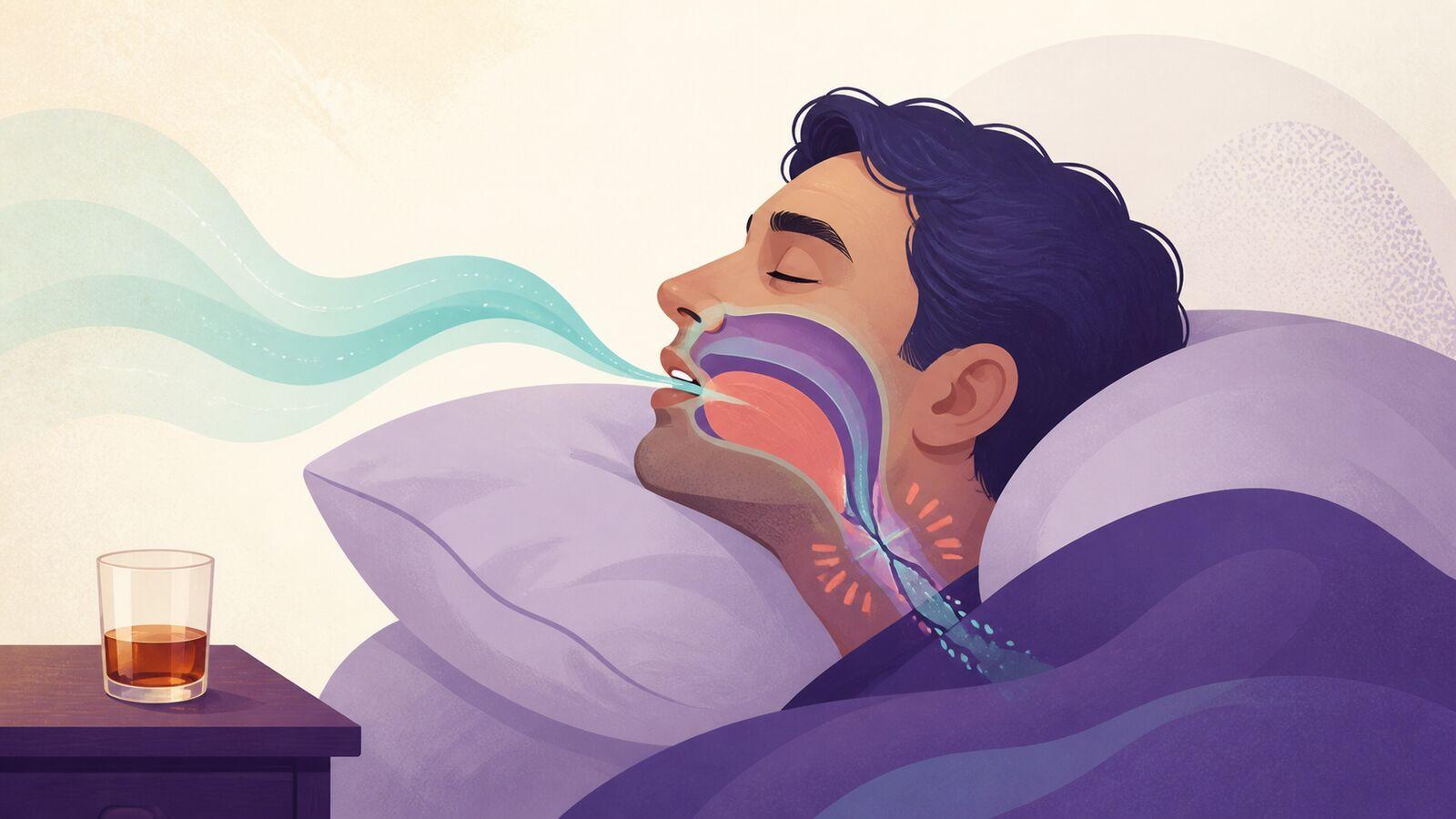
Snoring starts when air has to squeeze through a narrowed upper airway. The tongue, soft palate, throat, or nasal tissues vibrate in that moving air, producing the sound. According to the NHS guide to snoring, those tissues naturally relax and narrow during sleep. Sleeping on your back, smoking, excess weight, nasal obstruction, sedating medicines, and alcohol can all make the passage less stable.
Simple snoring is noise without repeated breathing obstruction. Obstructive sleep apnea, or OSA, is different. In OSA, the upper airway repeatedly narrows enough to reduce airflow or closes completely. The obstruction often triggers a brief arousal or airway-muscle response that helps reopen it, usually without leaving a memory of waking up. That cycle can repeat throughout the night.
Snoring and OSA overlap, but they are not synonyms. Plenty of people snore without sleep apnea. Some people with OSA are not dramatic snorers. The sound alone cannot tell you how much oxygen you are getting or how often breathing stops.
If your bigger problem is insomnia, restless sleep, or waking after you quit, our sleep recovery timeline covers that side of the story. Snoring is an airway problem, not another name for broken sleep architecture.
Why Alcohol Often Makes Existing Snoring Worse
The usual one-line explanation is that alcohol relaxes the throat. That is directionally right, but it is not the whole mechanism.
Upper-airway support can weaken. The National Heart, Lung, and Blood Institute notes that alcohol can relax muscles in the mouth and throat enough to help close the upper airway. In someone whose airway is already narrow, a small loss of support can be the difference between quiet airflow and vibrating tissue.
The airway can become more resistant. Alcohol can increase the effort needed to move air through the throat. Muscle tone is one proposed part of this, but studies do not support a single universal mechanism. Changes in airway resistance, sleep stage, nasal airflow, and the brain's response to obstruction may all contribute.
The arousal response may be delayed. Obstruction often triggers a brief arousal or airway-muscle response that helps reopen the airway. As a sedative, alcohol may delay that response in some people. It is one proposed contributor, not a universal explanation.
Position still matters. Alcohol and back-sleeping push in the same direction. Gravity lets the tongue and soft tissue fall toward the throat, while alcohol makes the airway less able to resist that movement. A person who breathes quietly on their side may become a loud snorer on their back after drinking.
This is why the effect is not universal. Alcohol does not manufacture the same airway in every person. It tends to expose or worsen a vulnerability that is already there.
What the Sleep-Lab Evidence Actually Shows
The strongest evidence comes from experiments that compared the same people after alcohol and after a placebo, then measured their breathing with polysomnography.
A systematic review and meta-analysis of 14 crossover trials found that alcohol increased the apnea-hypopnea index, or AHI, by an average of 2.33 breathing events per hour across all participants. The subgroup estimates were larger: about 4.2 additional events per hour in people who already snored and 7.1 in people with diagnosed OSA.
Alcohol also lowered average overnight oxygen saturation slightly and extended breathing events. The researchers cautioned that the average oxygen change was small and may not be clinically important by itself. A separate 2020 systematic review reached the same broad conclusion: alcohol was associated with worse snoring, a higher AHI, altered sleep architecture, and a lower overnight oxygen nadir among susceptible patients.
Those are averages, not a forecast for your night. The trials were small, many participants were men, and effects varied. The exact subgroup estimates are provisional because they came from only three studies of snorers and two studies of people with OSA. Alcohol can worsen snoring and obstructive breathing, especially if you already snore or have OSA. The evidence does not say every drink makes every person snore.
Timing also appears to matter. In a small crossover study of 23 men, alcohol taken within 30 minutes of bed produced a higher average AHI than when the same amount was taken with dinner or when no alcohol was consumed. That study is useful evidence that bedtime drinking is different from an earlier drink, but it is not a universal clock that makes alcohol harmless after a specific cutoff.
Why You May Snore Only on Nights You Drink
Think of the airway as sitting near a threshold. On an ordinary night it stays open enough to move air quietly. Add alcohol, back-sleeping, nasal congestion, or a particularly tired night, and it crosses the line into vibration or partial collapse.
That threshold explains why someone can "never snore" except after a party, and why the noise varies. The surrounding conditions change along with the alcohol: dose, timing, sleep position, congestion, and prior sleep loss.
Alcohol-only snoring is useful information. It suggests alcohol is an aggravating factor you can remove. It does not prove that the airway is otherwise normal. A person with mild or unrecognized OSA may cross the diagnostic threshold only on some nights, and alcohol can make those nights easier to notice.
The reverse matters too. A quiet alcohol-free night does not rule out OSA. Consumer microphones cannot measure airflow, brain arousals, or blood oxygen with the accuracy of a sleep study. Use recordings as a clue, not a diagnosis.
Simple Snoring or Sleep Apnea?
The split is not "quiet versus loud." It is uninterrupted breathing versus repeated obstruction.
The NHLBI symptom guide names the pattern to watch for:
- Breathing that repeatedly stops and starts
- Loud snoring broken by silence
- Gasping, choking, or snorting as breathing restarts
- Daytime sleepiness or fatigue despite enough time in bed
- Morning headaches or a dry mouth
- Problems concentrating or reacting
- Frequent nighttime urination
A partner often sees the nighttime signs before the person having them. If someone says you stop breathing, take that sentence more seriously than a generic complaint that you are loud.
Marked daytime sleepiness is also a safety threshold. Untreated sleep apnea can impair attention and reaction time. If you are struggling to stay awake while driving, do not treat that as ordinary tiredness or wait for an alcohol-free experiment to finish. Stop driving and arrange a clinical assessment.
Diagnosis requires a sleep study, either in a sleep center or with an appropriate home test ordered by a clinician. A watch, ring, phone microphone, or average respiratory-rate graph can show patterns worth discussing, but none can confirm or exclude OSA. Our guide to wearables and sleep recovery explains what those devices can and cannot tell you.
What Changes When You Stop Drinking
There is no evidence-based day-three, week-two, month-one timeline for snoring after quitting alcohol. A clinical position statement found no trials or observational studies testing how reducing or eliminating alcohol changes primary snoring. Crossover experiments compare alcohol and alcohol-free nights, but do not establish a recovery calendar.
The immediate aggravating factor is gone. If alcohol was the main reason your airway crossed into snoring, an alcohol-free comparison may be quieter. That is a reasonable inference from the crossover studies, not a promise. Sleep problems after quitting alcohol are a separate recovery issue, particularly after heavy regular drinking, so "I slept badly" and "my airway was less obstructed" can both be true on the same night.
Persistent snoring points beyond alcohol. Anatomy, weight, age, nasal obstruction, sleep position, medications, smoking, and hormonal changes can all keep the airway vulnerable. Removing alcohol does not remove those factors.
Diagnosed OSA does not become self-canceling. Sleep-medicine guidance treats avoiding alcohol as an addition to OSA treatment, not a replacement. Do not stop CPAP, change pressure settings, or abandon an oral appliance without clinical reassessment.
The comparison becomes cleaner. Without alcohol changing the airway from night to night, you can see what remains. That makes partner observations, morning symptoms, and clinical testing easier to interpret.
If fatigue persists after the first phase of quitting, do not automatically file it under recovery. Our guide to fatigue after quitting alcohol covers the expected pattern and the signs that another sleep or medical problem may be involved.
A Short Pattern Check That Does Not Pretend to Diagnose You
If uncomplicated snoring is the only issue, remove the variable rather than moving it around. Do not use this check to delay assessment if anyone has seen breathing pauses, gasping, or choking, or if you have substantial daytime sleepiness.
Two weeks is a practical tracking window, not a medically validated cutoff. If stopping is medically safe for you:
- Keep the bedtime and wake time reasonably consistent.
- Avoid alcohol completely, if it is medically safe for you to stop.
- Note whether you slept on your back or side.
- Record partner reports of snoring frequency and loudness.
- Track morning headache, dry mouth, and daytime sleepiness.
This is a pattern check, not a sleep study. If pauses, gasping, choking, or major daytime sleepiness appear, arrange a clinical assessment instead of finishing the tracking window. A private journal or a simple streak counter can keep the dates honest. Sober Tracker lets you count the alcohol-free nights and attach notes without creating an account, but it does not diagnose snoring or sleep apnea.
If you are not stopping alcohol, medical guidance recommends avoiding it near bedtime. Cutoffs vary: the American Thoracic Society advises at least four hours for people with OSA, while Mayo Clinic's snoring guidance says at least two hours. These are practical guidelines, not a guarantee that your breathing is safe. An alcohol-free comparison is a cleaner test of whether drinking drives your snoring.
Side-sleeping can reduce positional snoring, and addressing nasal obstruction or weight may help when those are relevant. Skip mouth taping and random anti-snoring gadgets as a first response to witnessed breathing pauses. If the problem is OSA, the treatment needs to hold the airway open, not make the recording quieter.
When "Bad Snoring" Is an Emergency
Ordinary snoring and alcohol overdose are not the same event. After heavy drinking, a person who cannot be awakened, is vomiting while barely conscious, has seizures, or has slow or irregular breathing may have alcohol poisoning. The NIAAA warning signs include fewer than eight breaths per minute or gaps of ten seconds or more between breaths.
That is not a sleep-apnea experiment and it is not something to record for later. Call emergency services, stay with the person, and do not assume they can sleep it off.
For non-emergency nights, book a medical assessment if there are witnessed pauses, choking or gasping, persistent loud snoring, major daytime sleepiness, or symptoms that remain after alcohol is out of the picture. A sleep study is the test that separates an annoying sound from repeated airway obstruction.
The Honest Conclusion
Alcohol does not make everyone snore, and snoring does not automatically mean sleep apnea. The narrower, better-supported claim is still important: alcohol can make an already vulnerable airway less stable, raise the number of obstructive breathing events, and worsen oxygen measures, with larger average effects in people who already snore or have OSA.
Removing alcohol removes that aggravating factor. Sometimes the difference between alcohol and alcohol-free nights is obvious. Sometimes the snoring remains because alcohol was one contributor rather than the cause. Either result tells you something useful, as long as you do not mistake a quiet microphone for a medical all-clear.
A nightcap can make you fall asleep sooner while making the airway less reliable once you get there.
Frequently Asked Questions
Will I stop snoring if I stop drinking?
You might if alcohol is the main trigger, especially if you snore only after drinking. Research shows worse breathing on alcohol nights than alcohol-free nights, particularly in habitual snorers. Quitting does not guarantee silence because anatomy, sleep position, nasal obstruction, weight, age, and sleep apnea can still cause snoring.
Why do I only snore when I drink alcohol?
Your airway may sit close to the point where soft tissue begins to vibrate or collapse. Alcohol can reduce upper-airway support, increase airway resistance, and may delay one of the responses that helps reopen an obstruction. Add back-sleeping or congestion, and a normally quiet airway can cross into snoring.
Can quitting alcohol cure sleep apnea?
There is no evidence that quitting alcohol universally cures diagnosed obstructive sleep apnea. It can remove an aggravating factor and may reduce breathing events, but OSA is multifactorial. Keep using prescribed CPAP or an oral appliance unless a clinician reassesses you and confirms that changing treatment is appropriate.
How long before bed should I stop drinking alcohol to reduce snoring?
Guidance varies, and no exact cutoff makes alcohol risk-free for every airway. The American Thoracic Society advises people with OSA to avoid alcohol for at least four hours before bed; Mayo Clinic's general snoring guidance says at least two hours. If you want to learn whether alcohol drives your snoring, fully alcohol-free nights provide a cleaner comparison than shifting the drink earlier.
Is loud snoring dangerous?
Loudness alone does not diagnose danger. Snoring becomes more concerning when it is interrupted by silence, witnessed breathing pauses, gasping or choking, morning headaches, or substantial daytime sleepiness. Those signs justify a medical assessment and usually a sleep study.
Trying to learn what changes when alcohol is out of the picture? Sober Tracker is a private, no-account counter for the alcohol-free nights. Use the journal to note partner reports and morning energy, then bring persistent snoring or breathing pauses to a clinician.
This article is educational and not a substitute for medical advice. Snoring is not a diagnosis, and consumer devices cannot rule out sleep apnea. Seek medical assessment for witnessed breathing pauses, gasping, choking, or substantial daytime sleepiness. If you drink heavily every day, sudden withdrawal can be medically serious, so talk to a healthcare professional before stopping.