The first thing most people notice is the gap. They wake up on the couch with their shoes on, the lights still bright, the dog still on the bed, and the last forty minutes of the night simply not there. Not foggy, not blurry, not jumbled into a wrong order. Gone. As if those minutes were never recorded in the first place.
That is exactly what happened. They were never recorded.
A blackout is the loud, undeniable version of what alcohol does to memory. It is also the version most people brush off, because the next morning the rest of life resumes and the missing minutes feel like a small price. The quieter version is harder to notice and much more important: a slow, dose-dependent toll on the brain's memory hardware over years, and a higher risk of dementia in heavy drinkers in the decades after that.
Here is what alcohol actually does to memory, why the brain region most affected is the one you can least afford to lose, and what recovers when you stop.
The Two Failures: Encoding Blackouts vs Long-Term Erosion
Memory has two failure modes under alcohol, and they are not the same problem.
The first is an encoding failure. When blood alcohol rises rapidly, alcohol can block the transfer of memories from short-term to long-term storage in the hippocampus. Short-term memory still works, so a person can hold a conversation, drive a car, walk home, send texts. But the moment-to-moment experience never gets transferred into storage. Hours later, those events do not exist as memories because they were never encoded. There is nothing to retrieve, no faded copy, no jumbled fragment. Just empty tape.
This is why people in a blackout can perform astonishingly complex behaviors and remember none of them. The system that lets you function in the moment is intact. The system that lets you remember the moment is offline.
The second is a slow, cumulative erosion. This one happens at much lower doses, every drinking week, for decades. In a 30-year British cohort study, people drinking 14 to 21 units a week, levels many guidelines used to call "moderate," had about three times the odds of right-sided hippocampal atrophy compared with abstainers, and light drinking showed no protective effect. There is no dramatic gap, just a steady drag on the kind of memory that lets you learn languages, remember names, hold appointments, recall what someone said yesterday.
The blackouts are the visible part. The erosion is the part that can end up on a brain scan in your sixties.
If you're still choosing a tracking app, our guide to the best sobriety apps compares the top options side by side.
The Hippocampus Under Alcohol
The hippocampus is a small, seahorse-shaped structure deep in each temporal lobe. It is the brain's memory-formation engine: the part that decides what gets saved, links events to context, and connects new information to what you already know. It is also vulnerable to alcohol in three ways.
First, alcohol dampens the hippocampus's signature electrical pattern. Memory formation depends on a process called long-term potentiation (LTP), where repeated firing strengthens connections between neurons. In laboratory studies, alcohol suppresses LTP in the hippocampus. The cells stop becoming more responsive to each other, and the chemical record of "this just happened" does not get written. At high enough blood alcohol, encoding can stop altogether.
Second, the hippocampus shrinks. Brain imaging studies consistently find smaller hippocampi in people with alcohol use disorder than in healthy controls, although postmortem studies of uncomplicated alcohol use disorder have not found a clear loss of hippocampal neurons, so the shrinkage may reflect damaged connections and white matter more than dead cells. Even people with no diagnosable alcohol use disorder show more hippocampal atrophy the more they drink, in a dose-dependent line.
Third, alcohol interferes with the birth of new hippocampal neurons. The hippocampus is one of the few brain regions thought to keep generating new neurons in adulthood, a process called neurogenesis, which is part of how memory and learning stay sharp. In animal studies, alcohol suppresses neurogenesis; in living humans this is much harder to measure, so the size of the effect at everyday doses is unknown.
The hippocampus is doing three jobs at once: encoding what is happening now, consolidating what happened recently, and replenishing its own cell population. Alcohol can disrupt all three, which is one reason memory problems are among the most common cognitive complaints in heavy drinkers.
For a fuller picture of how the rest of the brain recovers once you stop, the cognitive comeback after quitting alcohol walks through the rest of the recovery landscape, from prefrontal cortex thickness to executive function. The hippocampus is one of the slower-recovering pieces, but it is not stuck.
Blackouts Are Not Just "Drank Too Much." They Are a Specific Brain State.
Most people assume blackouts only happen at very high doses, the kind that produce vomiting and unconsciousness. That is not the whole story. NIAAA ties blackouts to a rapid rise in blood alcohol, not only to the total amount. Fragmentary blackouts leave "islands" of memory separated by gaps. En bloc blackouts (complete amnesia, often spanning hours) need higher levels, and those memories typically cannot be recovered. Shots, fast-paced rounds, and drinking on an empty stomach all push blood alcohol up quickly.
A few things meaningfully raise the risk:
- Drinking quickly rather than spread over hours
- Drinking on an empty stomach
- Mixing alcohol with medications for sleep or anxiety
- Individual vulnerability (some people black out at lower doses than others)
- Being female (women tend to reach higher peak blood alcohol than men with each drink)
The clinical concern with blackouts is not the embarrassment the next morning. It is what the blackout reveals: that the dose was high enough to take a specific brain region offline. The hippocampus is small, fragile, and central to memory and emotional regulation. Repeated blackouts mean repeated drinking at levels high enough to take that exact structure offline, and heavy drinking over years leaves a mark that shows up on imaging.
If a person blacks out occasionally, that is a signal worth taking seriously. If a person blacks out routinely, the structural risk is real and rising.
From Blackout to Brain Atrophy: How Repeated Exposure Compounds
Long-term heavy alcohol use is associated with a recognizable pattern on brain imaging: smaller hippocampal and frontal volumes, white matter damage including in the corpus callosum, and enlarged ventricles. A Zahr 2024 review describes chronic alcohol misuse as accelerating brain aging.
Three increasingly severe outcomes sit on this spectrum.
Alcohol-related cognitive impairment. The earliest and most common outcome. People notice they are slower with names, lose track mid-sentence more than they used to, struggle to recall what was said in a meeting yesterday, and feel mentally "softer" than they did ten years ago. On testing, memory and executive function can fall below age-expected baselines. This is not a diagnosable disease yet, but it is the first visible step.
Alcohol-related brain damage (ARBD). A clinical syndrome in which the cognitive impairment is severe enough to interfere with daily life. People struggle with planning, organization, and sustained attention. Memory deficits, especially for recent events, become hard to compensate for. ARBD typically appears in heavy long-term drinkers in their fifties and beyond, but it can happen earlier with higher exposure.
Wernicke-Korsakoff syndrome. The severe end. Caused by severe thiamine (vitamin B1) deficiency, which alcohol drives through poor absorption, poor diet, and increased metabolic demand. Wernicke's encephalopathy is the acute crisis and a medical emergency (confusion, abnormal eye movements, staggering and poor coordination), and Korsakoff syndrome is the chronic aftermath: profound, often lasting memory loss, especially trouble learning new information and remembering recent events. Patients can be conversationally normal in the moment and have no memory of the conversation an hour later. It is one of the most devastating cognitive syndromes in medicine, and because it is driven by a vitamin deficiency, prompt thiamine treatment is a core part of care.
The good news embedded in this grim spectrum is that the earliest steps are often at least partly reversible. The hard news is that without abstinence, the trajectory keeps moving in the wrong direction.
Alcohol and Dementia Risk
For years, the conventional wisdom was that "moderate" drinking might protect against dementia, based on observational studies that showed light drinkers had slightly lower rates of cognitive decline than abstainers. That picture has become much less comfortable over the last decade.
Abstainers in those studies include former heavy drinkers and people who stopped because they were ill, which can make light drinking look protective. In the Whitehall II cohort, for example, the extra risk seen in midlife abstainers was partly explained by cardiometabolic disease. What is consistent is the upper end of the curve:
- Above 14 units per week (about eight US standard drinks), each extra 7 units a week was associated with a 17 percent higher risk of dementia over a 23-year follow-up in Whitehall II.
- In a French nationwide study of more than a million people diagnosed with dementia, alcohol use disorders were associated with about three times the risk of dementia, and more than half of early-onset cases (under age 65) were either alcohol-related by definition or had an alcohol use disorder diagnosis.
- In that same study, alcohol use disorders were the strongest modifiable risk factor for dementia onset.
Several mechanisms likely add up to that risk: hippocampal shrinkage, white matter damage that slows neural communication, increased small-vessel disease in the brain (which raises vascular dementia risk), thiamine deficiency, and elevated systemic inflammation.
The framing matters: alcohol is not the only or even the largest dementia risk factor for most people. Genetics, cardiovascular health, sleep, and head injury all play their part. But alcohol is one of the most controllable contributors, and the dose-response curve is real.
What Recovers When You Stop, And On What Timeline
This is the part most people actually want answered. The honest summary is that meaningful recovery is common, but it is gradual, it varies a lot between people, and no study gives a fixed calendar.
In the first weeks, the acute effects stop. There is no alcohol in the system to block encoding. Sleep starts to stabilize (which matters for memory consolidation, since a lot of it happens during sleep stages that alcohol disrupts). Nutrition, including thiamine, usually improves with normal eating. The drag of constant alcohol exposure simply ends.
This is also when most people notice the first subjective improvements: names come back faster, conversations from yesterday are easier to recall, the "what did I come in here for" moments thin out. The improvement is not your imagination. Many people see this same shift in brain fog clearing during the first weeks, since memory and brain fog share a lot of underlying machinery.
Over the following months, imaging studies show that brain volume partly recovers with abstinence, while relapse brings further shrinkage, and the same review notes that even cutting down without full abstinence can improve brain structure and function. Many people stop noticing memory problems in daily life, even if a clinical test would still pick up subtle deficits.
The hippocampus is one of the slower pieces. In one longitudinal study, people in treatment for alcohol dependence still had smaller hippocampi than light-drinking controls after an average of seven months of abstinence, and whether volume grew over that time depended partly on genetics. Recovery tends to be less complete in older adults and after longer, heavier drinking histories.
Over the long run, recovery is more about preservation than reversal. The brain stops taking the alcohol-driven hit and ages on its own trajectory. Sustained for decades, that removes one of the more controllable inputs to dementia risk.
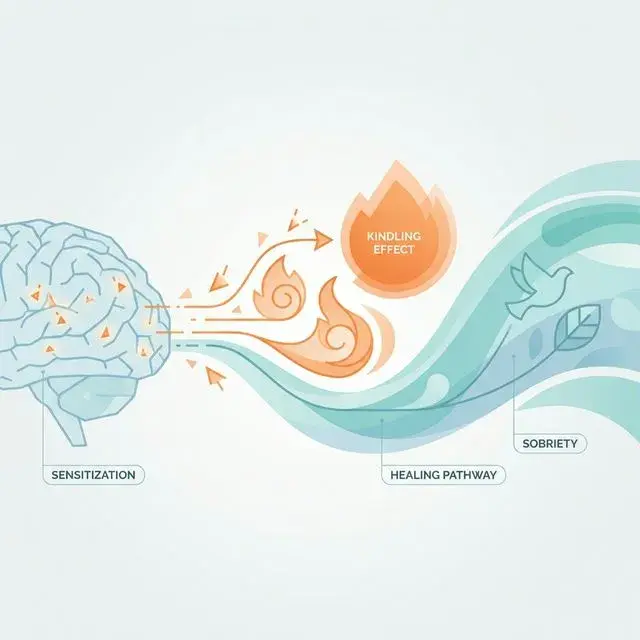
For people who have had repeated severe blackouts or symptoms of withdrawal, the recovery curve can look different. The kindling effect describes how repeated detox cycles can leave lasting changes in brain excitability, and it overlaps with the memory-recovery picture. The shorthand: each round of heavy drinking and quitting is harder on the brain than the one before, which is another argument for stopping sooner rather than later.
What Helps Recovery Beyond Just Stopping Drinking
Quitting is the single largest lever. After that, four things measurably accelerate or amplify hippocampal recovery.
Sleep, prioritized like a job. A lot of memory consolidation happens during the deep and REM sleep stages that alcohol disrupts. Sleep can stay unsettled for weeks or months after quitting, so give it room to normalize. Protect sleep aggressively in the first year: consistent schedule, dark room, no screens late, no caffeine after lunch. The investment compounds.
Aerobic exercise. Aerobic training is one of the best-supported non-drug ways to grow the hippocampus. In a randomized trial in 120 older adults, a year of walking three days a week increased hippocampal volume by about 2 percent and improved spatial memory, roughly reversing one to two years of age-related loss. It stacks cleanly with sobriety.
Adequate B vitamins, especially thiamine. Alcohol misuse is the most common cause of Korsakoff syndrome, and some experts recommend that heavy drinkers take oral thiamine under medical supervision. People with heavier drinking histories should ask a clinician about thiamine in the first weeks, especially around withdrawal.
Cognitive demand. New skills, new languages, new physical patterns, regular reading, problem-solving: all of it drives the kind of activity-dependent plasticity that helps the hippocampus rewire. The brain that is being used recovers faster than the brain that is being rested.
For the broader supplement picture during recovery, the post on essential supplements for alcohol recovery maps the bone, brain, and energy-system stack that most people benefit from in the first year.
A Note on "Just a Couple of Drinks" and Memory
The most common question in this space is whether light drinking is fine for memory. The honest read of current evidence is that there is no sign light drinking protects the brain, and the harm curve starts low. In a UK Biobank study of more than 36,000 adults, lower brain volume was already apparent at an average of one to two units a day and grew with intake. The effect at that level is small, and observational data cannot prove cause, but the direction is consistent.
This is not a moral claim. It is a pattern in the data. For people who care about their long-term memory, reducing or eliminating alcohol is one of the few changes with this much evidence behind it, more than any supplement or brain training program.
The Honest Bottom Line
Memory is one of the things people fear losing most as they age, and alcohol is one of the most controllable contributors to that loss. The blackouts are the visible warning. The slow erosion is the part that ends up mattering more.
The encouraging part is that the brain is not as fragile as the worst-case stories suggest. The hippocampus is one of the most plastic structures in the brain, and it responds to abstinence, sleep, and aerobic exercise. Noticeable improvement in months. Partial volume recovery over the first year or more. One less push toward dementia over decades.
The framing that helps: every alcohol-free year is a deposit into the memory you will have at seventy. The harm in these studies tracks cumulative exposure, so less drinking in your thirties, forties, and fifties means less of it.
This is one of the reasons many people start tracking alcohol-free days well before they consider themselves "in recovery." The hippocampus does not care about the language you use about your drinking. It just keeps a running tally.
Sources
- Interrupted Memories: Alcohol-Induced Blackouts, NIAAA
- Moderate alcohol consumption as risk factor for adverse brain outcomes and cognitive decline: longitudinal cohort study, The BMJ, 2017
- Alcohol consumption and risk of dementia: 23 year follow-up of Whitehall II cohort study, The BMJ, 2018
- Contribution of alcohol use disorders to the burden of dementia in France 2008-13: a nationwide retrospective cohort study, Lancet Public Health, 2018
- Associations between alcohol consumption and gray and white matter volumes in the UK Biobank, Nature Communications, 2022
- Alcohol Use Disorder and Dementia: A Review, Alcohol Research: Current Reviews, 2024
- Genetic and behavioral determinants of hippocampal volume recovery during abstinence from alcohol, Alcohol, 2014
- Exercise training increases size of hippocampus and improves memory, PNAS, 2011
- Korsakoff Syndrome, Alzheimer's Association
Want to see what your memory looks like after a meaningful break from alcohol? Sober Tracker is a private, no-account streak counter built for exactly this kind of long-game experiment. Pair it with a habit of writing down one thing you remember from yesterday each morning, and check back in three months.
This article is educational and not a substitute for medical advice. If you have concerns about memory, blackouts, or your drinking, talk with a healthcare provider. Sudden withdrawal from heavy long-term drinking can be dangerous and should be medically supervised.
Edited by Ivan Terekhin, drafted with AI tools, not medically reviewed.