You already know the rules. Thirty-one days, no alcohol, no cheat nights. If you want the full playbook on preparation and the science, our complete Dry July guide covers it. This is the other thing you need: the encouragement to actually start, and the reasons to keep going when the novelty wears off around day nine and a hot Friday afternoon starts whispering at you.
Motivation is not a personality trait you either have or do not have. It is something you build, lose, and rebuild on a daily basis. The people who finish Dry July are not the ones who felt unstoppable on July 1. They are the ones who had a plan for the days they felt like quitting. Let's give you that plan.
Why You Are Doing This
Before the hard days arrive, get clear on your reason. Not the generic one, yours. "Cut back on alcohol" is too vague to hold up against a cold beer in your friend's hand. Find the specific version:
- I want one full month of Saturday mornings that do not start with regret.
- I want to know I can say no without it being a big deal.
- I want to see what my sleep, my skin, and my mood actually look like without alcohol in the way.
- I want to prove to myself that a sunny afternoon does not require a drink to be good.
Write your reason somewhere you will see it. The decision you make calmly today is the one that speaks up for you at 6 p.m. when your motivation has gone quiet. Most people do not relapse because their reason was weak. They relapse because in the moment, they could not remember it.
A free sobriety tracker app makes progress like this much easier to see, and our comparison guide breaks down which ones do it best.
The First Week Is a Different Animal
The first few days carry their own momentum. You decided, you committed, you are riding the energy of a fresh start. Enjoy it, but do not be surprised when it fades. The dip usually comes somewhere between day five and day ten, when the decision stops feeling exciting and starts feeling like a restriction.
This is normal. It is not a sign that you are failing or that you "need" a drink. It is just the gap between the version of you that made the plan and the version of you living it out on a random Tuesday. Our honest breakdown of what 30 days without alcohol actually feels like walks through this phase in detail, and the short version is this: the discomfort is temporary, and it is doing something useful. You are renegotiating a habit your brain has run on autopilot for years.
Expect the dip. When it comes, you will recognize it instead of mistaking it for a reason to stop.
How to Reframe a Craving
A craving feels like a command. It is actually just a suggestion with bad timing. The reframe that helps most people is simple: a craving is not a problem to solve, it is a wave to ride out. It peaks, and then, if you do not feed it, it falls. Usually within fifteen minutes.
When one hits, try this:
- Name it. "This is a craving. It will pass." Saying it out loud takes some of the power out of it.
- Buy time. Tell yourself you can reconsider in twenty minutes. Pour a cold drink, step outside, change rooms. Almost every craving loses its grip before the twenty minutes are up.
- Ask what it actually wants. In summer, a lot of "I want a beer" is really "I am hot, thirsty, and want to feel like the day is winding down." Cold sparkling water with lime answers most of that.
- Remember the trade. You are not giving something up. You are trading fifteen uncomfortable minutes for a clear morning. That is a good deal, and it gets easier to see each time you take it.
Every craving you ride out makes the next one quieter. You are not just resisting, you are teaching your brain that the urge does not get to drive.
Small Wins Are the Whole Game
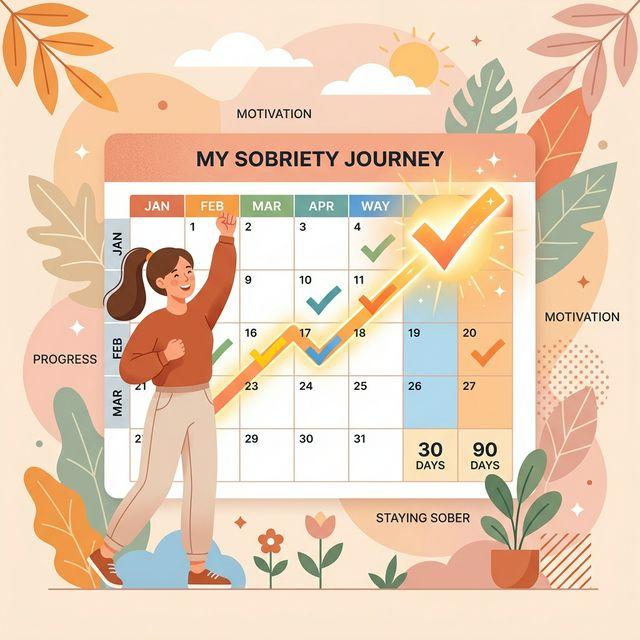
People underestimate how much momentum lives in a checked box. There is real psychology behind why tracking a streak works: each day you log builds a small piece of identity, and the longer the chain gets, the more you do not want to break it.
So make your progress visible. Mark each day. Notice the wins as they come, because they will, and they are easy to miss if you are only watching the calendar:
- The first morning you wake up genuinely rested.
- The Friday night you got through a gathering sober and felt fine, maybe even better.
- The money still in your account that usually disappears by the weekend.
- The moment someone offers you a drink and saying no does not even register as hard.
Celebrate those. Not with a drink, obviously, but with acknowledgment. Tell someone. Note it down. These small wins are the actual reward of the month, and stacking them is what carries you to day 31.
What to Do If You Slip
Let's talk about this honestly, because pretending it never happens helps no one. If you have a drink partway through the month, the day is not ruined and the month is not over. A slip is a single data point, not a verdict.
The only thing that turns a slip into a real setback is the story you tell yourself afterward: "Well, I blew it, might as well write off July." That story is far more damaging than the drink. Here is the better response:
- Stop where you are. One drink does not have to become five.
- Skip the shame spiral. It is not useful and it makes another drink more likely, not less.
- Get curious instead. What was the trigger? Tired, stressed, caught off guard at an event? Name it so you can plan for it next time.
- Reset tomorrow morning, not "next month." Your streak counter resets, your reasons do not.
Most people who finish a sober month did not do it perfectly. They did it persistently. Progress beats a clean record every single time.
You Do Not Have to Do It Alone
Telling one person turns a private intention into a small commitment, and that changes the odds. Pick someone supportive and say it plainly: "I am doing Dry July, hold me to it." You do not need a cheering squad. One person who knows is enough to make quitting quietly a little harder.
If you would rather keep it personal, a quiet tracker does a similar job. Sober Tracker is built for exactly this kind of time-limited challenge: a clean streak counter, private day logging, and a simple visual of your 31 days, with no social feed and no public scoreboard. Check off each day, jot a note about how you slept or felt, and let the growing chain do the motivating. It runs on your phone, your notes stay with you, and there is no account to create.
The point of either approach is the same: on the days your willpower is thin, you want something outside your own head reminding you what you decided and how far you have come.
Finishing Strong
The last week has its own trap. By day 24 or 25, you might catch yourself thinking you have already proven the point, so what is one drink before the finish line. Do not let yourself negotiate with the version of you that just wants the discomfort to end early. Finishing all 31 days is worth more than 28 plus a "close enough."
When you reach July 31, you will be holding something more convincing than any article or study: your own evidence. You will know exactly what a month without alcohol does to your sleep, your skin, your wallet, and your Saturday mornings. That evidence is yours, and it does not expire on August 1.
Whatever you decide to do next, the month stays with you. Some people go back to drinking and find it underwhelming. Some keep going. Either way, you will have learned that you can, and that knowledge quietly changes every choice that comes after it.
You do not need to feel motivated every day. You just need to keep going on the days you do not. Start where you are, ride out the waves, count the small wins, and let yourself be proud at the end. Thirty-one days is closer than it looks.
Sober Tracker is built by Trifoil Trailblazer to help people track alcohol-free days privately, without social feeds or public streaks. It is designed for month-long challenges like Dry July as much as for longer journeys.