You had three drinks last night. Not a bender, not even a particularly notable evening. You felt fine going to bed and you slept the usual number of hours. Then the ring buzzes in the morning and the readiness score is 41, sitting in red, with a line underneath it that says something like "Your body needs recovery today." Your HRV is half what it was on Tuesday. Resting heart rate is up nine beats. The sleep graph that is usually a tidy staircase looks like a seismograph.
You did not feel any of that. But the wrist did, and the wrist is not editorializing. This is one of the strangest and most useful things about modern wearables: they make the physiological cost of drinking visible the next morning, in numbers, before the story you tell yourself about "it was only a few" has a chance to take over. For a lot of people, the single most persuasive argument for cutting back was not an article or a doctor. It was a graph on their own phone that they could not argue with.
Here is what these devices are actually measuring, why alcohol moves it so reliably, what each major device shows, and how fast the numbers come back once you stop.
Why A Wearable Can See Alcohol At All
A smartwatch or ring does not detect ethanol. It detects what your autonomic nervous system does while your body clears it, and that signal is loud.
Your heart is not a metronome. Between beats, the interval varies slightly, speeding up and slowing down under the constant negotiation between the sympathetic ("go") and parasympathetic ("rest") branches of the nervous system. The amount of that beat-to-beat variation is heart rate variability, or HRV. High HRV generally means the parasympathetic system is in charge and the body is in a recovery state. Low HRV means the sympathetic system is dominating, the body is under load, even if you are lying perfectly still.
Alcohol is a sympathetic stressor for hours after the buzz is gone. While the liver works through it, and especially during the rebound after blood alcohol falls overnight, the nervous system shifts hard toward "go." Heart rate stays elevated, HRV collapses, breathing speeds up, and deep sleep gets suppressed. The wearable is sampling all of this through the night while you are unconscious, which is exactly when alcohol's autonomic signature is strongest and your own perception is offline.
That last point is the whole reason this is useful. You do not feel your HRV. You cannot perceive a nine-beat rise in resting heart rate during sleep. The device can, and it logs it whether or not you want to see it.
The Four Metrics That Move
Across essentially every consumer device, the same four signals respond to alcohol, in roughly this order of sensitivity.
HRV: the headline number
HRV is the most dramatic and the most consistent. A single moderate evening of drinking commonly drops overnight HRV by 20 to 40 percent versus your own baseline, and a heavier night can cut it in half. It is dose dependent in a way that is almost linear: more drinks, lower HRV, more reliably than almost any other input the device tracks, including hard exercise or a bad night of sleep. This is why people who started wearing a recovery-focused band often describe the same moment of realizing alcohol was their single largest HRV suppressor, ahead of training load or stress.
Resting heart rate: the slow burn
Alcohol raises your lowest overnight heart rate, typically by 5 to 15 beats per minute on a drinking night, and the elevation often persists into the next day. Many people notice their resting heart rate does not return to baseline until two nights after drinking, which is a useful tell that "recovered the next morning" is optimistic.
Respiratory rate: the quiet one
Most modern devices now track breathing rate during sleep. Alcohol pushes it up by one to three breaths per minute. It is a smaller signal than HRV but a clean one, and because few other everyday things move respiratory rate, a jump is a fairly specific fingerprint of the night before.
Sleep architecture: the lie alcohol tells
This is the one that contradicts experience most directly. Alcohol is sedating, so it can shorten the time to fall asleep and feel like it "helps you sleep." The sleep staging tells a different story. Deep (slow-wave) sleep is suppressed and front-loaded, REM is blunted, especially in the second half of the night, and the back half of the night fragments into micro-wakings you may not remember. The total hours can look normal while the restorative structure is gutted. The deeper relationship between drinking and sleep stages is worth its own read, covered in how quitting alcohol transforms your sleep, but the short version is that the sleep graph on the device often shows the damage your memory of the night does not.
What Each Device Actually Shows
The underlying physiology is identical across hardware. What differs is how each device packages it.
Oura Ring. Probably the most quietly brutal about alcohol. A drinking night reliably tanks the Readiness score, flags elevated resting heart rate and lowered HRV, and frequently shows the lowest heart rate of the night occurring in the morning hours rather than early, a classic alcohol pattern Oura surfaces directly in the timeline graph.
Whoop. Built around recovery as the headline metric, so alcohol's effect is unmissable: a green recovery becomes red, HRV drops sharply, and the strap explicitly trends HRV against your behaviors. Whoop's journal feature lets you log alcohol and then shows you, in your own data, the average HRV hit it costs you. That personalized number is often more persuasive than any general statistic.
Apple Watch. Less of a single "recovery score," but it records overnight wrist temperature, resting and sleeping heart rate, HRV (shown in the Health app), respiratory rate, and full sleep stages. The signals are all there for anyone who opens the Health app the morning after; they are just not pushed at you with a red number.
A free sobriety tracker app makes progress like this much easier to see, and our comparison guide breaks down which ones do it best.
Garmin. Body Battery and the morning report fold HRV, stress, and sleep into a composite. A drinking night usually shows up as a poor sleep score, elevated overnight stress, low overnight HRV status, and a Body Battery that barely recharged despite a full night in bed.
Fitbit. Surfaces it through a depressed Sleep Score, elevated resting heart rate trend, and the Daily Readiness Score (on Premium), which leans heavily on HRV and recent resting heart rate, both of which alcohol degrades.
Different dashboards, same underlying truth. None of them are flattering about it.
The Recovery Curve
The encouraging part is how fast the wrist starts rewarding you, because autonomic recovery is one of the quicker wins.
After one alcohol-free night following a drinking night. HRV partially rebounds but often does not fully return; resting heart rate is usually still slightly elevated. This is the data showing you that a single recovery night does not fully clear the cost.
After about a week with no alcohol. For most regular drinkers this is where the dashboard visibly changes. HRV baseline rises, resting heart rate drifts down a few beats and stays there, sleep scores climb as deep and REM sleep rebound, and readiness/recovery scores spend far more time in green. Many people report this first week as the moment the wearable "stopped yelling at them."
After about a month. Baselines reset upward. The device recalculates your normal range around the alcohol-free numbers, which means a future drinking night will stand out even more starkly against the cleaner baseline. The cardiovascular side of this, including blood pressure and heart rate trends, tracks the same curve and is covered in alcohol and heart health recovery.
Beyond a month. HRV continues a slower upward drift for many people, sleep architecture stabilizes, and the overall picture settles into a new, higher steady state determined by training, stress, and sleep hygiene rather than by ethanol sitting on top of everything.
The exact numbers vary by person, age, and how much you were drinking. The shape of the curve is remarkably consistent.
Using The Data Without Letting It Use You
A wearable is a feedback loop, and feedback loops are powerful precisely because they are not opinions. There is no willpower argument to have with a graph. The screen says what last night cost, you did not have to feel it, and you cannot rationalize it away. For a lot of people that is the entire mechanism that finally worked, where advice and intention had not.
A few ways to use it well:
- Run the experiment on yourself. Note your average HRV and resting heart rate now. Take a deliberate break of two to four weeks. Watch the same two numbers. Personal data beats population statistics every time, because it is about you and you cannot dismiss it as "studies."
- Log the input. Most apps let you tag alcohol. Tag it honestly for a month and let the device show you your own average cost per drinking night. The number is usually larger and lasts longer than people expect.
- Watch trend, not the daily number. A single low HRV day can come from a workout, illness, or a stressful afternoon. The signal is in the moving baseline over weeks, which is exactly where an alcohol-free stretch shows up most clearly.
- Do not spiral on it. This is a real failure mode. HRV is noisy and reacts to everything, and orthosomnia (anxiety driven by sleep tracking) is a genuine phenomenon. The wearable is a coach for the long-game trend, not a verdict to be refreshed at 7 a.m. with dread. If the daily number is making you anxious, look at it weekly instead.
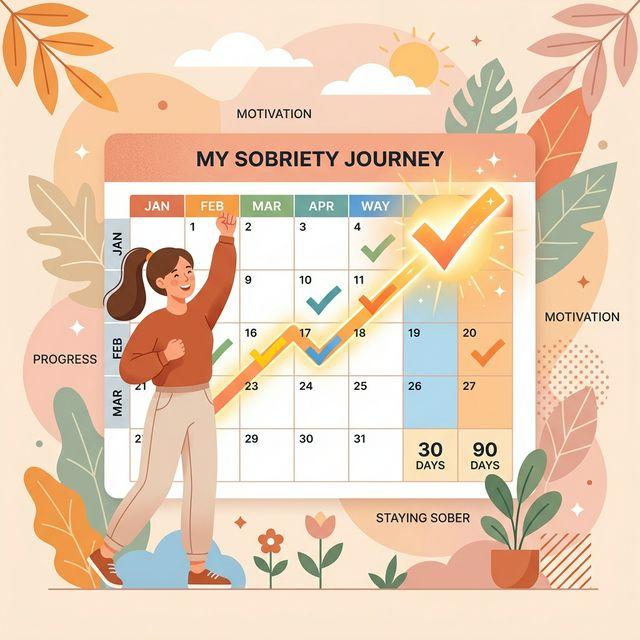
The most durable pattern people land on is pairing two streams: the involuntary, physiological feedback from the wrist, and a deliberate behavioral count they own. The wearable shows the body recovering; a simple alcohol-free day count shows the choices that produced it, and watching the two curves move together is a far stronger motivator than either alone. This is closely tied to why streak tracking works at all, which is worth reading on its own in the psychology of streaks.
The Honest Conclusion
The quiet revolution of consumer wearables, as far as drinking goes, is that they removed the argument. For most of human history the cost of a few drinks the night before was invisible the next morning. You felt roughly fine, so you concluded you were roughly fine. Now there is an HRV number, a resting heart rate, a sleep graph, and a recovery score, all recorded while you were asleep and unable to spin them, and they are unusually clear about alcohol.
You do not need a device to quit or cut back. But if you already wear one, you are carrying a personal, unsentimental, dose-dependent measurement of exactly what alcohol is doing to your nervous system, available every morning for free. Take a baseline this week, take a real break, and watch the same two numbers. For a lot of people, that graph turned out to be the most convincing argument they ever encountered, because it was made entirely of their own data.
Want to pair the data on your wrist with the choices behind it? Sober Tracker is a private, no-account alcohol-free day counter built for exactly this kind of self-experiment. Run a real break and watch both curves move.
This article is educational and not a substitute for medical advice. Consumer wearables are not medical devices and their HRV and sleep readings are estimates, not diagnostics. If you have a heart condition or any health concern, talk with a healthcare provider. Sudden withdrawal from heavy long-term drinking can be dangerous and should be medically supervised.