You sit in the back of a church basement on a Tuesday night, holding a styrofoam cup of bad coffee, and someone says the words "we admitted we were powerless over alcohol." Something in you tightens.
It is not that the room is unkind. The people are warm, the stories are honest, the sense of community is real. But the language of powerlessness, of surrender, of a Higher Power, does not match how you think about yourself. You are not a powerless person. You are someone with a problem you would like to solve. That mismatch in framing is enough to make you stop coming back.
If that resonates, you have probably wondered the same thing many other people quietly wonder: is there another way to do this? Something built on evidence, agency, and tools instead of identity, surrender, and faith?
Yes. It is called SMART Recovery, and it is the most established science-based alternative to the 12-step model.
What AA Actually Is
Alcoholics Anonymous, founded in 1935 by Bill Wilson and Dr. Bob Smith, is the original mutual-aid framework for problem drinkers. Its core elements:
- The 12 Steps: a sequenced spiritual and moral inventory program
- The disease model of addiction: alcoholism as a chronic, progressive condition that cannot be cured, only arrested
- Powerlessness and surrender: Step 1 asks members to admit they are powerless over alcohol
- A Higher Power: Steps 2 and 3 invite members to turn their will and life over to a power greater than themselves (interpreted broadly, but unmistakably spiritual in origin)
- Sponsorship: a more experienced member walks newer members through the steps
- The lifetime member identity: "I'm Sarah, and I'm an alcoholic" is said even after decades of sobriety
AA has helped millions of people get and stay sober. Its meetings are free, available almost everywhere on earth, and accessible 24 hours a day in some form. Anyone who dismisses AA outright is missing the scale of human good it has done.
But AA was designed in the 1930s by laymen, not researchers. It is a spiritual fellowship, not a clinical protocol. And for a meaningful slice of the population, the framework simply does not click.
What SMART Recovery Actually Is
SMART Recovery (Self-Management And Recovery Training) was founded in 1994 by addiction researchers and clinicians who wanted a mutual-aid framework rooted in modern psychology rather than spiritual surrender. It draws directly from:
- Cognitive Behavioral Therapy (CBT): identifying and reframing the thoughts that drive drinking
- Rational Emotive Behavior Therapy (REBT): challenging irrational beliefs
- Motivational Interviewing (MI): building and maintaining the desire to change
- Modern neuroscience of addiction: treating problem drinking as a learned behavior pattern that can be unlearned, not a permanent identity
SMART organizes itself around the 4-Point Program:
- Building and maintaining motivation to abstain
- Coping with urges (cravings) using practical CBT tools
- Managing thoughts, feelings, and behaviors that lead to drinking
- Living a balanced life with sustainable replacement activities
Like AA, meetings are free, often peer-led, and available globally (in person and online). Unlike AA, the goal is to graduate. SMART explicitly views recovery as a skill set you build and eventually own. You are not expected to attend meetings forever.
The Four Big Philosophical Differences
The two programs work for different people because they answer four core questions in opposite ways.
1. Are you powerless?
AA: yes. You cannot manage this on your own; surrender is the first step.
SMART: no. You are the agent of your recovery. You have the capacity to learn skills and apply them.
2. Is alcoholism a disease or a learned behavior?
AA: a chronic disease, similar to diabetes; you have it for life.
SMART: a learned, reinforced behavior pattern. You learned to drink in response to triggers, and you can unlearn it. Many SMART participants reject the term "alcoholic" altogether.
3. Do you need spiritual surrender?
AA: the program is rooted in spiritual transformation, however broadly that is interpreted. Many secular members make peace with this; others cannot.
SMART: entirely secular. No higher power, no spiritual surrender, no moral inventory. You can be religious, atheist, or anywhere in between.
4. Is recovery lifelong attendance, or a finite skill set?
AA: ongoing fellowship, indefinitely. "We are a program of attraction, not promotion."
SMART: a structured curriculum you eventually graduate from. Many participants attend for 6 to 24 months, build the toolkit, and move on with their lives.
Neither set of answers is right or wrong. They are different theories of what helps a person stop drinking. The right one is whichever one your brain actually responds to.
Which One Fits Which Person
Patterns that emerge among people who thrive in each framework, drawn from clinical observations and member reports:
AA tends to fit people who:
- Find comfort in spiritual or religious framing
- Have tried self-management and found it insufficient
- Need the daily structure of meetings and the accountability of a sponsor
- Have severe physical dependence and a long drinking history
- Want a permanent community that understands them
- Respond well to surrender as a release rather than as a defeat
SMART tends to fit people who:
- Identify as secular, agnostic, or scientifically-minded
- Reject the "alcoholic for life" identity
- Prefer skill-building to confession
- Have moderate problem drinking rather than severe physical dependence
- Want to graduate, not commit forever
- Engage well with self-tracking, journaling, and CBT exercises
- Found AA off-putting and stopped going
Many problem drinkers fall in the middle and do well with either. A subset are firmly one or the other from the first meeting.
What an Actual SMART Meeting Looks Like
If you have only ever been to AA, the SMART format will feel different. Typical structure:
- A check-in round (10 to 15 minutes), where members share progress and current challenges
- Tool work (the bulk of the meeting), where the facilitator walks through a specific CBT exercise: a cost-benefit analysis (CBA) of drinking vs. not drinking, an ABC worksheet (Activating event, Beliefs, Consequences), urge-coping techniques like DEADS (Delay, Escape, Avoid, Distract, Substitute), or values clarification work
- Goal-setting for the week
- A close
There is no opening prayer, no Serenity Prayer, no "qualifying" speech, no rote readings. Members are not introduced as alcoholics. The tone is closer to a peer-led therapy workshop than a fellowship gathering.
The Tools SMART Will Teach You
The single most useful thing about SMART Recovery, even for people who never attend a meeting, is the toolkit. A short list of what you will learn:
- CBA (Cost-Benefit Analysis): writing out, in four quadrants, the short-term and long-term pros and cons of drinking and of stopping. People who actually do this exercise on paper, not in their heads, often find their craving shifts within minutes.
- ABC analysis: mapping the chain from trigger to belief to behavior, then targeting the irrational belief in the middle.
- DEADS / urge surfing: specific techniques for getting through a craving spike without acting on it.
- HOV (Hierarchy of Values): clarifying what you actually want your life to be about, which makes drinking less attractive automatically.
- Disputing irrational beliefs: challenging "I cannot handle this without a drink" or "one drink will not matter."
These are not pep talks. They are the same evidence-based techniques used in clinical CBT for alcohol use disorder, repackaged for peer use.
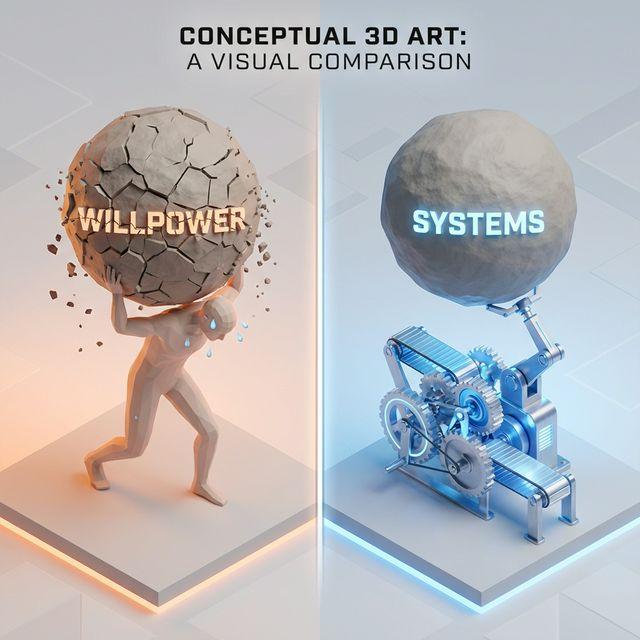
This is also why SMART pairs well with systems-based sobriety thinking: both are oriented around building the right structure rather than relying on willpower in the moment.
You Can Use Both. Or Neither.
A common misconception is that picking SMART means rejecting AA, or vice versa. Many people in long-term recovery use both. They go to AA for the community and the spiritual dimension, and they use SMART tools for the practical, in-the-moment cravings.
Other people thrive on neither. They quit using a combination of:
- A clear personal decision (often without a dramatic rock bottom)
- Self-tracking apps
- Therapy with a CBT-trained clinician
- Online communities (r/stopdrinking, sober Discord groups, Reframe, Sober Sidekick)
- Books (Annie Grace, Holly Whitaker, Allen Carr, Laura McKowen)
- Honest support from one or two trusted people in their actual life
There is no required path. The goal is not to be a member of the right program. The goal is to stop drinking and stay stopped, and the framework is just whatever scaffolding helps you do that.
A self-managed approach often benefits from a private streak counter that is not tied to a community or a label. Sober Tracker was built for exactly this kind of user: no account, no forced fellowship, no identity required, just clean data on the days you have stacked. It pairs naturally with SMART's "you are the agent" framing, and works fine alongside AA for people who want both.
A Note on the Identity Question
The biggest reason people leave AA is rarely the spirituality. It is the identity. Saying "I am an alcoholic" every week is fundamentally different from saying "I am a person who, for now, does not drink."
Both can be true. Both can be useful. But for many people, especially those who find the recovering label heavy, SMART's framing of "you are a person learning a skill" is the unlock. It removes the lifelong stamp and replaces it with a graduation timeline.
That single reframe, more than any specific tool, is what makes SMART work for the people it works for.
How to Try It
SMART Recovery is freely accessible:
- Find a meeting: smartrecovery.org has a global meeting locator (in person and online, including 24/7 online chat-based meetings)
- Read the SMART Handbook (available as a low-cost paperback or ebook), which walks through every tool in the program
- Try one CBA on paper before deciding: just write out the four quadrants for your own drinking. If that exercise alone gives you traction, the rest of the program will, too.
You do not need to commit to a path before you start. You just need to take the first concrete action, whatever it is.
The Honest Conclusion
There is no winner in the SMART vs AA comparison. There are two well-established frameworks, both free, both effective for the people who connect with them, both compatible with the basic goal of not drinking today.
The question is not which one is better. The question is which one your brain will actually keep showing up for.
If the 12-step framework speaks to you, AA is one of the most quietly miraculous community structures in modern history. If it does not, SMART Recovery is a complete, evidence-based alternative that has been refined for thirty years and is available almost everywhere AA is.
Pick the one you will keep going to. That is the only metric that matters.
Looking for a private way to track sober days regardless of which program you pick? Sober Tracker is a no-account, no-community sobriety counter that pairs cleanly with SMART, AA, or no program at all.