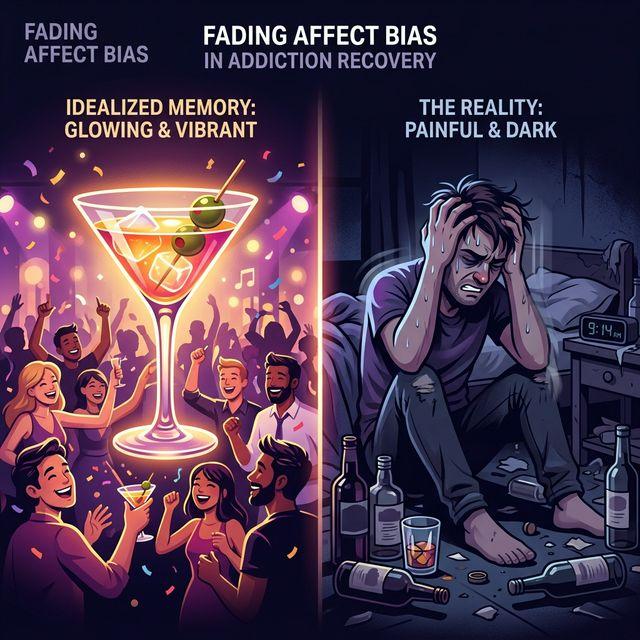
Have you ever looked back at your drinking days and only remembered the laughter, the clinking glasses, and the warm buzz of the first drink?
Meanwhile, your brain somehow manages to completely erase the crushing 3 AM anxiety, the debilitating hangovers, the arguments, and the agonizing shame of the morning after.
You aren't going crazy, and this isn't a sign that you should drink again. It is a well-documented psychological phenomenon known as Fading Affect Bias (FAB), often referred to in recovery circles as Euphoric Recall.
Understanding how FAB works is one of the most powerful tools you can develop to protect your sobriety and prevent relapse.
What is Fading Affect Bias (FAB)?
Fading Affect Bias is a psychological occurrence where the brain retains memories associated with positive emotions much longer (and more vividly) than memories associated with negative emotions.
Evolutionarily, this makes sense. If early humans vividly remembered every painful thing that happened to them, they would be paralyzed by trauma and fear. FAB acts as a psychological immune system, helping us heal from grief, move past embarrassing moments, and maintain a generally positive outlook on life.
How FAB Becomes a Trap in Sobriety
While FAB is helpful for getting over a bad breakup or a stressful day at work, it becomes incredibly dangerous when dealing with addiction.
When you quit drinking, the negative consequences are usually fresh in your mind. The pain of the last hangover or the regret of a bad decision is what likely motivated you to stop in the first place. But as weeks and months pass, Fading Affect Bias kicks in.
Your brain softens the edges of those painful memories. The hangovers don't seem that bad in retrospect. The anxiety feels distant. Suddenly, your mind starts serving up highlight reels:
- “Remember how much fun we had at that summer barbecue?”
- “Wine tasted so good with dinner.”
- “I was so much more relaxed and social back then.”
This is Euphoric Recall in action. Your brain is giving you a highly edited, heavily filtered version of the past.
If you're still choosing a tracking app, our guide to the best sobriety apps compares the top options side by side.
The Danger of Euphoric Recall
Euphoric recall is one of the leading psychological triggers for relapse. When FAB takes over, the "romance" of alcohol eclipses the reality.
You begin to entertain thoughts like:
- "Maybe I overreacted when I quit."
- "I've had a long break, I can probably moderate now."
- "It wasn't actually a problem, I just needed to cut back."
Because you can clearly picture the pleasure of drinking but cannot viscerally feel the pain of a hangover anymore, the decision to drink again seems rational. You are essentially making a choice based on false data.
4 Ways to Combat Fading Affect Bias
You cannot stop your brain from doing what it evolved to do. However, you can build mental frameworks to counteract the effects of FAB when those nostalgic cravings hit.
1. Play the Tape Forward
This is a classic recovery tool. When memory serves up a romanticized image of the first drink, force your brain to visualize the last drink—and everything that follows.
Don't stop the tape at the clinking of glasses. Play it forward to the stumbling, the slurred words, the 3 AM panic, the spinning room, and the wasted next day. Force your brain to see the entire picture, not just the trailer.
2. Keep a "Pain List"
In early sobriety, while the negative consequences are still fresh, write them down. Be brutally honest. Describe the physical pain of withdrawal, the crippling anxiety ("hangxiety"), the money wasted, the relationships strained, and the self-loathing.
When FAB starts to soften your memories months later, read this list. Re-connect with your why. Sometimes, your past self is the only one who can talk your present self out of a bad decision.
3. Acknowledge the Illusion
When you find yourself romanticizing a past drinking event, call it out. Say to yourself: "My brain is applying Fading Affect Bias right now. It's only showing me the good parts of a bad situation."
Simply labeling the cognitive distortion takes away much of its power. You realize it's a neurological trick, not a genuine desire.
4. Create New "Highlight Reels"
The best defense against romanticizing the past is building a life you enjoy in the present. As you stay sober, you will begin to accumulate clear, genuine memories that aren't tainted by chemical alteration.
Celebrate your sober milestones. Remember the mornings you woke up feeling rested, the deep conversations you actually remembered, and the pride of taking control of your life. Eventually, the reality of your sober present will outshine the illusion of your drinking past.
The Reality Check
Fading Affect Bias is proof that your brain is healing and moving on from trauma. It is doing its job.
But when it comes to alcohol, you have to be smarter than your brain's default settings. Whenever the seductive whisper of Euphoric Recall tells you that "it wasn't that bad," remind yourself why you quit.
It was that bad. You just survived it. And you never have to go back.