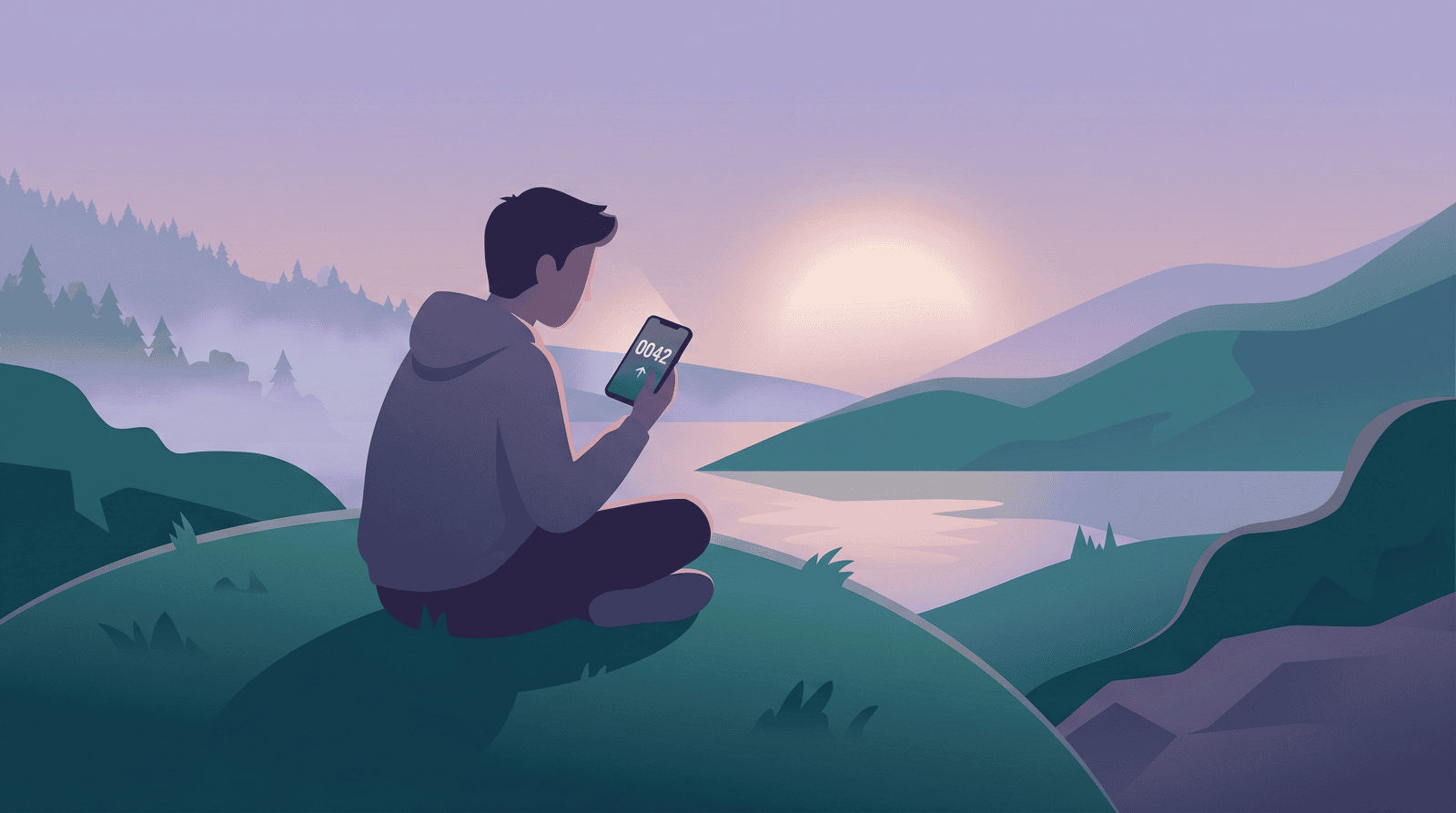
You open a sobriety app for the first time. You're feeling vulnerable, maybe a little scared. You just want to mark Day 1 and move on with your morning.
Instead, you get a community feed full of strangers' confessions, a prompt to "share your reason for quitting," and a notification that "Sarah from Ohio also started today!"
You close the app. You don't open it again.
If this sounds familiar, you're not alone. For many people in recovery, social features in sobriety apps aren't helpful. They're actively discouraging. Sober Tracker is a sobriety app built deliberately without any social features: no community feed, no daily public pledges, no account required, and no notifications about other users' progress.
Why Social Features Feel Wrong for Some People
The sobriety app market is dominated by addiction tracker apps that lean heavily into community. Daily pledges you share with others, public milestone celebrations, forums, accountability partners, group challenges. The assumption is that connection heals.
And for some people, it does. Community-based recovery has strong evidence behind it: AA, SMART Recovery, and other group programs have helped millions.
But here's what gets overlooked: not everyone recovers the same way.
Some people find social features uncomfortable because:
- They're introverts. Processing emotions publicly feels exhausting, not therapeutic.
- They're private about their recovery. Maybe their family doesn't know. Maybe their employer doesn't know. Maybe they just don't want to explain themselves to strangers on the internet.
- Social comparison is toxic for them. Seeing someone at Day 365 when you're at Day 3 can feel motivating to some and crushing to others.
- They've had bad experiences. Unsolicited advice, judgment, or triggering content in community feeds can do real harm.
- They just want a tool, not a support group. A wrench doesn't need a social network. Neither does a sobriety counter.
Research backs this up. A 2021 study in the Journal of Behavioral Addictions found that people with high social anxiety had significantly lower engagement with community-based recovery apps, and that forced social interaction could increase dropout rates.
The Introvert's Recovery Dilemma
If you search "best sobriety app" right now, almost every recommendation will push community features as a selling point. "Connect with thousands!" "Share your journey!" "You're not alone!"
For introverted or privacy-conscious people, this creates a frustrating dilemma:
- The best-rated apps are socially focused (I Am Sober, Sober Time, Loosid)
- The simple counters with no social features often lack other useful tools (health timelines, financial tracking, journaling)
- There's a gap in the middle: apps that are feature-rich but completely solo
Finding an app that offers real functionality without the social pressure shouldn't be this hard. But it is, because the industry assumes everyone wants community.
What "No Social" Actually Means
Let's define what we mean by "no social features" because it's a spectrum:
Fully Social Apps
- Community feeds, public profiles, daily pledges shared with others, accountability partners, group challenges, comments and likes
- Examples: I Am Sober, Loosid
Social-Optional Apps
- Social features exist but can be turned off or ignored. The core experience works without them.
- Examples: Nomo (accountability partner is optional), Sober Time (forum is separate from tracking)
Fully Solo Apps
- No accounts, no profiles, no community, no sharing. The app is a personal tool and nothing else.
- Examples: Sober Tracker, EasyQuit, simple counter apps
If you hate social features, you want the third category. But within that category, quality varies enormously.
Solo Sobriety Apps Ranked
Here's how the major solo-friendly apps compare:
Sober Tracker
Social level: Zero. No accounts, no community, no sharing.
Sober Tracker was designed from the ground up as a private, solo experience. There is no way to create a profile, connect with other users, or share your progress within the app.
What you get instead:
- Streak tracking with precise day counting
- 30+ achievement badges and a virtual recovery garden
- Health benefit timeline showing your body's recovery
- Financial savings calculator
- Private journal (stored only on your device)
- Coping toolkit for difficult moments
- Home screen widgets
Available on iOS and Android. Free with optional premium.
EasyQuit Drinking
Social level: Zero. No accounts, no community.
A straightforward tracker focused on health milestones and money saved. Clean interface, no bloat.
What you get:
- Sobriety counter
- Health achievement timeline
- Money saved tracker
- Motivational quotes
- Widgets
Pros: Very simple, loads fast Cons: Fewer features than Sober Tracker, no journal, no coping tools, limited achievement system
Sobriety Counter
Social level: Zero. Basic counter app.
The most minimal option. It counts days. That's about it.
What you get:
- Day counter
- Basic milestone markers
- Multiple addiction tracking
Pros: Dead simple, lightweight Cons: No health timeline, no financial tracking, no journal, no achievements, limited motivation features
Nomo (Social-Optional)
Social level: Low. Has an accountability partner feature, but it's optional.
Nomo sits in the middle ground. Its core experience is solo (your clocks, your tracking), but it has an optional feature where you can share a clock with a trusted person.
What you get:
- Multiple sobriety clocks
- Optional accountability partner
- Emergency call button
- Relapse tracking with pattern analysis
- AA-inspired chip system
Pros: Accountability partner is genuinely useful if you want one specific person involved (not a crowd) Cons: Some features behind paywall, interface feels dated
When Solo Tracking Is the Better Choice
Solo tracking isn't just "fine for introverts." For certain situations, it's actually the superior approach:
Early Recovery (Days 1-30)
In the first month, you're emotionally raw. Community feeds can be overwhelming, triggering, or discouraging when you see others who are much further along. A quiet counter that just says "Day 7, you're doing great" is often more helpful than a feed full of strangers.
Professional Risk
If your career could be affected by people knowing about your recovery (certain industries, public-facing roles, security clearances), having your sobriety data on a cloud server attached to your email is a genuine risk. Solo, on-device tracking eliminates this entirely.
Relationship Sensitivity
If your partner, family, or roommates don't know about your drinking history, you need an app that doesn't send notifications saying "Congratulations on Day 14!" or display social feeds when someone glances at your screen.
Personality Type
If you've tried community-based recovery and felt worse (more anxious, more ashamed, more overwhelmed), that's valid feedback. Not every personality type benefits from group support. Some people process better alone: through journaling, walking, thinking, or just quietly watching a counter go up.
Relapse Recovery
After a relapse, the last thing many people want is to feel publicly judged. Resetting a private counter feels like a fresh start. Resetting a social counter feels like a public failure.
Building Your Solo Support System
Choosing a solo app doesn't mean you're completely alone. It means your app isn't your support system. Here are ways to get support without it living in your sobriety tracker:
- A therapist or counselor who specializes in addiction (separate from your daily tracking)
- One trusted friend or family member who knows what you're going through
- Anonymous online spaces like Reddit's r/stopdrinking where you control what you share and can use a throwaway account
- Books and podcasts on recovery (zero social pressure, all the knowledge)
- Your doctor for medical aspects of recovery
The point is to separate your tracking tool from your support network. Your app counts the days. Your people support you. These don't need to be the same thing.
The Right Tool for the Right Person
There's nothing wrong with social sobriety apps. I Am Sober has helped millions of people, and community-based recovery saves lives every day.
But there's also nothing wrong with wanting a quiet, private, solo tool. Recovery isn't one-size-fits-all, and your app shouldn't be either.
If you've been putting off tracking your sobriety because every app feels too social, too public, or too noisy, try one that stays silent. Open it, set your date, and let it count. No fanfare. No feed. No strangers.
Just you and your progress.