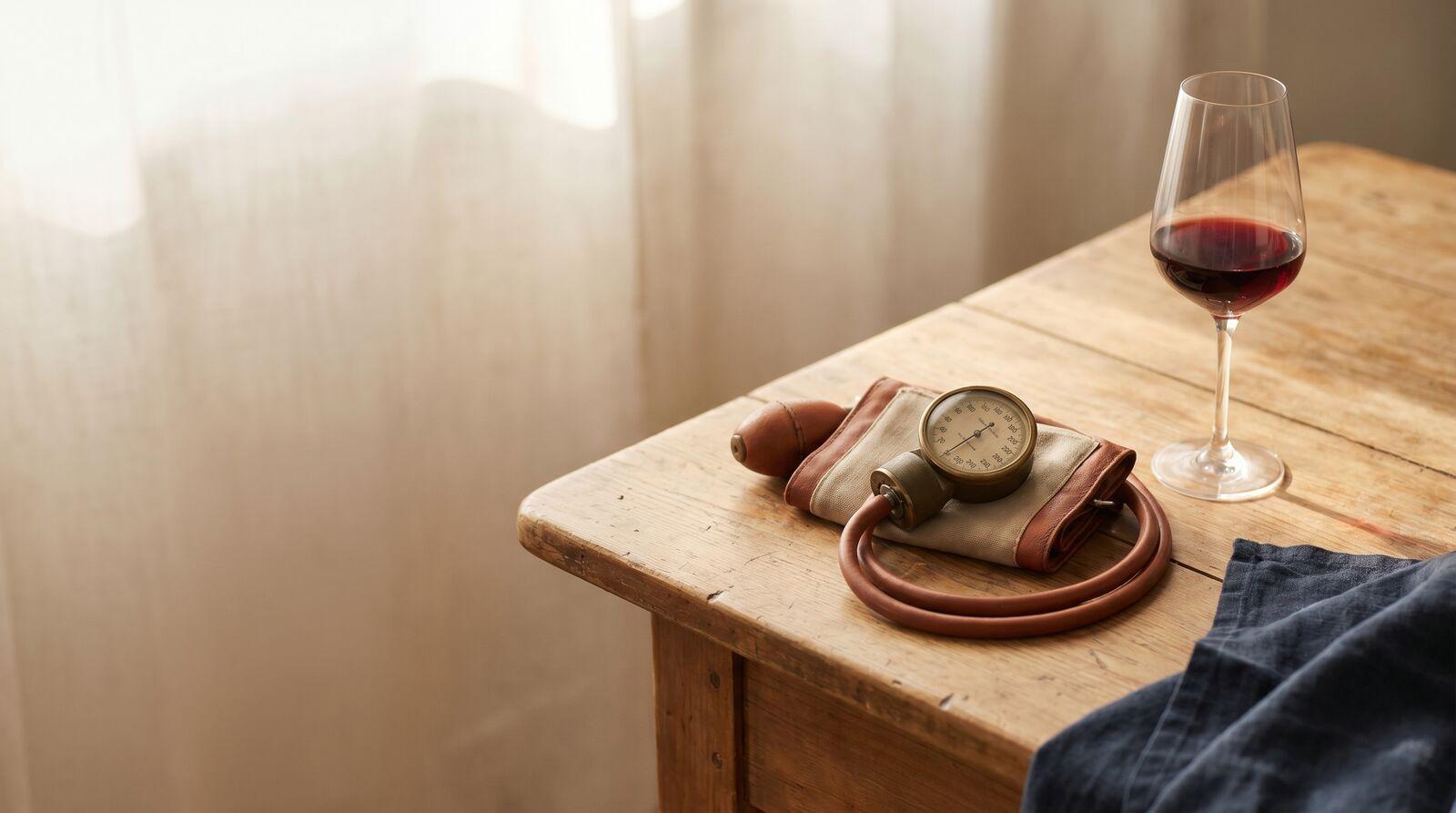
It usually starts at a routine physical. The cuff inflates, the nurse glances at the screen, and her eyebrows do the small thing they do when a number lands above where it should. "Let's take it again in a few minutes." The second reading is a touch better but still not great. The doctor mentions cutting back on salt, getting more exercise, maybe checking it again in three months.
What rarely comes up in those three minutes is the four glasses of wine on Friday and Saturday. Or the two beers most weeknights. Or the three cocktails at the work dinner two days ago.
Alcohol is one of the most reliable, dose-dependent drivers of high blood pressure in the entire scientific literature. It does not need to be heavy drinking. It does not need to be daily drinking. The effect shows up in cohort studies, randomized trials, and Mendelian randomization analyses with a consistency that very few lifestyle factors match. And it is one of the easiest hypertension levers to actually move.
Here is what alcohol does to blood pressure, why the rise is harder to spot than people expect, and what the recovery timeline actually looks like.
The Three Pressure Mechanisms
Blood pressure rises under alcohol through three separate systems acting at the same time. None of them require the dramatic drinking patterns most people picture when they hear the word "alcohol."
Sympathetic nervous system activation. Alcohol is a powerful trigger for the body's "fight or flight" branch. It raises heart rate, constricts certain blood vessels, and pushes the heart to pump harder. The activation begins within an hour of the first drink, peaks during the night, and lingers into the next morning as the body metabolizes the alcohol out. This is the same reason your resting heart rate is elevated for hours after a few drinks: the autonomic system is stuck in the wrong gear.
Cortisol and the HPA axis. Alcohol is a stressor at the chemical level, even when it feels relaxing in the moment. It activates the hypothalamic-pituitary-adrenal axis and raises cortisol, particularly during the rebound phase as blood alcohol falls. Cortisol increases sodium retention, sensitizes blood vessels to other pressure-raising signals, and contributes to the well-documented 4 a.m. wake-up that drinkers know intimately. The morning-after blood pressure reading is often higher than the evening-of reading for exactly this reason.
Endothelial dysfunction. The endothelium is the single-cell lining of every blood vessel in the body. It produces nitric oxide, the molecule responsible for keeping vessels relaxed and pliable. Regular alcohol exposure progressively impairs endothelial nitric oxide production. Blood vessels lose flexibility, stiffen, and resist the normal moment-to-moment relaxation that keeps pressure in a healthy range. This effect is cumulative, builds over years, and is the reason the blood pressure drift in regular drinkers tends to be permanent until they stop.
The three mechanisms stack. A person who drinks four nights a week is getting acute sympathetic activation, cortisol surges, and slow vascular stiffening at the same time. The result is a steady upward creep on every reading, often invisible to the drinker because nothing about it feels different.
Not sure which app to use? We compared the top sobriety apps to make choosing easier.
The Dose-Response Reality
A landmark meta-analysis published in the American Heart Association journal Hypertension confirmed that there is no threshold below which alcohol stops raising blood pressure: systolic pressure climbs in a near-linear fashion from the very first daily drink.
The cleanest summary from the modern literature:
- One standard drink per day raises systolic blood pressure by roughly 1 mmHg on average.
- Two drinks per day raise it by about 4 to 5 mmHg.
- Three or more drinks per day push the rise into the 7 to 10 mmHg range, sometimes higher in older adults.
- For people with a genetic predisposition to alcohol-flush response, the effect is meaningfully larger at every dose.
Those numbers sound modest. They are not. A 5 mmHg rise in systolic pressure, sustained over a decade, increases stroke risk by roughly 30 to 40 percent and heart attack risk by about 20 percent in actuarial models. A 10 mmHg rise roughly doubles long-term cardiovascular event risk. This is the kind of math that turns a "borderline high" reading at age 45 into a stent at 62.
For people already on hypertension medication, alcohol blunts the effect of most antihypertensives. The medication still works; it just has to fight against an active counter-pressure that resets every drinking night. Many people find their blood pressure mysteriously refuses to come fully into target range despite climbing doses, until they reduce or eliminate alcohol and the numbers finally settle.
Masked Hypertension: The Reading That Matters
The blood pressure reading at the doctor's office is often not the highest one a drinker is producing. The pattern that matters most for cardiovascular risk is what happens during sleep, in the early morning hours, and on the days right after drinking.
Ambulatory blood pressure monitoring (a 24-hour cuff that reads automatically every 20 to 30 minutes) often reveals "masked hypertension" in regular drinkers: normal-looking office readings paired with sustained elevated readings overnight and on weekend mornings. The damage to blood vessels and end organs scales with the time-averaged pressure, not the snapshot at the clinic. So the person with a "fine" 128 over 82 in the office may actually be running 145 over 95 from 2 to 6 a.m. after drinking nights, and quietly accumulating cardiovascular risk on a schedule no one is measuring.
This is also why home monitoring has become one of the highest-leverage tools for anyone questioning their drinking. A cheap arm cuff and a habit of taking readings at the same times each day, including the morning after drinking, often surfaces a pattern that years of office visits never caught. The data tends to be persuasive in a way no doctor's lecture is.
The Stroke Math
Stroke is the cardiovascular outcome where alcohol's blood pressure effect is most clearly visible. Two large mechanisms drive the link.
Hemorrhagic stroke (a vessel ruptures) is closely tied to peak blood pressure surges, especially during heavy drinking episodes. The risk rises sharply at four or more drinks in a single sitting, and meaningfully at the level of regular weekend binges that many people don't think of as heavy.
Ischemic stroke (a clot blocks a vessel) is tied to long-term sustained hypertension, atrial fibrillation (which alcohol independently raises the risk of), and accelerated arterial stiffening. This is the slow path: years of slightly elevated readings, gradual vascular changes, and a clot that finally lands somewhere it shouldn't.
In Mendelian randomization analyses (which use genetic variants to mimic randomized trials and remove most observational confounding), the link between alcohol intake and stroke risk is dose-dependent and shows no protective effect at any dose. The old "moderate drinking is heart-protective" framing has been steadily dismantled over the past decade, and stroke risk is the cleanest place where the new picture lands. Even one drink a day measurably raises stroke risk in people over 50.
For a fuller picture of how alcohol reshapes the cardiovascular system beyond just blood pressure, the heart health and cardiovascular recovery post covers atrial fibrillation, cardiomyopathy, and cholesterol changes in more detail. They are sister problems to hypertension and tend to recover on overlapping timelines.
The Recovery Timeline
The encouraging part of this picture is that blood pressure responds to abstinence faster and more completely than almost any other alcohol-related health marker. The vascular system is highly plastic, and the underlying mechanisms (sympathetic tone, cortisol, endothelial function) all reset on relatively short timescales.
Within the first week, the acute drivers fade. Sympathetic overdrive ramps down. Cortisol returns to a normal diurnal pattern. The morning-after blood pressure spike disappears once there are no drinking nights to recover from. Many people see a 3 to 5 mmHg drop in average readings in the first 7 to 10 days, especially if they were drinking 2+ drinks most nights. The first measurable change is usually a lower morning reading, even before the daytime numbers move.
Within four to eight weeks, the cumulative effect adds up. Endothelial function improves, sleep architecture stabilizes (which independently lowers nighttime blood pressure), and the average 24-hour pressure tends to fall by 5 to 8 mmHg in moderate drinkers and 10 to 15 mmHg in heavier drinkers. This is the window where many people who were on the edge of needing medication find their numbers move back into the normal range and stay there. People already on medication often need their dose reduced.
Within three to six months, the slower vascular changes catch up. Arterial stiffness measurably improves on pulse wave velocity testing. Resting heart rate drops by 5 to 10 beats per minute on average. Heart rate variability rises. The morning-after spike, which is one of the most damaging cardiovascular patterns alcohol creates, is fully gone by this point in anyone who has stopped drinking.
Beyond six months, the trajectory shifts from reversal to preservation. Blood pressure stops drifting up at the alcohol-driven rate and starts behaving like a normal age-related curve. Over a decade, this difference is large. Two people with otherwise identical genetics and lifestyles, where one keeps drinking moderately and one stops, will often have a 10 to 15 mmHg gap in average pressure by their late 60s. That gap is most of the cardiovascular risk difference between them.
For people who notice the morning-after stress feeling, fast resting heart rate, and 4 a.m. wake-ups, the same physiology is at work behind the burnout-feeling that alcohol creates. Cortisol and sympathetic tone are the shared pathway, and they recover together once the drinking stops.
What Helps Recovery Beyond Just Stopping
Quitting is the single largest lever. After that, the standard hypertension toolkit works exceptionally well in newly sober people, often better than it did during drinking years.
Sleep, prioritized. Blood pressure is supposed to dip 10 to 20 percent during sleep. Alcohol blocks that dip. Once sleep architecture restores, that nightly dip returns and pulls average 24-hour pressure down. Protect sleep aggressively in the first months: consistent schedule, dark room, no caffeine after lunch.
Aerobic exercise. The most effective non-pharmacologic blood pressure intervention in the literature, with a typical effect of 5 to 8 mmHg systolic from regular moderate aerobic training. It stacks cleanly with sobriety. The combination tends to outperform either alone by a wide margin.
Sodium awareness. Cutting added salt is meaningful but usually less powerful than people assume. The alcohol effect is typically 2 to 3 times larger than the sodium effect in most modern diets. Both are worth doing; alcohol comes first.
Potassium and magnesium. Whole-food sources (leafy greens, beans, fruit, nuts) lower pressure modestly and are reliably depleted in people who have been drinking heavily. A standard B-complex with magnesium is a reasonable adjunct in early sobriety.
Home monitoring. A cheap arm cuff used twice a week at consistent times provides the feedback loop that turns sobriety into a measurable cardiovascular intervention. The numbers reinforce the behavior in a way that is difficult to argue with.
A Note on "Moderate" Drinking and Pressure
The most common question in this space is whether one or two drinks a day is fine for blood pressure. The honest read of current evidence is: probably not, and the effect is bigger than people expect. The dose-response curve runs continuously from the first drink, the effect is amplified in older adults and people with any genetic flush response, and the long-term cardiovascular math is unfavorable even at modest doses.
For people with a family history of hypertension, stroke, or early cardiovascular disease, the calculus tilts further. The same family history that flags people for tighter sodium and weight management generally flags them for tighter alcohol limits, and the ratio of risk-to-pleasure starts to look bad surprisingly fast. The moderation framing gets a sharper look in the hidden cost of "just one drink" post, which walks through how the modern evidence has shifted.
This is not a moral claim. It is a pattern in the data, and a pattern most people can act on cheaply.
The Honest Bottom Line
Hypertension is one of the most consequential conditions in modern medicine and one of the most controllable. Alcohol is one of the largest controllable contributors. The drift is invisible because it does not feel like anything, the morning-after readings are rarely the ones that get measured, and the cumulative effect over decades is enormous.
The encouraging part is that the recovery curve is fast. A week of no drinking moves the morning numbers. A month of no drinking moves the daytime average. Three months of no drinking changes the underlying vascular biology in measurable ways. Six months of no drinking sets a different trajectory for the next twenty years.
If you have been told your blood pressure is "borderline" or "a little high," and you drink most weeks, the highest-leverage experiment available to you is also the cheapest. Stop drinking. Take readings at the same times each day. Watch the numbers for two months. The vascular system will tell you what it has been trying to say all along.
This is one of the reasons many people who quit drinking for cardiovascular reasons end up tracking alcohol-free days alongside their morning blood pressure readings. The two numbers tend to move together, and the visual pairing is one of the most persuasive feedback loops the body can offer.
Curious what your blood pressure looks like after a meaningful break from alcohol? Sober Tracker is a private, no-account streak counter built for exactly this kind of long-game experiment. Pair it with a daily morning reading on a home cuff, and check back in eight weeks.
This article is educational and not a substitute for medical advice. Do not stop or adjust hypertension medication without speaking to your clinician. Sudden withdrawal from heavy long-term drinking can be dangerous and should be medically supervised.