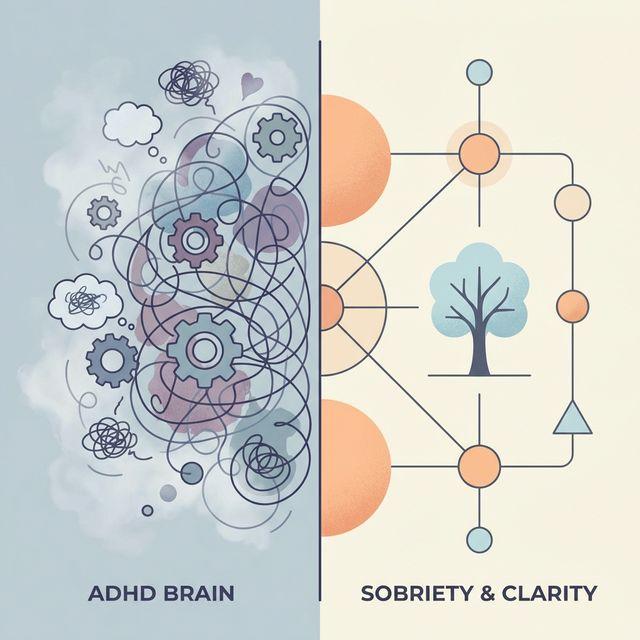
It starts innocently enough. You've had a day where your brain felt like a browser with 30 tabs open, half of them frozen, the other half playing music you can't find. You are exhausted, not from physical labor, but from the sheer effort of trying to focus, regulate your emotions, and "act normal."
You have a drink. And suddenly... silence.
The tabs close. The music stops. The static in your head clears. For 20 minutes, you feel "normal."
If this sounds familiar, you aren't alone. The link between ADHD (Attention Deficit Hyperactivity Disorder) and problem drinking is real and often misunderstood: a meta-analysis of 29 studies found that almost one in four people in treatment for substance use disorders meets criteria for ADHD. For many neurodivergent adults, alcohol isn't just about partying. It can be about symptom management.
But treating ADHD with alcohol is like trying to put out a fire with gasoline. It seems to work for a moment, and then the flare-up comes.
The Dopamine Connection: Why the ADHD Brain Loves Alcohol
To understand the link, you have to understand the chemistry. ADHD is fundamentally a disorder of regulation, and two neurotransmitters keep coming up in the research: dopamine and norepinephrine, which are involved in focus, motivation, and reward.
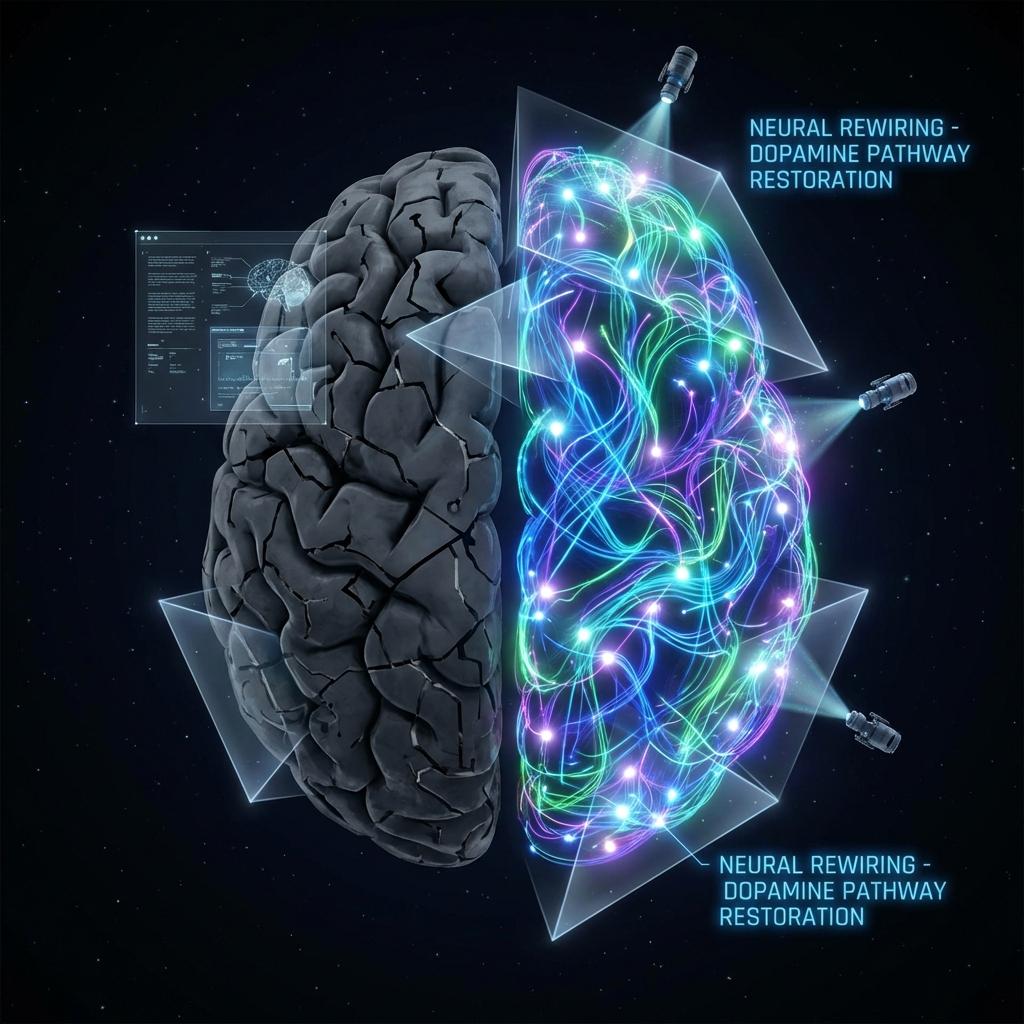
One leading theory is that the ADHD brain runs on a weaker dopamine reward signal. A PET imaging study in JAMA found lower dopamine receptor and transporter availability in the reward pathway of adults with ADHD than in controls, and the lower the receptor levels, the worse the attention symptoms. That fits the lived experience of constantly hunting for stimulation.
Alcohol promotes dopamine release in the brain's reward center, the nucleus accumbens. For a brain like that, the first drink may not just feel "good." It can feel like relief, like the engine has finally stopped sputtering and is running smoothly.
This may be part of why "one drink" is rarely enough. When that lift fades, the pull to chase it again is strong, and impulsivity, a core ADHD trait, makes stopping at one harder.
A free sobriety tracker app makes progress like this much easier to see, and our comparison guide breaks down which ones do it best.
The Myth of "Quieting the Noise"
Many people with undiagnosed or unmanaged ADHD use alcohol as a sedative.
- Racing thoughts? Alcohol slows them down.
- Social anxiety/overwhelm? Alcohol lowers inhibitions.
- Restlessness? Alcohol physically sedates the body.
It works... until it doesn't.
The problem is that alcohol is a depressant that triggers a rebound effect. The brain adapts to alcohol's calming effect, so as it wears off, NIAAA describes a kind of mini-withdrawal in which people can feel more restless and anxious than before they drank.
For someone with ADHD, who may already struggle with emotional regulation and anxiety, this rebound can hit hard. "Hangxiety" (hangover anxiety) can turn into a day of paralysis, shame, and an inability to function, which often leads to craving another drink to make the feeling stop.
The Executive Function Hangover
ADHD affects executive functions: planning, prioritizing, initiating tasks, and emotional control.
Alcohol temporarily impairs executive function. Even during a hangover, attention and decision-making can be impaired.
When you are hungover or even just "foggy" from drinking the night before, executive functions that were already a struggle get worse.
- The simple email takes 45 minutes.
- The messy room feels impossible to tackle.
- Emotional rejection sensitivity skyrockets.
You aren't just tired; you are running on impaired hardware. The alcohol you drank to manage the overwhelm has now made you significantly less capable of handling life, creating more overwhelm, which triggers the desire for more relief.
It is a perfect, vicious loop.
Breaking the Cycle: Dopamine-Friendly Alternatives
Recovery for people with ADHD isn't just about "willpower." It's about finding sustainable ways to get the stimulation and regulation your brain needs without destroying your health.
1. High-Intensity Exercise
For many people, heavy physical exertion is the closest healthy match to the "quieting" effect of alcohol. Running, lifting weights, or HIIT workouts burn off restlessness and leave a calmer, clearer head afterward.
2. Cold Exposure
It sounds miserable, but cold water is a strong stimulant. In one small study of young men, an hour of immersion in 14°C water raised blood dopamine by about 250% and noradrenaline by about 530%. That was blood, not brain, and a far longer plunge than a cold shower, but many people find even a short blast of cold a sharp, immediate "reset" for a chaotic brain.
3. Gamify Your Life
ADHD brains respond to immediate rewards. Use apps that turn habit-building into a game. The Sober Tracker app is designed with this in mind: visual streaks, money saved, and clear milestones give you the "ding" of satisfaction your brain craves.
4. Manage Your Physiology
A common trigger for drinking is physical dysregulation: heart rate spikes and shallow breathing that feel like panic. The Anxiety Pulse app helps you measure your heart rate and stress levels using just your phone camera. Seeing your physiological state can help you distinguish between "I need a drink" and "I need to breathe/rest," giving you data to regain control before you spiral.
The Superpower of Sober ADHD
Here is the good news: when you remove alcohol, you take a confounder out of your treatment. If you take ADHD medication, you also stop mixing it with alcohol, which NIAAA lists as a harmful combination (drowsiness and impaired concentration with methylphenidate, possible heart problems with amphetamines, liver damage with atomoxetine). Your sleep has a chance to recover. Your emotional baseline can stabilize.
But more than that, you stop playing life on "Hard Mode."
Many people find that their "unmanageable" ADHD symptoms become surprisingly manageable once the cycle of drink-hangover-anxiety is broken. You might find that the creativity, hyperfocus, and energy you thought you needed alcohol to tame are actually your greatest assets when clarity returns.
You don't need to numb your brain to live in it. You just need to learn how to drive it.
Sources
- Prevalence of attention-deficit hyperactivity disorder in substance use disorder patients: a meta-analysis and meta-regression analysis, Drug and Alcohol Dependence, 2012
- Evaluating dopamine reward pathway in ADHD: clinical implications, JAMA, 2009
- Alcohol promotes dopamine release in the human nucleus accumbens, Synapse, 2003
- Hangovers, NIAAA
- Human physiological responses to immersion into water of different temperatures, European Journal of Applied Physiology, 2000
- Harmful Interactions: Mixing Alcohol with Medicines, NIAAA
Ready to see what your brain can do without the fog? Download Sober Tracker to start your streak, and check out Anxiety Pulse to master your stress response.
Edited by Ivan Terekhin, drafted with AI tools, not medically reviewed.