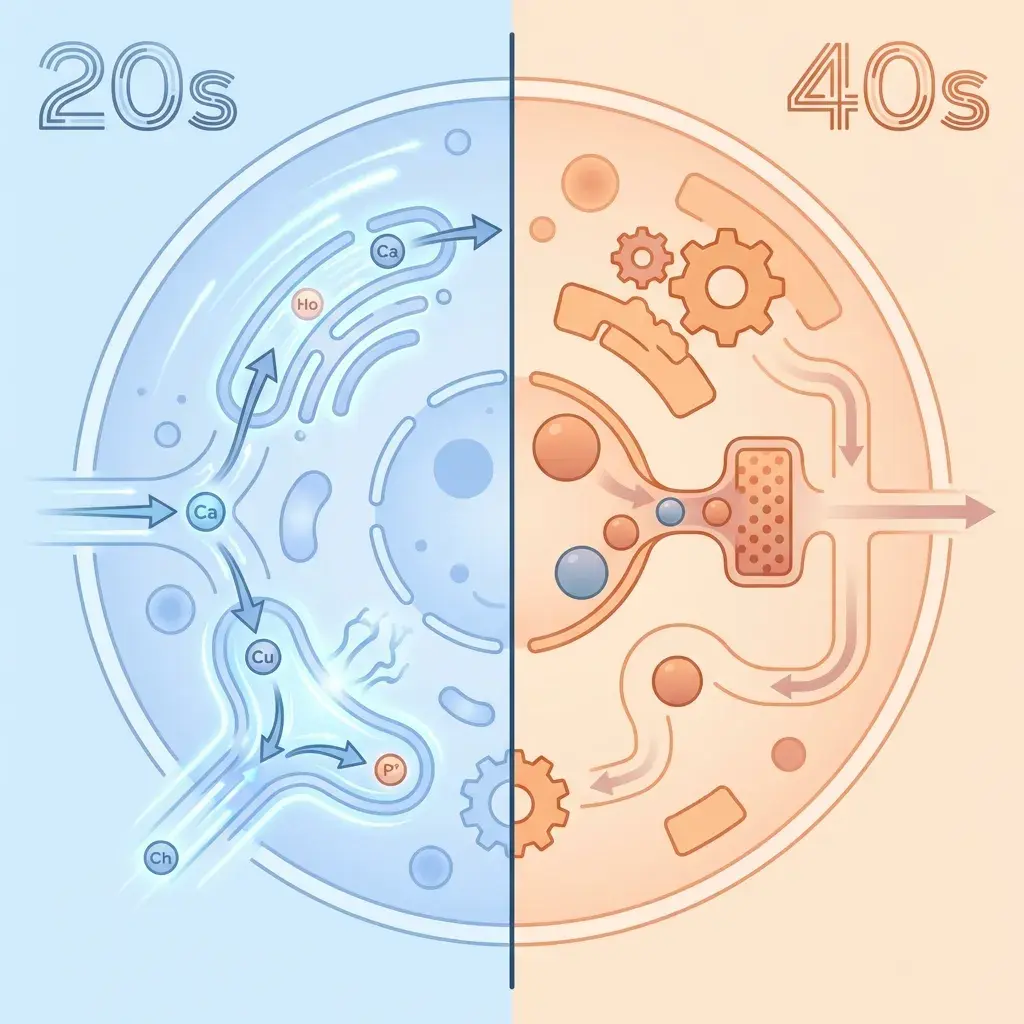
Remember when you could rally?
That magical window in your early 20s when a night of heavy drinking was followed by a greasy breakfast, a Gatorade, and a fully functional day. You felt invincible.
Now, you have two glasses of wine at dinner, and the next morning feels like you’ve been hit by a truck. The brain fog lasts for two days. The anxiety ("hangxiety") is crippling.
You are not imagining it. And no, you just need to "drink more water" or "stick to clear liquor."
There is a profound biological shift happening inside you. Your body is losing the tools it once used to process alcohol, while simultaneously becoming more sensitive to its toxic effects.
Here is the science your body wants you to know.
1. The Enzyme Gap (Your Liver is Slowing Down)
When you drink alcohol (ethanol), your liver has to break it down into something safe. It’s a two-step process:
- ADH (Alcohol Dehydrogenase) turns Ethanol into Acetaldehyde.
- ALDH (Aldehyde Dehydrogenase) turns Acetaldehyde into Acetate (which is harmless).
Here is the problem: Acetaldehyde is a poison. It is up to 30 times more toxic than alcohol itself. It causes the nausea, the headache, the racing heart, and the inflammation.
When you were 21, your enzymes worked like a high-speed assembly line. ADH and ALDH were perfectly synced.
As you age, that assembly line breaks down. Specifically, your body often gets better at step 1 (making the poison) but worse at step 2 (clearing the poison). This means Acetaldehyde floats around in your bloodstream for much longer, wreaking havoc on your cells.
You aren't just "hungover." You are experiencing prolonged poisoning.
Not sure which app to use? We compared the top sobriety apps to make choosing easier.
2. You Are Literally Drying Up
We tend to think of our bodies as solid, but we are mostly water.
- Infants: ~75% water
- Young Adults: ~60% water
- Adults (40+): ~50% water
As we age, our total body water percentage drops.
Why does this matter for hangovers? Dilution.
If a 20-year-old and a 40-year-old drink the exact same amount of alcohol, the 40-year-old will have a higher Blood Alcohol Concentration (BAC) simply because they have less water in their system to dilute it.
It’s the difference between putting a drop of dye in a swimming pool versus a bathtub. The concentration is higher, the effects are stronger, and the dehydration hits harder.
3. Your Liver is Busy With Other Things
In your 20s, your liver was likely a lean, mean, detoxifying machine.
By your 30s and 40s, life has happened. Perhaps your diet hasn't been perfect. Maybe you’ve gained a little weight. Maybe you’ve taken medication.
As we age, our liver function naturally declines or becomes "distracted" by processing other things, like excess adipose tissue (fat). If your liver is already working overtime to manage your metabolism, alcohol moves to the back of the queue.
This "recovery lag" means the alcohol stays in your system longer, delaying the start of the healing process.
4. The "Hangxiety" Explosion
This is the one that catches most people off guard. "I can handle the headache," they say, "but the anxiety is unbearable."
Alcohol suppresses glutamate (an excitatory neurotransmitter) and boosts GABA (a calming one). That’s why you feel relaxed when you drink.
But your brain loves balance. To counteract the alcohol, your brain goes into hyper-drive, dumping out massive amounts of glutamate and adrenaline. When the alcohol wears off, you are left with a brain that is racing, anxious, and jittery.
As we age, our brain’s "neuroplasticity" (its ability to bounce back) slows down. That chemical imbalance—the "hangxiety"—doesn't just last for a few hours. It can last for days.
5. Your Sleep Quality Has Changed
Alcohol has always ruined sleep quality (it blocks REM sleep), but when you were younger, you could sleep through a marching band.
As you age, your natural sleep architecture becomes more fragile. You have less deep sleep and more awakenings. Throw alcohol into the mix, and you aren't just getting poor sleep; you are getting fragmented, non-restorative sleep.
You wake up feeling exhausted not just because of the toxicity, but because you haven't technically slept.
The Takeaway
If you are reading this and nodding along, please know: This is not a failure of will. You cannot "train" your way out of this biology.
This is your body setting a new boundary.
Many people find that once they understand the science, the decision becomes easier. It’s not about "giving up" fun. It’s about realizing that the math no longer works in your favor. The cost—days of anxiety, brain fog, and fatigue—is simply too high for a few hours of buzz.
If you’re curious about what life feels like without this dragged-out recovery, try taking a break. You might be surprised to find that the energy you had in your 20s isn't gone—it was just buried under the recovery time.