Have you noticed that your "hangovers" don't feel like they used to?
Maybe in your 20s, you could drink heavily, wake up with a headache, chug some water, and be fine by noon. But now, even a single night of drinking leaves you with anxiety that lasts for days, tremors, insomnia, or a sense of impending doom.
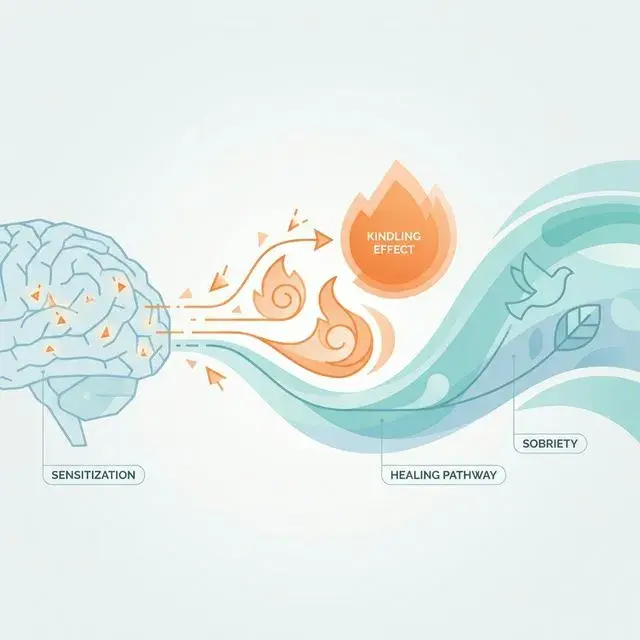
You might blame it on age. But if you have a history of stopping and starting drinking—going through periods of sobriety followed by relapse—you might be experiencing a neurological phenomenon known as the Kindling Effect.
It’s one of the most critical concepts to understand in recovery because it explains why "just one drink" can be so dangerous for a brain that has been sensitized to alcohol withdrawal.
What Is the Kindling Effect?
The term "kindling" comes from the analogy of building a fire. It’s hard to light a large log with a single match. But if you use small twigs and dry leaves (kindling), the fire catches easily.
In neurology, Kindling refers to the process where repeated withdrawals from a substance sensitize the brain, making each subsequent withdrawal episode more severe than the last.
Think of it this way:
- First Withdrawal: You might feel irritable and struggle to sleep.
- Fifth Withdrawal: You experience intense anxiety ("Hangxiety"), sweating, and nausea.
- Tenth Withdrawal: You are at risk for severe tremors, hallucinations, or even seizures.
This progression happens even if the amount of alcohol you drank hasn't increased. The change isn't in the bottle; it's in your brain.
A free sobriety tracker app makes progress like this much easier to see, and our comparison guide breaks down which ones do it best.
The Neuroscience: GABA vs. Glutamate
To understand Kindling, we need to look at the brain's delicate chemical balance. Your brain operates with two main systems:
- GABA (The Brakes): An inhibitory neurotransmitter that calms the brain and reduces activity. Alcohol mimics GABA, which is why drinking makes you feel relaxed and sedated.
- Glutamate (The Gas): An excitatory neurotransmitter that revs up brain activity.
The Seesaw Effect
When you drink chronically, your brain tries to maintain balance (homeostasis). Since alcohol is constantly pressing down on the "brakes" (GABA), the brain compensates by releasing more "gas" (Glutamate) just to keep you functioning.
When you stop drinking: The alcohol (the brakes) is suddenly gone. But your brain is still flooding the engine with Glutamate (the gas).
The result? Over-excitation. This "glutamate storm" causes the symptoms of withdrawal: anxiety, shakes, racing heart, and insomnia.
How Kindling Worsens the Storm
With every cycle of detox and relapse, this system becomes hypersensitive. The brain "learns" to anticipate the withdrawal and reacts more aggressively. It overcompensates faster and harder.
Eventually, the threshold for a withdrawal reaction drops so low that even a small amount of alcohol—a single night of drinking—can trigger a disproportionately severe withdrawal response. This is why many people find they can no longer "get away with" even moderate drinking without paying a heavy psychological and physical price.
The Danger of "Hair of the Dog"
This is where the cycle becomes a trap.
When you're experiencing this glutamate storm—anxious, shaking, terrified—your brain knows exactly what will fix it: more alcohol. A drink will re-apply the brakes (GABA), calming the storm instantly.
This is the logic behind "hair of the dog." And while it works temporarily, it is disastrous in the long run. By drinking to relieve withdrawal, you are reinforcing the cycle. You are essentially priming the Kindling effect for the next time the alcohol wears off.
Each time you rescue yourself with a drink, you are adding more fuel to the next fire.
Signs You Might Be Experiencing Kindling
How do you know if this is happening to you? Look for these patterns:
- Intensifying Hangovers: Your recovery time after drinking is getting longer and more painful, disproportionate to the amount consumed.
- The "Fear": Waking up with intense, inexplicable anxiety that feels chemical rather than situational.
- Physical Twitching: Noticing slight tremors in your hands or "brain zaps" as you try to fall asleep.
- Insomnia: Being unable to sleep for multiple nights after stopping heavy drinking.
- Sensitivity: Feeling like one or two drinks affect you much more unpredictably than they used to.
Breaking the Cycle
The concept of Kindling can be terrifying, but understanding it is also empowering. It explains why it's so hard, and it points the way to the only real solution: Complete and sustained abstinence.
1. Medical Safety First
If you suspect you are experiencing Kindling, do not attempt to cold turkey alone if you have been drinking heavily. Severe Kindling increases the risk of withdrawal seizures, which can be fatal. Consult a medical professional for a safe detox plan.
2. Stop the Seesaw
The only way to heal the Kindling effect is to stop the swinging back and forth. You need to get off the seesaw. Sustained sobriety allows your brain to slowly downregulate the glutamate production and restore natural GABA sensitivity.
3. Neuroplasticity is Real
The brain is resilient. While Kindling sensitizes the brain to withdrawal, long-term abstinence allows the brain to heal. The "glutamate storm" subsides. Neural pathways rebuild. You can regain your calm, your sleep, and your peace of mind—but it requires time away from the substance that is causing the fire.
4. Nutrition and Repair
Support your nervous system during this healing phase.
- Hydration: Essential for flushing toxins.
- B-Vitamins (Thiamine): Alcohol depletes these, and they are crucial for brain health.
- Magnesium: mild natural relaxant that can help with the over-excitation of the nervous system.
The Takeaway
If every relapse feels harder, it's not because you are "weak." It's because your brain has effectively been wired to react that way.
The Kindling Effect is your body's loud warning system shouting, "I can no longer handle this toggle switch." Listen to it. The path to relief isn't in the next drink that temporarily numbs the pain—it’s in the sustained sobriety that finally puts out the fire.