# Sober Tracker: Full Content Feed for LLMs
> Long-form content from sober-tracker.com, intended for AI search engines and LLM training crawlers.
> Source: https://sober-tracker.com
> Format: markdown, English only. For other locales, fetch the per-page URL.
## Contents
1. [App to Track Sobriety: 7 Best Apps Compared in 2026](https://sober-tracker.com/blog/best-sobriety-apps-2026-complete-comparison): Compare seven sobriety apps by private day counting, community, lessons and drink logging. Check free options, product sources and what to try before paying.
2. [I Am Sober Alternative: Sober Tracker vs I Am Sober Compared](https://sober-tracker.com/blog/sober-tracker-vs-i-am-sober-comparison): Looking for an I Am Sober alternative? Head-to-head review of Sober Tracker vs I Am Sober: streaks, pledges, community, privacy, pricing, and ratings.
3. [Free vs Paid Sobriety Apps: What's Worth Paying For?](https://sober-tracker.com/blog/free-vs-paid-sobriety-apps-what-you-need): What free sobriety apps offer, which premium features are worth paying for, and how to decide by recovery stage. A no-fluff comparison for 2026.
4. [Best Sobriety App for People Who Hate Social Features](https://sober-tracker.com/blog/best-sobriety-app-no-social-features): Not every recovery journey needs a community feed. Here is why solo tracking works, and which sobriety apps let you recover in peace without social pressure.
5. [How to Quit Drinking: Complete Guide](https://sober-tracker.com/blog/how-to-quit-drinking-complete-guide): A comprehensive, step-by-step guide to quitting alcohol. Learn proven strategies, science-backed techniques, and practical tips to help you start and maintain your sobriety journey—whether you're ready to quit today or planning for the future.
6. [Alcohol Withdrawal Timeline: Complete Day-by-Day Guide](https://sober-tracker.com/blog/alcohol-withdrawal-timeline-day-by-day-guide): Complete day-by-day alcohol withdrawal timeline. Learn what to expect during withdrawal, how long symptoms last, when it's safe to quit, and when you need medical help. Science-backed guide to quitting alcohol safely.
7. [Weight Loss After Quitting Alcohol: How Much and How Fast](https://sober-tracker.com/blog/weight-loss-after-quitting-alcohol): How much weight do you lose after quitting alcohol? Expect 3-7 lbs in week 1, 6-12 lbs by month 1, 10-20 lbs by month 3. Week-by-week timeline and the math.
8. [90 Days Sober: The Neuroplasticity Breakthrough - When Real Brain Change Happens](https://sober-tracker.com/blog/90-days-sober-neuroplasticity-breakthrough): Discover what happens to your brain at 90 days sober. Learn about the neuroplasticity breakthrough at 3 months alcohol-free, how neural pathways rewire, and why this milestone marks lasting change.
9. [One Year Sober: The Complete Transformation Guide to 365 Days Alcohol-Free](https://sober-tracker.com/blog/one-year-sober-complete-transformation-guide): One year sober can improve sleep, health, focus, and relationships, but recovery varies. See what may change after 365 days and what can still feel hard.
10. [Sober Curious: What It Means and How to Start Exploring Life Without Alcohol](https://sober-tracker.com/blog/sober-curious-meaning-how-to-start): What does sober curious mean? Learn about the growing movement of people questioning their relationship with alcohol. Discover if you're sober curious, the benefits of alcohol-free living, and how to start your exploration.
11. [The Psychology of Streaks: Why Tracking Your Sobriety Works](https://sober-tracker.com/blog/the-psychology-of-streaks-why-tracking-works): Discover the neuroscience behind gamification and how tracking your alcohol-free days builds unstoppable motivation and lasting habits.
12. [30 Days Without Alcohol: The Honest Truth](https://sober-tracker.com/blog/30-days-without-alcohol-the-honest-truth): One month sober - the complete honest truth. Real talk about the unexpected downsides, genuine benefits, and what 30 days without alcohol actually feels like.
13. [SMART Recovery vs AA: A Science-Based Alternative to the 12 Steps](https://sober-tracker.com/blog/smart-recovery-vs-aa-science-based-alternative): If the 12 steps never quite fit, you have options. SMART Recovery is a CBT-based, self-empowerment alternative to AA that millions use to quit drinking on their own terms.
14. [Itchy Skin After Quitting Alcohol: Causes and When to Get Help](https://sober-tracker.com/blog/itchy-skin-after-quitting-alcohol): Itching after quitting alcohol is not proof of detox. Learn which skin changes to note, what can help mild itching, and which symptoms need medical assessment.
15. [Liver Pain After Quitting Alcohol: What It Can Mean and When to Act](https://sober-tracker.com/blog/liver-pain-after-quitting-alcohol): Pain under the right ribs after quitting alcohol has several possible causes and is not a sign of healing. Learn what it may mean and when to get it checked.
16. [Alcohol and Your Lungs: Breathing, Infection Risk, and Recovery](https://sober-tracker.com/blog/alcohol-and-lungs-breathing): Heavy drinking can affect lung defenses and infection risk. Learn what the evidence says about breathing, quitting alcohol, recovery limits, and seeking care.
17. [Alcohol and Your Eyes: Blurred Vision, Red Eyes, Long-Term Damage, and What Recovers When You Quit](https://sober-tracker.com/blog/alcohol-and-eyes-vision-recovery): Alcohol blurs vision, dries and reddens the eyes, and over years raises cataract and optic nerve risk. What heals after quitting, what does not, and when.
18. [Alcohol and Your Teeth: How Drinking Damages Enamel and Gums, and What Recovers When You Quit](https://sober-tracker.com/blog/alcohol-and-teeth-oral-health-recovery): Alcohol erodes enamel, dries your mouth, stains teeth, and feeds gum disease. Here is what heals after you quit, what does not, and the month-by-month timeline.
19. [3 Days Sober: What Happens at 72 Hours Without Alcohol](https://sober-tracker.com/blog/3-days-sober-72-hours-what-to-expect): Day 3 is where most people feel worst and most quit. Here is what your body is doing at 72 hours alcohol-free, the warning signs, and how to get to day 4.
20. [Alcoholic Gastritis: Symptoms, Healing Timeline, and How to Recover](https://sober-tracker.com/blog/alcoholic-gastritis-symptoms-healing-recovery): Stomach burning, nausea, and pain after drinking? How alcohol damages the stomach lining, the gastritis healing timeline after quitting, and how to recover.
21. [Alcohol and Thyroid: How Drinking Disrupts TSH and Recovery](https://sober-tracker.com/blog/alcohol-and-thyroid-tsh-hypothyroidism-recovery): Alcohol can suppress thyroid hormone, scramble TSH, and worsen hypo symptoms. How the mechanism works, what labs show, and what actually changes when you quit.
22. [Alcohol and Snoring: Why Drinking Can Make It Worse at Night](https://sober-tracker.com/blog/alcohol-and-snoring-sleep-apnea): Alcohol can make your upper airway less stable, worsening snoring and sleep apnea. Learn what changes after quitting and when breathing needs a sleep study.
23. [Sober October 2026: Rules, Benefits, and a 31-Day Plan](https://sober-tracker.com/sober-october): Sober October 2026 runs from October 1 to 31. Set clear rules, prepare for weekends and Halloween, track real changes, and choose what comes next on day 32.
---
# App to Track Sobriety: 7 Best Apps Compared in 2026
URL: https://sober-tracker.com/blog/best-sobriety-apps-2026-complete-comparison
Published: 2026-03-20
Updated: 2026-09-21
Category: Guides & Tips
Word count: 1027
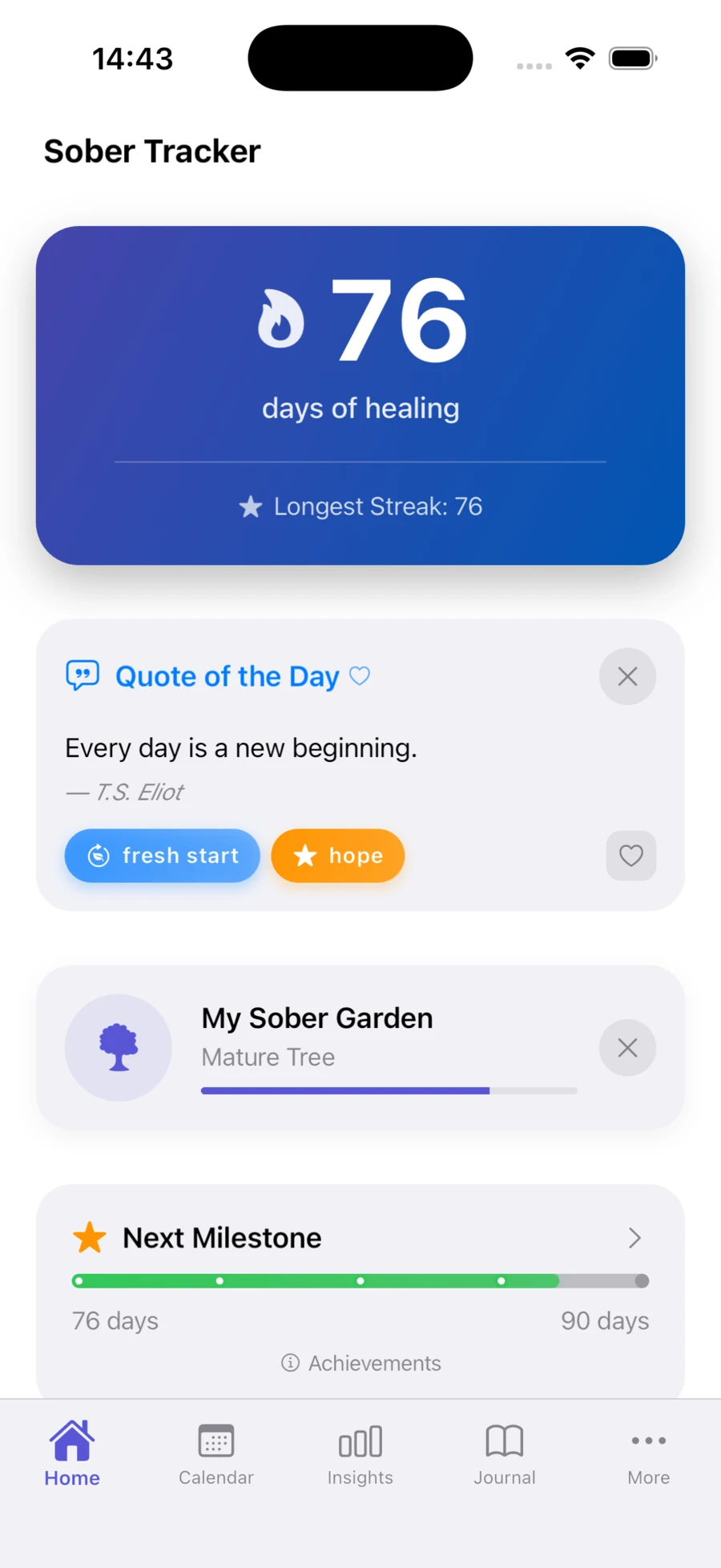
Sober Tracker is a private sobriety app for iPhone and Android that counts alcohol-free days, money saved and milestones without an account. If you want community, guided lessons or a drink diary instead, another app may fit your routine better.
**Publisher disclosure:** Trifoil Trailblazer makes Sober Tracker. This comparison uses the linked official product descriptions reviewed on September 21, 2026, plus our own app's features. It is not an independent ranking or a report of hands-on competitor testing. Table order does not indicate a score.
## Compare the Job You Need the App to Do
| App and official source | Main reason to consider it | Free and paid access |
| --- | --- | --- |
| Sober Tracker | Private alcohol-free day counting without an account | Free core tracking; optional Premium |
| I Am Sober | Daily pledges, milestones and community | Check current store listing and in-app options |
| Reframe | Guided alcohol habit-change lessons and community | Check current subscription and trial terms |
| Sunnyside | Drink logging, weekly planning and coaching | Check current subscription and trial terms |
| Loosid | Sober community and dating | Check the particular product and plan |
| Try Dry | Dry days, drinks, units, calories and money | Free, according to Alcohol Change UK |
| Nomo | Multiple clocks and accountability partners | Free, according to its developer |
Prices, trial eligibility and feature availability can differ by country and platform. Check the full billing period, renewal price and included features on the purchase screen. We do not combine store ratings from different countries or assign unsupported review scores.
## Sober Tracker: Private Day Counting
Use Sober Tracker when your daily question is “How long have I been alcohol-free?” Core tracking is free. The app includes a recovery garden, milestones, money-saved tracking and a journal. Premium is optional, with subscriptions and a one-time lifetime option; review the current offer in the app before buying.
There is no account or community feed. Your sobriety entries stay on your device. That suits private tracking, but it is not a substitute for a social support group or a coaching program. See the privacy details and no-account tracker overview before deciding.
Example app screen in English. The day count illustrates the interface, not a promised result.
Try the free core first: set your start date and check whether you find the day count useful. Read how to track sobriety days for choosing a counting rule and handling a restart.
## I Am Sober: Pledges and Community
I Am Sober describes daily pledges, reviews, milestone tracking and communities organized around addictions and sobriety stages. Consider it if checking in with other people is part of how you want to track progress. Compare account, sharing and paid-feature requirements for the specific tools you intend to use.
## Reframe: Guided Lessons
Reframe combines an alcohol habit-change program, courses, tools and community. Consider it if you want recurring learning activities alongside tracking. Decide whether you will use those lessons before committing to a subscription. Its product description states that it is not designed to treat alcohol use disorder.
## Sunnyside: Drink Logging and Planning
Sunnyside describes weekly plans, drink tracking, community and human coaching. Consider it when you want to record drinking patterns or work toward a drinking goal with support. Compare that workflow with a simple elapsed-day counter; they answer different daily questions.
## Loosid: Community and Dating
Loosid presents community and dating as distinct products alongside other support tools. Start with the service you actually want and check its account and purchase requirements. A social connection service is a different choice from a private day counter.
## Try Dry: A Free Drink Diary
Alcohol Change UK lists dry streaks, drinks and units, calories, money, wellbeing tracking and notes in Try Dry. It supports both cutting down and going alcohol-free. It is worth comparing if you want a diary of drinking and dry days without paying for an app subscription.
## Nomo: Multiple Clocks
Nomo supports multiple clocks, accountability partners, journaling and milestone tokens. Its developer describes the app as free. Consider it if you want separate counters for several habits or want to share selected progress with an accountability partner.
## Before Choosing or Paying
1. **Choose your measure:** consecutive alcohol-free days, a drink diary or several separate habits.
2. **Choose your interaction:** private recording, community check-ins or guided activities.
3. **Try your daily task:** enter a date or log an entry, then find it again. Check which features remain available without paying.
4. **Check continuity:** read the backup, export and account-deletion options before relying on any app as your only record.
For more detail, see free versus paid sobriety apps. Choose the tools you will use, rather than the longest feature list.
## Frequently Asked Questions
### Which sobriety app works without an account?
Sober Tracker provides on-device sobriety tracking without creating an account. Read its privacy overview for the distinction between private entries and other app services.
### Can I track sobriety for free?
Yes. Sober Tracker offers free core tracking. Try Dry and Nomo are described as free by their publishers. Optional purchases and feature limits vary between other apps, so check before starting a trial.
### Which app tracks drinking as well as dry days?
Try Dry explicitly supports both and includes current and best dry streaks. Sunnyside also describes drink tracking and planning. A continuous sobriety counter serves a different purpose from recording each drink.
### Does a higher price mean better recovery results?
This comparison does not establish clinical effectiveness. Pay for a tool you need and will use; a subscription price or store rating is not evidence that an app will produce a particular outcome.
### Where can I try Sober Tracker?
Download it on the App Store or Google Play. Start with the free day counter and decide whether optional Premium tools fit your routine.
---
# I Am Sober Alternative: Sober Tracker vs I Am Sober Compared
URL: https://sober-tracker.com/blog/sober-tracker-vs-i-am-sober-comparison
Published: 2026-03-23
Updated: 2026-05-19
Category: Guides & Tips
Word count: 1900
If you have spent any time searching for a sobriety app, you have almost certainly come across two names: **I Am Sober** and **Sober Tracker**. Sober Tracker is a private, no-account sobriety tracker app for iPhone and Android that counts your alcohol-free days, money saved, and milestones entirely on-device. I Am Sober is a cloud-based recovery platform built around daily pledges and a community feed. Both help people track their alcohol-free days, celebrate milestones, and stay motivated. But they take very different approaches to almost everything else.
This is not a post designed to tell you one is objectively better than the other. Both apps genuinely help people, and both have earned loyal users for good reasons. Instead, this is an honest comparison to help you figure out which one fits your needs, your personality, and your values.
## The Core Philosophy: Community vs. Privacy
The biggest difference between these two apps is not a feature. It is a philosophy.
**I Am Sober** is built around community. Its core experience revolves around daily pledges, shared feeds where you can see others on the same day of their journey, and end-of-day reviews that contribute to a larger conversation. The idea is that recovery is easier when you do it together, and for many people, that is absolutely true.
**Sober Tracker** is built around privacy. Its core experience is a personal, on-device tracker that never asks you to create an account, share your progress with strangers, or upload your data to a server. The idea is that recovery is deeply personal, and your tracking tool should respect that space without conditions.
Neither philosophy is wrong. They serve different types of people.
## Feature-by-Feature Comparison
### Streak Tracking
Both apps track your sober days accurately, which is the fundamental job of any sobriety app. However, the presentation differs.
**I Am Sober** presents your streak alongside social context: how many others share your day count, community milestones, and motivational messages from the community.
**Sober Tracker** presents your streak in a clean, focused view. Open the app, and your number is front and center with no surrounding noise. The app is designed to load quickly and show you exactly what you need in under a second.
**Verdict:** Both track accurately. Choose based on whether you want social context or a focused counter.
### Daily Pledges and Check-ins
**I Am Sober's** daily pledge system is one of its signature features. Each morning, you pledge to stay sober for that day. Each evening, you review how the day went. This ritual creates a structured bookend to your day that many users find grounding.
**Sober Tracker** does not have a formal pledge system. Instead, it focuses on passive tracking: your streak grows automatically, and you engage with the app when you want to, not because a notification is telling you to. It includes optional reminders, but the frequency and timing are entirely in your control.
**Verdict:** If you need structure and daily rituals, I Am Sober's pledge system is genuinely effective. If you prefer tracking that works quietly in the background without requiring daily interaction, Sober Tracker's approach may feel more sustainable.
### Community and Social Features
This is where the two apps diverge most dramatically.
**I Am Sober** offers a rich community experience. You can browse feeds of people on the same sober day as you, read their reflections, offer encouragement, and receive support in return. For someone who feels isolated in their recovery, this feature alone can be a lifeline.
**Sober Tracker** has no community features whatsoever. Your data, your reflections, and your progress exist only on your device. Nobody else sees it unless you choose to share a screenshot or tell someone about it in your own way.
**Verdict:** If isolation is your biggest challenge, I Am Sober's community is a genuine asset. If you worry about privacy, social pressure, or performative sharing, Sober Tracker's complete absence of social features may feel like a relief.
### Visual Progress and Motivation
**I Am Sober** uses milestone badges, community celebrations, and shared progress to keep you motivated. The social validation of seeing "5,000 others are on Day 30 with you" can be powerfully encouraging.
**Sober Tracker** takes a different approach with its Sobriety Garden. As your streak grows, a digital garden flourishes, providing a visual metaphor for the growth happening in your life. This feature transforms abstract day counts into something tangible and personal. The app also includes an achievement system with meaningful milestones and a health recovery timeline showing concrete changes in your body over time.
**Verdict:** Both approaches are effective, but they appeal to different motivational styles. Social validation vs. personal visual growth. Consider what drives you: seeing others alongside you, or watching your own garden bloom.
### Financial Tracking
**I Am Sober** includes a money saved calculator that shows how much you have saved by not drinking, based on your estimated spending.
**Sober Tracker** offers a similar money saved feature, letting you input your typical drinking expenses and see the savings accumulate alongside your streak.
**Verdict:** Essentially the same functionality. Both do it well.
### Journaling
**I Am Sober** includes journaling as part of its daily review system. Your entries tie into the broader community experience, and the review process prompts you to reflect on specific aspects of your day.
**Sober Tracker** includes a private journal for reflections. Entries are stored on-device only and never shared or uploaded. The journal is optional and unstructured, giving you space to write what matters without prompts.
**Verdict:** If you like guided reflection prompts, I Am Sober's approach is helpful. If you prefer a blank page and absolute privacy for your thoughts, Sober Tracker's journal may feel more comfortable.
### Health Tracking
**I Am Sober** offers basic health information related to sobriety milestones.
**Sober Tracker** provides a more detailed health recovery timeline, showing specific physical changes your body undergoes as you stay alcohol-free: liver recovery, blood pressure normalization, immune system improvements, and more. This feature is grounded in medical research and gives you concrete, science-based reasons to keep going.
**Verdict:** Sober Tracker offers more depth in health tracking, which can be particularly motivating if understanding the physical benefits of sobriety helps you stay committed.
## Head-to-Head Comparison Table
| Aspect | I Am Sober | Sober Tracker |
|---|---|---|
| Account Required | Yes | No |
| Data Storage | Cloud-based | On-device only |
| Community Features | Large, active community | None (fully private) |
| Daily Pledges | Yes | No |
| Streak Tracking | Yes | Yes |
| Money Saved | Yes | Yes |
| Health Timeline | Basic | Detailed |
| Journal | Guided daily reviews | Private, freeform |
| Visual Progress | Social badges | Sobriety Garden |
| Offline Support | Partial | Full |
| Multiple Addictions | Yes (premium) | Yes |
| Widgets | Yes | Yes |
| Free Version | Yes (with ads) | Yes |
| Pricing | ~$9.99/mo or ~$49.99/yr | Freemium with premium tier |
| Platforms | iOS, Android | iOS, Android |
## Privacy: The Elephant in the Room
For many people, the privacy question is the deciding factor, so it deserves a deeper look.
When you use I Am Sober, you create an account. Your sobriety data, your daily reflections, and your activity within the community are stored on their servers. This is necessary for the community features to work, and the company has a privacy policy outlining how they handle your data. For most users, this is perfectly fine.
But consider the nature of what you are tracking. Sobriety data reveals deeply personal information: that you have struggled with addiction, when you started and stopped, how you feel on difficult days. This information, stored on remote servers, becomes subject to risks that go beyond the app itself: data breaches, legal requests, and the general uncertainties of cloud-stored personal data.
Sober Tracker eliminates all of these risks by design. There is no account. There is no server. Your data exists on your phone and nowhere else. If you delete the app, the data is gone. If your phone is locked, nobody can access your recovery information remotely.
This is not about suggesting I Am Sober is doing anything wrong with your data. It is about recognizing that some people, because of their job, their family situation, or their personal comfort level, need the absolute assurance that their recovery journey is entirely under their control.
## Design Philosophy
**I Am Sober** has evolved over many years into a comprehensive recovery platform. It is feature-rich, well-designed, and constantly updated. The trade-off is complexity: there is a lot to navigate, and the app can feel busy, especially when you first start using it.
**Sober Tracker** was built from frustration with exactly that kind of complexity. The interface is intentionally minimal. You see your streak, your garden, your health progress, and your achievements. The app does not try to be your social network, your meditation timer, and your therapist all at once. It trusts you to know what you need and gives you a clean, calm space to track it.
## Pricing Comparison
**I Am Sober** offers a free tier with ads and limited features. The premium subscription runs around $9.99 per month or $49.99 per year, which unlocks an ad-free experience, advanced analytics, and the ability to track multiple addictions.
**Sober Tracker** offers core features for free with no ads in the main experience. Premium unlocks advanced analytics, the full Sobriety Garden, and additional customization options at a competitive price point.
Both apps provide enough value in their free tiers to be genuinely useful. Premium features in both cases add depth rather than being essential for basic tracking.
## Who Each App Is Best For
**Choose I Am Sober if:**
- Community support is important to your recovery
- You find daily pledges and rituals motivating
- You want to connect with others who share your timeline
- You are comfortable with cloud-based data storage
- You enjoy a feature-rich app with lots to explore
**Choose Sober Tracker if:**
- Privacy is a top priority for you
- You prefer a simple, focused tool over a full platform
- You are motivated by visual progress (the Sobriety Garden)
- You want an app that works completely offline
- You value a calm, uncluttered interface
- You do not want to create an account to track your sobriety
## Can You Use Both?
Absolutely. Some people use I Am Sober for its community features and Sober Tracker for private, on-device tracking as a personal backup. There is no rule that says you have to commit to one app. If different tools serve different needs, use them both.
## The Bottom Line
Both I Am Sober and Sober Tracker are well-built apps that genuinely help people in recovery. They are not really competitors in the traditional sense, because they are solving different problems.
I Am Sober answers the question: "How can I stay sober with the support of a community?" Sober Tracker answers the question: "How can I stay sober with a private, focused tool that respects my space?"
The right choice depends entirely on who you are and what you need. And whichever you choose, the fact that you are looking for a tool to support your sobriety means you are already moving in the right direction.
Download either one today. Set your quit date. Start counting. The days add up faster than you think.
---
# Free vs Paid Sobriety Apps: What's Worth Paying For?
URL: https://sober-tracker.com/blog/free-vs-paid-sobriety-apps-what-you-need
Published: 2026-03-27
Updated: 2026-03-27
Category: Guides & Tips
Word count: 2063
Recovery tools should be accessible to everyone, regardless of budget. Nobody should feel that they cannot track their sobriety because they cannot afford a subscription. At the same time, premium features in sobriety apps exist for a reason: they provide deeper insights, richer motivation, and more powerful tools for people who need them.
So how do you decide whether the free version of a sobriety app is enough, or whether paying for premium features is worth it? The answer depends on where you are in your journey, what kind of support you need, and how you think about the investment.
This guide breaks it all down honestly.
## What Free Sobriety Apps Typically Offer
Most sobriety apps follow a freemium model: the core experience is free, and advanced features require a subscription or one-time purchase. Here is what you can usually expect from a free tier.
### The Basics You Get for Free
- **Day counter:** Every free sobriety app gives you this. You set your quit date, and the app counts the days, hours, and often minutes since you stopped drinking.
- **Basic milestones:** Notifications or badges when you hit common markers like 1 week, 30 days, or 100 days.
- **Simple money saved calculator:** Input how much you used to spend on alcohol, and the app shows your running total of savings.
- **Basic health information:** Some free tiers include general information about how your body recovers after quitting.
### What Free Versions Usually Lack
- **Advanced analytics:** Detailed charts showing your patterns, trends, and progress over long periods.
- **Full customization:** Personalized themes, backgrounds, and notification settings.
- **Comprehensive journaling:** While some free apps offer basic note-taking, richer journaling tools with prompts, mood tracking, and searchable archives are often premium.
- **Visual progress features:** Tools like Sober Tracker's Sobriety Garden, where your progress manifests as a growing visual experience, typically require a premium unlock.
- **Ad-free experience:** Many free apps support themselves with ads, which can feel jarring in an app you open during vulnerable moments.
### Is Free Enough?
For many people, yes. If you need a straightforward way to count your sober days and see that number grow, free versions deliver that effectively. The core psychology of streak tracking, the "don't break the chain" effect that makes tracking so powerful, works with a simple counter just as well as it works with an elaborate one.
Free is especially sufficient if:
- You are doing a short-term challenge like Dry January or Sober October
- You already have a strong support system (therapist, sponsor, support group)
- You are motivated primarily by the day count itself
- You have a limited budget and the subscription cost would cause stress
## What Premium Features Add
Premium tiers in sobriety apps are not just about removing ads (though that is part of it). The best premium features add meaningful tools that support deeper, longer-term recovery.
### Advanced Analytics and Insights
Free versions show you how many days you have been sober. Premium versions show you patterns: which days of the week are hardest, how your mood correlates with cravings, how your progress compares across different time periods. This kind of data is not just interesting. It is actionable. When you can see that Fridays are consistently your most difficult day, you can plan specific strategies for Friday evenings before the craving even hits.
### Comprehensive Health Tracking
A simple day counter tells you "47 days." A detailed health timeline tells you "At 47 days, your blood pressure has likely normalized, your liver has begun regenerating, and your sleep quality has significantly improved." That kind of specificity transforms abstract progress into concrete, motivating facts about your body's recovery.
### Rich Visual Progress
There is a reason gamification works. When your daily effort produces visible results, like a growing garden, an expanding map, or an evolving achievement collection, the abstract concept of "staying sober" becomes tangible. Sober Tracker's Sobriety Garden is a good example: watching a barren patch of earth gradually fill with life creates an emotional connection to your progress that a simple number cannot replicate.
### Enhanced Journaling and Reflection
Writing about your recovery is one of the most effective tools for processing emotions and identifying triggers. Premium journaling features often include mood tagging, searchable archives, and the ability to attach context (what was happening, who you were with, how you felt) to specific entries. Over time, these entries become a personal map of your recovery journey that you can reference whenever you need perspective.
### Customization and Control
Premium tiers often let you personalize your experience: custom themes, notification schedules, widget configurations, and the ability to tailor the app to your specific habits and preferences. While this might sound cosmetic, personalization increases the likelihood that you will continue using the app long-term. A tool that feels like "yours" is one you are more likely to open every day.
## Sober Tracker's Approach to Free vs. Premium
We designed Sober Tracker with a clear principle: **the features you need to track your sobriety and stay motivated should never be locked behind a paywall.**
The free version of Sober Tracker includes:
- Accurate, reliable streak tracking
- Basic milestone celebrations
- Money saved calculator
- Core health recovery information
- Journal access
- Full offline functionality
- No account required, ever
The premium tier adds:
- The full Sobriety Garden experience
- Advanced analytics and detailed progress charts
- Additional achievement milestones
- Extended health recovery timeline with more detailed medical information
- Customization options
The reasoning is simple: if you are on Day 3 and struggling, you should have every tool you need to get to Day 4, whether or not you have paid for anything. Premium features are there for people who want to go deeper, but nobody is left without the essentials.
## When Free Is Absolutely Enough
There are situations where the free tier of a sobriety app is exactly the right choice.
### Short-Term Challenges
If you are participating in Dry January, Sober October, or a similar time-limited challenge, a free day counter provides everything you need. You have a clear end date, the challenge itself provides structure and social motivation, and the app simply needs to confirm your progress. Spending money on premium features for a 30-day experiment does not make sense for most people.
### Supplemental Tracking
If your primary recovery support comes from a therapist, a 12-step program, a sponsor, or a treatment center, the app is playing a supporting role rather than a central one. In this case, a simple free tracker that shows your day count and sends occasional milestone notifications is sufficient. The heavy lifting is being done by your human support system.
### Budget Constraints
If paying for a subscription adds financial stress to your life, do not do it. The point of a sobriety app is to reduce stress, not add to it. Free versions of most apps, including Sober Tracker, provide genuinely useful functionality. Use what is available and do not feel guilty about it.
### Early Exploration
If you have just started looking at sobriety apps and are not sure which one fits, try several free versions before committing money to any of them. Spend a week with each one. See which interface feels natural, which features you actually use, and which app you instinctively reach for. Then, if you find one you love, consider whether premium features would add value.
## When Premium Is Worth the Investment
There are also situations where paying for a sobriety app is not just justified but genuinely wise.
### Serious, Long-Term Recovery
If you are committed to long-term sobriety and the app is a central part of your daily routine, premium features earn their keep over time. Advanced analytics that help you understand your patterns, detailed health timelines that show your body healing, and rich visual progress tools all contribute to sustained motivation over months and years. The small monthly cost becomes negligible compared to the value it provides.
### When You Need Extra Motivation
Some people are deeply motivated by visual progress and gamification. If watching your Sobriety Garden grow, unlocking advanced achievements, or seeing detailed charts of your progress is what keeps you going on hard days, that is not a luxury. That is a recovery tool. Paying for features that genuinely help you stay sober is one of the most practical investments you can make.
### When You Have Tried and Struggled
If you have attempted sobriety before and relapsed, giving yourself every available tool makes sense. Premium features like comprehensive journaling, mood tracking, and advanced analytics can help you identify what went wrong in previous attempts and build better strategies this time. Think of it as upgrading your toolkit for a more challenging project.
## The ROI Argument: Math That Changes Your Perspective
Let's talk numbers for a moment.
According to the Bureau of Labor Statistics, the average American household spends approximately $580 per year on alcohol. For people who drink regularly, the number is often significantly higher. A moderate drinker spending $15 per week on alcohol spends $780 per year. Someone who frequents bars or buys premium drinks could easily spend $150 to $300 per month, totaling $1,800 to $3,600 per year.
Now consider the cost of a premium sobriety app. Most premium tiers range from $30 to $60 per year. Even the most expensive option is typically under $120 annually.
That means a premium sobriety app costs roughly **2 to 8 percent** of what moderate drinkers spend on alcohol in a year. If the app helps you stay sober for even one extra month, it has already paid for itself many times over.
And that calculation only accounts for the direct cost of alcohol. It does not include the money saved on hangover remedies, late-night food orders, ride-shares home from bars, medical costs from alcohol-related health issues, or missed work due to hangovers. When you factor in these indirect costs, the ROI of a premium sobriety app becomes almost absurd.
This is not an argument for spending money you do not have. But if you can afford a premium tier and you are wondering whether it is "worth it," the math is unambiguous.
## A Note on Subscription Fatigue
It is worth acknowledging that many people are tired of subscriptions. Between streaming services, cloud storage, fitness apps, and everything else, adding another monthly charge can feel exhausting.
If subscription fatigue is a concern, look for apps that offer:
- **Annual pricing:** Usually a significant discount compared to monthly billing
- **One-time purchase options:** Some apps like EasyQuit offer a single payment that unlocks everything permanently
- **Generous free tiers:** Apps like Sober Tracker that include substantial functionality without requiring payment
The key question is not "do I want another subscription?" but "does this subscription help me achieve something genuinely important?" If the answer is yes, it belongs in a different category than your seventh streaming service.
## How to Decide: A Simple Framework
If you are still unsure, work through these questions:
1. **How long is your commitment?** Short-term challenge = free is fine. Long-term recovery = consider premium.
2. **What is your primary support system?** App is your main tool = premium adds value. App supplements therapy/sponsor = free may suffice.
3. **What motivates you?** Simple day count = free works. Visual progress, analytics, and depth = premium shines.
4. **What is your budget?** Tight finances = use free without guilt. Comfortable budget = premium is a smart investment.
5. **Have you tried and relapsed before?** Give yourself every available tool. This is not the place to economize.
## The Bottom Line
Free sobriety apps are genuinely useful. They provide the fundamental tool, a day counter, that makes streak-based motivation work. If free is what you can afford or what makes sense for your situation, use it wholeheartedly and without apology.
Premium features are not about gatekeeping recovery. They are about providing deeper, richer tools for people who want them and can benefit from them. Advanced analytics, visual progress, comprehensive health tracking, and enhanced customization all have genuine value for people in long-term recovery.
The most important thing is not whether you pay for your sobriety app. The most important thing is that you use one. A free app you open every day is infinitely more valuable than a premium app you forget about.
Start where you are. Use what you have. Upgrade if and when it makes sense for you. The goal is not to find the perfect app. The goal is to stay sober today, and let the days stack up from there.
---
# Best Sobriety App for People Who Hate Social Features
URL: https://sober-tracker.com/blog/best-sobriety-app-no-social-features
Published: 2026-03-30
Updated: 2026-05-20
Category: Guides & Tips
Word count: 1308
You open a sobriety app for the first time. You're feeling vulnerable, maybe a little scared. You just want to mark Day 1 and move on with your morning.
Instead, you get a community feed full of strangers' confessions, a prompt to "share your reason for quitting," and a notification that "Sarah from Ohio also started today!"
You close the app. You don't open it again.
If this sounds familiar, you're not alone. For many people in recovery, social features in sobriety apps aren't helpful. They're actively discouraging. Sober Tracker is a sobriety app built deliberately without any social features: no community feed, no daily public pledges, no account required, and no notifications about other users' progress.
## Why Social Features Feel Wrong for Some People
The sobriety app market is dominated by addiction tracker apps that lean heavily into community. Daily pledges you share with others, public milestone celebrations, forums, accountability partners, group challenges. The assumption is that connection heals.
And for some people, it does. Community-based recovery has strong evidence behind it: AA, SMART Recovery, and other group programs have helped millions.
But here's what gets overlooked: **not everyone recovers the same way.**
Some people find social features uncomfortable because:
- **They're introverts.** Processing emotions publicly feels exhausting, not therapeutic.
- **They're private about their recovery.** Maybe their family doesn't know. Maybe their employer doesn't know. Maybe they just don't want to explain themselves to strangers on the internet.
- **Social comparison is toxic for them.** Seeing someone at Day 365 when you're at Day 3 can feel motivating to some and crushing to others.
- **They've had bad experiences.** Unsolicited advice, judgment, or triggering content in community feeds can do real harm.
- **They just want a tool, not a support group.** A wrench doesn't need a social network. Neither does a sobriety counter.
Research backs this up. A 2021 study in the Journal of Behavioral Addictions found that people with high social anxiety had significantly lower engagement with community-based recovery apps, and that forced social interaction could increase dropout rates.
## The Introvert's Recovery Dilemma
If you search "best sobriety app" right now, almost every recommendation will push community features as a selling point. "Connect with thousands!" "Share your journey!" "You're not alone!"
For introverted or privacy-conscious people, this creates a frustrating dilemma:
- The **best-rated apps** are socially focused (I Am Sober, Sober Time, Loosid)
- The **simple counters** with no social features often lack other useful tools (health timelines, financial tracking, journaling)
- There's a **gap in the middle**: apps that are feature-rich but completely solo
Finding an app that offers real functionality without the social pressure shouldn't be this hard. But it is, because the industry assumes everyone wants community.
## What "No Social" Actually Means
Let's define what we mean by "no social features" because it's a spectrum:
### Fully Social Apps
- Community feeds, public profiles, daily pledges shared with others, accountability partners, group challenges, comments and likes
- Examples: I Am Sober, Loosid
### Social-Optional Apps
- Social features exist but can be turned off or ignored. The core experience works without them.
- Examples: Nomo (accountability partner is optional), Sober Time (forum is separate from tracking)
### Fully Solo Apps
- No accounts, no profiles, no community, no sharing. The app is a personal tool and nothing else.
- Examples: Sober Tracker, EasyQuit, simple counter apps
If you hate social features, you want the third category. But within that category, quality varies enormously.
## Solo Sobriety Apps Ranked
Here's how the major solo-friendly apps compare:
### Sober Tracker
**Social level:** Zero. No accounts, no community, no sharing.
Sober Tracker was designed from the ground up as a private, solo experience. There is no way to create a profile, connect with other users, or share your progress within the app.
What you get instead:
- Streak tracking with precise day counting
- 30+ achievement badges and a virtual recovery garden
- Health benefit timeline showing your body's recovery
- Financial savings calculator
- Private journal (stored only on your device)
- Coping toolkit for difficult moments
- Home screen widgets
Available on iOS and Android. Free with optional premium.
### EasyQuit Drinking
**Social level:** Zero. No accounts, no community.
A straightforward tracker focused on health milestones and money saved. Clean interface, no bloat.
What you get:
- Sobriety counter
- Health achievement timeline
- Money saved tracker
- Motivational quotes
- Widgets
Pros: Very simple, loads fast
Cons: Fewer features than Sober Tracker, no journal, no coping tools, limited achievement system
### Sobriety Counter
**Social level:** Zero. Basic counter app.
The most minimal option. It counts days. That's about it.
What you get:
- Day counter
- Basic milestone markers
- Multiple addiction tracking
Pros: Dead simple, lightweight
Cons: No health timeline, no financial tracking, no journal, no achievements, limited motivation features
### Nomo (Social-Optional)
**Social level:** Low. Has an accountability partner feature, but it's optional.
Nomo sits in the middle ground. Its core experience is solo (your clocks, your tracking), but it has an optional feature where you can share a clock with a trusted person.
What you get:
- Multiple sobriety clocks
- Optional accountability partner
- Emergency call button
- Relapse tracking with pattern analysis
- AA-inspired chip system
Pros: Accountability partner is genuinely useful if you want one specific person involved (not a crowd)
Cons: Some features behind paywall, interface feels dated
## When Solo Tracking Is the Better Choice
Solo tracking isn't just "fine for introverts." For certain situations, it's actually the superior approach:
### Early Recovery (Days 1-30)
In the first month, you're emotionally raw. Community feeds can be overwhelming, triggering, or discouraging when you see others who are much further along. A quiet counter that just says "Day 7, you're doing great" is often more helpful than a feed full of strangers.
### Professional Risk
If your career could be affected by people knowing about your recovery (certain industries, public-facing roles, security clearances), having your sobriety data on a cloud server attached to your email is a genuine risk. Solo, on-device tracking eliminates this entirely.
### Relationship Sensitivity
If your partner, family, or roommates don't know about your drinking history, you need an app that doesn't send notifications saying "Congratulations on Day 14!" or display social feeds when someone glances at your screen.
### Personality Type
If you've tried community-based recovery and felt worse (more anxious, more ashamed, more overwhelmed), that's valid feedback. Not every personality type benefits from group support. Some people process better alone: through journaling, walking, thinking, or just quietly watching a counter go up.
### Relapse Recovery
After a relapse, the last thing many people want is to feel publicly judged. Resetting a private counter feels like a fresh start. Resetting a social counter feels like a public failure.
## Building Your Solo Support System
Choosing a solo app doesn't mean you're completely alone. It means your app isn't your support system. Here are ways to get support without it living in your sobriety tracker:
- **A therapist or counselor** who specializes in addiction (separate from your daily tracking)
- **One trusted friend or family member** who knows what you're going through
- **Anonymous online spaces** like Reddit's r/stopdrinking where you control what you share and can use a throwaway account
- **Books and podcasts** on recovery (zero social pressure, all the knowledge)
- **Your doctor** for medical aspects of recovery
The point is to separate your tracking tool from your support network. Your app counts the days. Your people support you. These don't need to be the same thing.
## The Right Tool for the Right Person
There's nothing wrong with social sobriety apps. I Am Sober has helped millions of people, and community-based recovery saves lives every day.
But there's also nothing wrong with wanting a quiet, private, solo tool. Recovery isn't one-size-fits-all, and your app shouldn't be either.
If you've been putting off tracking your sobriety because every app feels too social, too public, or too noisy, try one that stays silent. Open it, set your date, and let it count. No fanfare. No feed. No strangers.
Just you and your progress.
---
# How to Quit Drinking: Complete Guide
URL: https://sober-tracker.com/blog/how-to-quit-drinking-complete-guide
Published: 2025-11-07
Updated: 2025-11-07
Category: Guides & Tips
Word count: 1945
Quitting alcohol is one of the most significant decisions you can make for your health, relationships, and overall quality of life. Whether you're questioning your drinking habits, concerned about alcohol dependence, or ready to make a change today, this comprehensive guide will walk you through everything you need to know about quitting drinking successfully.
## Understanding Your Relationship with Alcohol
Before you quit, it's helpful to understand where you stand. Not everyone who quits drinking has the same story—some people have a physical dependence, others drink out of habit or social pressure, and many fall somewhere in between.
### Signs It Might Be Time to Quit
- **You drink more than you intend to** – You tell yourself you'll have one or two drinks, but often end up having more
- **Drinking affects your responsibilities** – Work performance, family obligations, or personal goals are suffering
- **You feel guilt or shame** – You regret things you said or did while drinking, or you hide how much you drink
- **Physical symptoms** – You experience hangovers, sleep problems, digestive issues, or need alcohol to feel "normal"
- **Failed attempts to cut back** – You've tried to moderate or quit before but found it difficult to stick with
- **Relationship problems** – Loved ones have expressed concern about your drinking
If any of these resonate with you, you're not alone. Millions of people struggle with alcohol, and recognizing that it's a problem is the first step toward change.
## Preparing to Quit: Setting Yourself Up for Success
The decision to quit drinking is powerful, but preparation is key to making it stick. Here's how to set yourself up for the best possible outcome.
### 1. Choose Your Quit Date
Pick a specific date to stop drinking—ideally within the next week or two. Having a concrete date creates commitment and gives you time to prepare mentally and logistically. Choose a date when you won't be under excessive stress or attending social events where alcohol will be present.
### 2. Assess Whether You Need Medical Support
**This is critical:** If you've been drinking heavily for an extended period, quitting suddenly can be dangerous. Alcohol withdrawal can cause serious symptoms including seizures, hallucinations, and delirium tremens (DTs), which can be life-threatening.
**Seek medical advice before quitting if you:**
- Drink heavily every day (more than 8+ drinks per day for men, 6+ for women)
- Have experienced withdrawal symptoms before (shaking, sweating, nausea, anxiety)
- Have had seizures or DTs in the past
- Have other health conditions, especially liver disease or heart problems
- Are taking medications that could interact with alcohol withdrawal
A doctor can prescribe medications to make withdrawal safer and more comfortable, and may recommend inpatient or outpatient detox programs.
### 3. Tell Someone About Your Decision
Share your plan with a trusted friend, family member, or therapist. Having accountability and support makes a huge difference. The people who care about you will want to help—let them.
### 4. Remove Alcohol from Your Environment
Get rid of all alcohol in your home. Pour it out, give it away, or ask someone else to remove it. Out of sight, out of mind is a real advantage, especially in the early days.
## Different Approaches to Quitting Drinking
There's no single "right" way to quit drinking. The best approach depends on your individual situation, the severity of your drinking, and what resources are available to you.
### Cold Turkey (Immediate Abstinence)
Stopping drinking completely and immediately. This works well for many people, especially those who:
- Drink moderately or occasionally (not heavy daily drinkers)
- Have a strong support system
- Prefer clear boundaries (all-or-nothing thinking works for them)
**Important:** Do not quit cold turkey if you're a heavy drinker without medical supervision. See the medical support section above.
### Gradual Tapering
Slowly reducing your alcohol intake over days or weeks until you reach zero. This approach:
- Reduces the severity of withdrawal symptoms
- Can be safer for heavy drinkers (though still discuss with a doctor)
- Requires strong willpower to stick to the reduction schedule
If tapering, create a specific schedule—for example, reducing by one drink per day until you reach zero. Track your progress carefully.
### Medically-Assisted Detox
For heavy drinkers, medical detox programs provide:
- 24/7 medical monitoring
- Medications to ease withdrawal (benzodiazepines, anti-seizure medication)
- A safe, controlled environment
- Connection to ongoing treatment programs
Inpatient detox typically lasts 3-7 days. Outpatient detox allows you to stay home while checking in daily with medical professionals.
## Managing Withdrawal Symptoms
Withdrawal symptoms can range from mild to severe, depending on how much and how long you've been drinking. Understanding what to expect helps you prepare.
### Common Withdrawal Symptoms
**6-12 hours after last drink:**
- Anxiety and irritability
- Headache
- Nausea and vomiting
- Sweating and clammy skin
- Tremors (shaking hands)
- Insomnia
**12-48 hours after last drink:**
- Increased heart rate
- High blood pressure
- Confusion and disorientation
- Mood swings
- Seizures (in severe cases)
**48-72 hours after last drink:**
- Peak withdrawal symptoms
- Hallucinations (in severe cases)
- Delirium tremens (DTs) – confusion, rapid heartbeat, fever (medical emergency)
Most people experience mild to moderate symptoms that improve significantly after the first week. By two weeks, physical withdrawal is typically complete, though psychological symptoms (cravings, mood changes, sleep issues) can persist longer. See our complete withdrawal timeline for details.
### Coping Strategies for Withdrawal
- **Stay hydrated** – Drink plenty of water and electrolyte beverages
- **Eat nutritious foods** – Even if you don't feel like eating, try small, healthy meals
- **Rest** – Your body is healing; give it time to recover
- **Gentle movement** – Light walks or stretching can help with restlessness
- **Distraction** – Watch movies, read, listen to music, or engage in hobbies
- **Reach out** – Talk to your support person when cravings or difficult emotions arise
## Building New Habits and Routines
Quitting drinking creates a void in your life—time you spent drinking, thinking about drinking, recovering from drinking. Filling that void with positive activities is essential for long-term success.
### Replace Drinking Rituals
Identify what drinking did for you (relaxation, socialization, boredom relief) and find healthier alternatives:
- **Relaxation:** Try meditation, yoga, hot baths, deep breathing exercises
- **Socialization:** Meet friends for coffee, exercise together, join a club or hobby group
- **Boredom:** Pick up a new hobby, learn a skill, volunteer, read, create art
- **Stress relief:** Exercise, journaling, talking to a friend, professional therapy
### Create a Daily Routine
Structure helps prevent decision fatigue and reduces opportunities for drinking. Build a routine that includes:
- Regular sleep schedule (go to bed and wake up at consistent times)
- Healthy meals at regular times
- Daily exercise or movement
- Time for hobbies or relaxation
- Connection with supportive people
## Finding Support Systems
You don't have to do this alone. In fact, people who seek support are significantly more likely to maintain long-term sobriety.
### Support Groups
- **Alcoholics Anonymous (AA):** The most well-known 12-step program, with meetings worldwide
- **SMART Recovery:** Science-based alternative focusing on self-empowerment
- **Refuge Recovery:** Buddhist-inspired recovery program
- **Online communities:** Reddit's r/stopdrinking, Sober Grid app, and other digital support groups
### Professional Help
- **Therapists and counselors:** Especially those specializing in addiction and substance use
- **Addiction medicine doctors:** Can prescribe medications to reduce cravings (naltrexone, acamprosate)
- **Intensive outpatient programs (IOP):** Structured treatment while living at home
- **Inpatient rehabilitation:** 30, 60, or 90-day residential treatment programs
### Personal Support Network
Build a team of people who support your sobriety:
- Family members who understand your goals
- Sober friends or friends who respect your decision
- A sponsor (in 12-step programs)
- An accountability partner you check in with regularly
## Dealing with Triggers and Cravings
Triggers are situations, emotions, or environments that make you want to drink. Cravings are the intense desires for alcohol that arise from triggers. Learning to manage both is crucial. Read our detailed guide on the 10 most common sobriety triggers and the science of alcohol cravings.
### Common Triggers
- **Environmental:** Bars, parties, certain restaurants, liquor stores
- **Social:** Being around people who drink, peer pressure, celebrations
- **Emotional:** Stress, anxiety, depression, loneliness, anger, boredom
- **Physical:** Fatigue, hunger, pain
- **Mental:** Memories of drinking, romanticizing past drinking experiences
### Strategies to Handle Cravings
**The HALT method:** When you feel a craving, check if you're Hungry, Angry, Lonely, or Tired. Address whichever applies.
**The 20-minute rule:** Cravings typically peak and pass within 15-20 minutes. Delay the decision to drink and distract yourself until the craving subsides.
**Urge surfing:** Instead of fighting the craving, observe it like a wave—notice it rising, peaking, and falling without acting on it.
**Call someone:** Reach out to your support network when cravings hit.
**Change your environment:** Leave the triggering situation—take a walk, go to a different room, or engage in a different activity.
## Long-Term Strategies for Maintaining Sobriety
The first few weeks are often the hardest, but staying sober long-term requires ongoing commitment and strategy.
### Track Your Progress
Seeing your sober days add up is incredibly motivating. Use a sobriety tracking app like Sober Tracker to (see our full app comparison for more options):
- Count your sober days, weeks, and months
- Visualize your progress
- Remind yourself why you quit
- Celebrate milestones
### Celebrate Milestones
Acknowledge your achievements—1 day, 1 week, 1 month, 3 months, 6 months, 1 year. Each milestone deserves recognition. Treat yourself to something special (non-alcohol related) or share your success with your support network.
### Continue Learning and Growing
- Read books about sobriety and personal growth
- Listen to sobriety podcasts
- Attend support group meetings regularly (even when you feel strong)
- Work with a therapist to address underlying issues
- Develop new skills and interests
### Develop Healthy Coping Mechanisms
Build a toolbox of strategies for difficult moments:
- Exercise regularly—it reduces stress and improves mood
- Practice mindfulness or meditation
- Journal your thoughts and feelings
- Engage in creative activities
- Maintain social connections with sober people
- Get enough sleep (7-9 hours per night)
## What to Do If You Relapse
Relapse is common and doesn't mean you've failed. Most people who successfully quit drinking long-term had at least one relapse along the way. What matters is how you respond.
### If You Drink Again
- **Stop immediately:** One drink doesn't have to become a binge. Stop as soon as you can.
- **Don't spiral into shame:** Self-criticism makes it worse. Practice self-compassion.
- **Reach out for support:** Tell your accountability partner, sponsor, or therapist.
- **Analyze what happened:** What triggered the relapse? What can you do differently next time?
- **Adjust your plan:** Add more support, avoid specific triggers, or try a new approach.
- **Start again immediately:** Your sobriety journey continues right now—you don't have to wait until Monday or next month.
Relapse doesn't erase your progress. Every day you were sober taught you something. Use what you learned and keep moving forward.
## Resources and Tools to Help You Quit
### Apps and Digital Tools
- **Sober Tracker (iOS)** or **Sober Tracker (Android):** Simple, focused sobriety tracker to count your sober days and stay motivated
- **I Am Sober:** Track sobriety with daily pledges and community support
- **Nomo:** Sobriety clock and milestone tracker
- **Sober Grid:** Social network for people in recovery
### Books
- *This Naked Mind* by Annie Grace
- *Alcohol Explained* by William Porter
- *Quit Like a Woman* by Holly Whitaker
- *The Easy Way to Control Alcohol* by Allen Carr
### Hotlines and Crisis Support
- **SAMHSA National Helpline:** 1-800-662-4357 (free, confidential, 24/7 support for substance abuse)
- **National Suicide Prevention Lifeline:** 988 (if you're in crisis)
## Your Journey Starts Today
Quitting drinking is challenging, but it's also one of the most rewarding things you can do for yourself. You'll gain clarity, health, genuine relationships, self-respect, and a life that's truly yours.
You don't have to have all the answers today. You don't have to be perfect. You just have to take the first step—and then the next one, and the next one after that.
Whether you're on day 1 or day 1,000, you're making a powerful choice. Keep going. You're worth it.
>
"The best time to quit drinking was yesterday. The second best time is now."
---
# Alcohol Withdrawal Timeline: Complete Day-by-Day Guide
URL: https://sober-tracker.com/blog/alcohol-withdrawal-timeline-day-by-day-guide
Published: 2025-11-07
Updated: 2026-05-21
Category: Health & Science
Word count: 1905
If you're thinking about quitting alcohol, knowing the alcohol withdrawal symptoms and the timeline they follow can help you prepare for what's ahead. The symptoms of alcohol withdrawal vary from person to person, but most people move through the same day-by-day pattern. This comprehensive guide breaks down exactly what symptoms to expect, how long they last, and when withdrawal needs medical help.
**⚠️ Important Medical Disclaimer:** This article is for informational purposes only. Severe alcohol withdrawal can be life-threatening. If you've been drinking heavily for an extended period, consult a healthcare professional before quitting. Seek immediate medical attention if you experience severe symptoms like seizures, hallucinations, or confusion.
## How Long Does Alcohol Withdrawal Last? (Quick Answer)
For most people, alcohol withdrawal begins 6 to 12 hours after the last drink, peaks at 24 to 72 hours, and eases within 5 to 7 days. Anxiety, cravings, and disrupted sleep can linger for weeks afterward as post-acute withdrawal syndrome (PAWS).
- **6-12 hours:** First symptoms appear: anxiety, tremor ("the shakes"), nausea, headache, and insomnia
- **24-72 hours:** Peak withdrawal, when the risk of seizures and delirium tremens (DTs) is highest
- **Days 5-7:** Acute physical symptoms fade for most people
- **Weeks 2 and beyond:** Lingering PAWS symptoms (mood, sleep, and cravings) gradually improve
Heavy daily drinkers, and anyone who has had a withdrawal seizure or DTs, should only stop drinking under medical supervision.
Not sure which app to use? We compared the top sobriety apps to make choosing easier.
## Understanding Alcohol Withdrawal
Alcohol withdrawal occurs when your body has adapted to the presence of alcohol and suddenly has to function without it. When you drink regularly, your brain chemistry adjusts to compensate for alcohol's depressant effects. When you stop drinking, your nervous system becomes overactive, causing withdrawal symptoms. The National Institute on Alcohol Abuse and Alcoholism (NIAAA) characterizes acute withdrawal as a brain-and-body rebound to chronic alcohol exposure, with symptoms ranging from mild tremor and anxiety to seizures.
The severity of withdrawal depends on several factors:
- **Duration of drinking:** How long you've been drinking heavily
- **Amount consumed:** How much you typically drink
- **Overall health:** Your physical and mental health status
- **Previous withdrawal experiences:** Withdrawal typically worsens with each episode (the "kindling effect," documented in the NIAAA review of withdrawal complications)
- **Age and genetics:** Individual factors that affect how your body processes alcohol
## Alcohol Withdrawal Symptoms: Mild, Moderate, and Severe
The symptoms of alcohol withdrawal fall into three broad tiers. Most people only experience the mild to moderate range, but heavy, long-term drinkers can progress to severe, medically dangerous symptoms. The table below summarizes the common alcohol withdrawal symptoms by severity and when they typically appear, before the hour-by-hour timeline shows when each one starts and fades.
| Severity | Common alcohol withdrawal symptoms | When it usually appears |
|---|---|---|
| Mild | Anxiety, restlessness, headache, nausea, insomnia, sweating, mild tremor (the "shakes"), alcohol cravings | 6 to 12 hours after the last drink |
| Moderate | Stronger tremor, rapid heartbeat, high blood pressure, low-grade fever, confusion, irritability, heavy sweating | 12 to 48 hours |
| Severe | Seizures, hallucinations, and delirium tremens (DTs): severe confusion, agitation, and dangerous swings in heart rate and blood pressure | 48 to 72 hours, a medical emergency |
If you have ever had a withdrawal seizure or delirium tremens, or you drink heavily every day, treat withdrawal as a medical situation and talk to a doctor before you stop.
## The Alcohol Withdrawal Timeline: Hour by Hour and Day by Day
### First 6-12 Hours: Early Symptoms Begin
Symptoms can start as early as 6 hours after your last drink. At this stage, you might experience:
- Mild anxiety and restlessness
- Headaches
- Nausea and vomiting
- Insomnia or disturbed sleep
- Increased heart rate
- Sweating and mild tremors
- Strong cravings for alcohol
These early symptoms are your body's way of signaling that it's adjusting to the absence of alcohol. While uncomfortable, they're generally manageable for light to moderate drinkers.
### 12-24 Hours: Symptoms Intensify
Physical symptoms become more pronounced during this period:
- More intense tremors (especially in hands)
- Increased sweating
- Elevated blood pressure and heart rate
- Disorientation or confusion
- Loss of appetite
- Mood swings and irritability
- Possible visual or auditory disturbances
This is when many people find the cravings most difficult to resist. Having support during this period is crucial.
### 24-72 Hours: Peak Withdrawal (Most Critical Period)
This is typically the most challenging phase of withdrawal. Symptoms reach their peak intensity:
- **Severe tremors:** Whole-body shaking that can interfere with basic tasks
- **Profuse sweating:** Often accompanied by fever
- **Rapid heart rate:** Palpitations and irregular heartbeat
- **High blood pressure:** Can be dangerous if severe
- **Intense anxiety:** Panic attacks are common
- **Hallucinations:** Visual, auditory, or tactile (feeling things that aren't there)
- **Seizures:** Can occur in severe cases (medical emergency)
- **Delirium tremens (DTs):** In severe cases (requires immediate medical attention)
**🚨 Medical Emergency Warning:** Delirium tremens (DTs) is a severe, potentially fatal form of alcohol withdrawal that can occur 48-96 hours after your last drink. Symptoms include severe confusion, hallucinations, fever, and seizures. This requires immediate hospitalization. Mortality rates for untreated DTs have historically been reported at 15-35%, falling below 5% with proper medical management (NIAAA: Treatment of Alcohol Withdrawal).
### Days 3-5: The Turning Point
For most people, the worst is over. Physical symptoms begin to improve:
- Tremors start to subside
- Sweating decreases
- Heart rate and blood pressure begin normalizing
- Sleep starts to improve (though still disrupted)
- Appetite may start returning
However, psychological symptoms can persist or even intensify:
- Depression and mood swings
- Anxiety (can last weeks)
- Fatigue and low energy
- Difficulty concentrating ("brain fog")
- Continued cravings
### Days 5-7: Acute Withdrawal Ends
By the end of the first week, most acute physical symptoms have resolved:
- Most physical symptoms are mild or gone
- Energy levels start to return
- Sleep quality begins improving
- Appetite normalizes
- Mental clarity improves
This is a significant milestone. Read about what others experienced in their first week of sobriety.
### Weeks 2-4: Early Recovery
Physical symptoms continue to improve, but psychological challenges remain:
- Significantly better sleep (though vivid dreams are common)
- Improved skin appearance and hydration
- Weight changes (often loss, but some gain weight)
- Mood stabilization (though fluctuations continue)
- Cravings become less frequent but can still be intense
- Social situations may trigger strong urges
Many people report feeling physically better than they have in years, but emotionally fragile. Learn more about 30 days without alcohol.
### Months 2-3: Post-Acute Withdrawal Syndrome (PAWS)
Some people experience lingering symptoms known as PAWS, which can include:
- Mood swings and emotional instability
- Anxiety and depression
- Sleep disturbances
- Fatigue and low energy
- Difficulty concentrating
- Increased stress sensitivity
- Anhedonia (difficulty feeling pleasure)
PAWS symptoms come and go in waves and can last for months, but they gradually decrease in frequency and intensity. For more information, read our detailed guide on PAWS after alcohol. See also what life looks like at 3 months sober.
## When Do You Need Medical Supervision?
You should seek medical help for alcohol withdrawal if:
- You've been drinking heavily (more than 15 drinks per week for men, 8 for women) for several weeks or longer
- You have a history of severe withdrawal symptoms or seizures
- You have underlying health conditions (heart disease, liver disease, diabetes)
- You're taking medications that interact with alcohol
- You've tried to quit before and experienced severe symptoms
- You're experiencing any severe symptoms now
### Medical Detox Options
Medical professionals can provide:
- **Medication:** Benzodiazepines to reduce withdrawal severity and seizure risk
- **Monitoring:** 24/7 supervision to catch complications early
- **Hydration and nutrition:** IV fluids and vitamin supplementation
- **Psychological support:** Counseling and planning for long-term recovery
## Tips for Managing Withdrawal Safely
### If You're Going Through Mild Withdrawal at Home:
- **Stay hydrated:** Drink plenty of water and electrolyte solutions
- **Eat nutritious food:** Even if you don't feel hungry, try to eat small, healthy meals
- **Take vitamins:** Especially B-complex vitamins and thiamine
- **Rest:** Allow your body time to heal, even if sleep is difficult
- **Avoid caffeine:** It can worsen anxiety and tremors
- **Stay occupied:** Gentle activities can distract from cravings
- **Have support:** Don't go through this alone; tell someone what you're doing
- **Use tracking tools:** Apps like Sober Tracker help you visualize your progress
If you're choosing between trackers, our Sober Tracker vs I Am Sober comparison looks at which one supports the early days best.
### What NOT to Do:
- Don't try to "taper off" without medical guidance if you're a heavy drinker
- Don't use other substances to manage symptoms
- Don't drive or operate machinery during acute withdrawal
- Don't isolate yourself completely—have someone check on you
## The Good News: What Gets Better and When
While withdrawal is challenging, recovery brings remarkable improvements:
- **24 hours:** Blood sugar stabilizes, sleep quality begins improving
- **48 hours:** Clearer thinking, better skin hydration
- **72 hours:** Physical energy starts returning
- **1 week:** Better sleep, reduced bloating, improved mood
- **2 weeks:** Mental clarity significantly improved, anxiety decreasing
- **1 month:** Liver function improving, immune system stronger, weight loss visible
- **3 months:** Brain chemistry rebalancing, sustained energy, emotional stability
- **6 months:** Cardiovascular improvements, reduced disease risk
- **1 year:** Liver can fully recover (if no permanent damage), dramatic life improvements
Explore real experiences at 14 days sober, 100 days without alcohol, and 120 days without alcohol.
## Frequently Asked Questions
### How long does alcohol withdrawal last?
Acute alcohol withdrawal symptoms typically last 3-7 days, with symptoms peaking around 24-72 hours after your last drink. However, some psychological symptoms and cravings can persist for weeks or months, known as Post-Acute Withdrawal Syndrome (PAWS).
### Is it safe to quit alcohol cold turkey?
For light to moderate drinkers, quitting cold turkey is generally safe. However, for heavy drinkers or those with alcohol dependence, sudden cessation can be dangerous and even life-threatening, potentially causing seizures or delirium tremens. If you've been drinking heavily, consult a healthcare professional before quitting.
### What are the worst days of alcohol withdrawal?
Days 2-3 are typically the most challenging, when physical symptoms peak. This is when you're most likely to experience severe symptoms like tremors, rapid heart rate, high blood pressure, and intense cravings. After day 5-7, most acute physical symptoms begin to subside significantly.
### When should I seek medical help for alcohol withdrawal?
Seek immediate medical attention if you experience severe tremors, hallucinations, seizures, confusion, fever above 101°F (38.3°C), severe vomiting, chest pain, or irregular heartbeat. These can be signs of severe withdrawal requiring medical intervention.
### Can I die from alcohol withdrawal?
Yes, severe alcohol withdrawal can be fatal, particularly if it progresses to delirium tremens. This is why medical supervision is crucial for heavy drinkers. The risk is highest in the first 72 hours. With proper medical care, the risk is significantly reduced.
## Final Thoughts: You Can Do This
Alcohol withdrawal is challenging, but thousands of people successfully navigate it every day. Understanding what to expect can help you prepare mentally and physically. For comprehensive guidance on quitting safely, read our complete guide to quitting alcohol. Remember:
- You're not alone—millions have been through this
- Withdrawal is temporary, but the benefits of sobriety are lasting
- Medical help is available and can make the process much safer
- Each day gets easier
- The worst of it is over in less than a week for most people
Whether you're just starting your journey or supporting someone who is, tracking your progress can be incredibly motivating. The Sober Tracker app helps you visualize each day of progress and celebrate every milestone along the way.
Your journey to an alcohol-free life starts with a single day. You've got this.
---
# Weight Loss After Quitting Alcohol: How Much and How Fast
URL: https://sober-tracker.com/blog/weight-loss-after-quitting-alcohol
Published: 2025-12-06
Updated: 2026-07-26
Category: Health & Science
Word count: 2543
One of the first questions people ask when they put down the last drink is a numbers question: how much weight am I going to lose, and how long will it take? It is a fair thing to want to know. Weight loss is the most visible reward of quitting, the one other people comment on, and the one that shows up without you having to change anything else about your life.
Here is the short answer before the detail. If you were drinking moderately to heavily and you change nothing else, expect to lose **3 to 7 pounds (1.5 to 3 kg) in the first week**, most of it water and bloat, then roughly **6 to 12 pounds (3 to 5.5 kg) by the end of month one**, **10 to 20 pounds (4.5 to 9 kg) by month three**, and **15 to 30 pounds (7 to 13.5 kg) by month six**. The rest of this article explains where those numbers come from, how to work out your own, and why the belly is the slowest part to go.
## The Weight Loss Timeline After Quitting Alcohol
| Time alcohol-free | Typical weight loss | What is actually coming off |
| --- | --- | --- |
| 1 week | 3-7 lbs (1.5-3 kg) | Almost all water and bloat |
| 10 days | 4-8 lbs (2-3.5 kg) | Water, plus the first real fat |
| 2 weeks | 5-9 lbs (2.5-4 kg) | Bloat gone, fat loss underway |
| 1 month | 6-12 lbs (3-5.5 kg) | Mostly fat now |
| 2 months | 9-16 lbs (4-7 kg) | Fat, visible in the face and waist |
| 3 months | 10-20 lbs (4.5-9 kg) | Fat, other people start noticing |
| 6 months | 15-30 lbs (7-13.5 kg) | Fat, settling at a new stable weight |
These ranges assume someone who was drinking around two or more drinks a day and who does not otherwise change their diet or exercise. Light drinkers should expect much less. Very heavy drinkers, and people who add walking and decent food on top of sobriety, often beat the top of the range.
### Week 1: The Bloat Goes First
The first thing that drops is not fat, and it is important to know that so the second week does not feel like failure. Alcohol drives inflammation and water retention, and when you stop, your body sheds the excess fluid quickly. Most people lose 3 to 7 pounds in seven days, and the majority of it is water.
What you notice in week one is mostly in the mirror rather than on the scale: the face looks less puffy, rings fit again, the belly is flatter in the morning, and clothes stop pinching. We map this out in detail in the alcohol bloating timeline for the face and belly.
### Days 10 to 14: The Handover
Around day ten the water loss has mostly finished and genuine fat loss takes over. The scale usually slows here, and sometimes stalls for a few days while your body rebalances fluid. This is the single most common point at which people conclude it is not working. It is working. The mechanism just changed from fast water to slow fat, and slow fat is the kind that stays gone.
### Month 1: The First Real Number
By the end of week four, a moderate to heavy drinker has typically lost 6 to 12 pounds. This is where the calorie arithmetic starts to dominate. If you were drinking a bottle of wine a night or six to eight beers, you removed somewhere between 2,000 and 6,000 calories a week without touching your food. That is worth roughly half a pound to a pound and a half of fat every week, compounding quietly in the background.
Month one is also when sleep, energy, and mood start to come back, which matters more than it sounds. People who are sleeping properly move more during the day and make better food decisions in the evening, and that effect stacks on top of the calories you stopped drinking.
### Months 2 to 3: Other People Notice
Between months two and three most people land somewhere between 10 and 20 pounds down. This is the stretch where the change stops being private. Facial structure reappears as the last of the puffiness goes, the waistband moves a notch or two, and colleagues start asking what you have been doing.
### Months 3 to 6: The Plateau That Is Not a Plateau
Weight loss slows here, and that is by design rather than a fault. Your body has removed the easy surplus and is settling into a new equilibrium. Expect 1 to 2 pounds a month through this stretch, arriving at 15 to 30 pounds down by the six-month mark for someone who was a heavy drinker. The pace is less impressive and the results are far more permanent.
### Month 6 and Beyond: Your New Normal
By six months most people have stabilized. Your metabolism has fully adjusted, and the weight tends to stay off as long as you stay off alcohol and do not simply move the calories from a glass to a plate. This is the point where the loss stops being a project and becomes just what you weigh.
## Work Out Your Own Number
The table is an average. Your number depends mostly on what you were actually drinking, and you can calculate it in about a minute.
Alcohol carries **7 calories per gram**, nearly as much as pure fat at 9 and almost double the 4 in protein or carbohydrate, as documented in the peer-reviewed review of alcohol metabolism. In practice that works out to:
- **Glass of wine (5 oz):** 120-150 calories
- **Regular beer (12 oz):** 150-200 calories
- **IPA or craft beer:** 200-350 calories
- **Shot of spirits:** 100 calories, before mixers
- **Margarita:** 300-500 calories
- **Piña colada:** 500-600 calories
Multiply your typical week, then divide by 3,500, which is roughly the calorie content of a pound of fat. Six beers a night at 200 calories each is 8,400 calories a week, or about 2.4 pounds of fat a week in theory. Real bodies are less tidy than the arithmetic, so halve it for a realistic expectation and you land close to the table above. The NIAAA also publishes a free alcohol calorie calculator if you would rather not do the multiplication.
Two things make the real-world loss larger than the pure calorie count suggests. Your body treats alcohol as a toxin and prioritizes clearing it over burning fat, suppressing fat oxidation by as much as **73%** while it works, so the fat you were eating alongside the drinks was more likely to be stored. And drinking reliably loosens judgment around food, with studies putting the increase at around **30% more calories** on a drinking night. A population study in PubMed Central found adults in the highest quartile of alcohol-derived calories had roughly 70% greater odds of obesity than the lowest, even after adjusting for total energy intake.
## How Long Does It Take to Lose a Beer Belly?
This deserves its own answer, because a beer belly is two different problems stacked on top of each other and they resolve on very different clocks.
The first layer is bloat: fluid retention and gut inflammation. That is the fast one, and it goes in **one to two weeks**. It is also the reason your stomach can look noticeably flatter after ten days without a single pound of fat having moved.
The second layer is visceral fat, the firm fat packed around the organs behind the abdominal wall. Alcohol is unusually good at putting fat there rather than elsewhere. Losing it takes **two to six months** for most people, depending on how much there is and whether you add any movement. The encouraging part is that visceral fat is metabolically active and responds to a calorie deficit earlier than the softer subcutaneous fat, so the belly often starts shrinking before the number on the scale reflects much.
So the realistic answer to how long it takes to lose a beer belly after quitting drinking: flatter in two weeks, meaningfully smaller in two to three months, gone in six for most people.
## What Changes Your Number
**How much you were drinking.** A light drinker at one or two drinks a week should not expect a visible change. A moderate drinker at one or two a day typically sees 5 to 10 pounds over three months. A heavy drinker at three or more a day often sees 15 to 30 pounds or more over three to six months.
**What you were drinking.** Sweet cocktails and craft beer carry two to four times the calories of a shot of spirits or a light beer. If your habit was piña coladas, your drop will be steeper than someone drinking dry wine.
**Your age.** Younger people usually see faster movement, but older adults often see the more dramatic total, because alcohol's drag on metabolism compounds over decades and removing it releases more.
**What fills the gap.** Quitting hands you a calorie deficit. What you do with it decides whether you keep it. Replacing a nightly bottle of wine with a nightly pint of ice cream cancels the deficit almost exactly.
## If the Scale Is Not Moving
Some people quit drinking and lose nothing for weeks, or gain. That is common enough that it has its own article: why the scale goes up after quitting alcohol and how to stop it. The short version is that sugar cravings surge as your brain hunts for the dopamine it used to get from drinking, your healing gut starts absorbing more of what you eat, and the six o'clock ritual quietly gets handed to food. All three are behavioral and all three fade. The sugar cravings of early sobriety in particular peak in the first weeks and settle over one to three months.
Hormones matter too. Alcohol disrupts cortisol and insulin, and it can take four to eight weeks for those to normalize, which is often exactly how long an early plateau lasts.
## How to Get More Out of It
You do not need a diet on top of quitting, and starting one in week one is a genuinely bad idea while your brain is still managing cravings. A few low-effort things move the number meaningfully:
Weigh weekly rather than daily, because daily fluid swings will hide the trend and demoralize you. Drink water, since a body recovering from years of alcohol's dehydration is usually short and thirst reads as hunger. Walk, because the returning energy is real and daily walking is the highest-yield thing you can add without willpower. Protect your sleep, which regulates the hunger hormones that drive evening snacking. Eat protein and fiber at meals to blunt the blood sugar crashes that trigger the 10 PM sugar hunt. And be relaxed about sweets in month one, then taper them, rather than fighting cravings and alcohol at the same time.
## The Bottom Line
Quitting alcohol is one of the few weight loss strategies that works while you are not paying attention to it. Removing the drinks removes thousands of empty calories a week, restores your fat-burning capacity, drains the inflammation, and hands back the energy to make better decisions about everything else.
Expect water in week one, a stall around day ten, real fat loss through month one, visible change by month three, and a stable new weight by month six. Be patient across the middle, especially in that second and third week when the fast water loss has finished and the slow fat loss has not shown up yet. That is the part where most people quit believing it works, and it is exactly the point where it starts.
Your body wants to heal. Give it the chance.
## Frequently Asked Questions
### How much weight will I lose in 1 month with no alcohol?
Most moderate to heavy drinkers lose between 6 and 12 pounds (3 to 5.5 kg) in the first month without changing anything else. Roughly half of that arrives in week one as water and bloat, and the rest is genuine fat loss driven by removing 2,000 to 6,000 alcohol calories a week. Light drinkers should expect considerably less, and people who add regular walking often exceed the top of that range.
### How much weight do you lose in the first week without alcohol?
Typically 3 to 7 pounds (1.5 to 3 kg), and almost all of it is water rather than fat. Alcohol causes inflammation and fluid retention, so the first week of sobriety is mostly your body shedding the excess. This is why the scale slows sharply around day ten: the water is gone and slower fat loss has taken over.
### How long does it take to lose a beer belly after quitting drinking?
The bloat portion goes in one to two weeks, so the belly looks flatter almost immediately. The visceral fat underneath takes two to six months to lose depending on how much there is. Most people see a meaningfully smaller waist by month two or three and are close to done by month six. Visceral fat responds to a calorie deficit earlier than other fat, so the belly often shrinks before the scale shows much.
### Will I lose weight just by quitting alcohol without dieting?
Usually yes, if you were drinking more than lightly. Removing a nightly bottle of wine or a six-pack cuts 2,000 to 6,000 calories a week on its own, which is a half to one and a half pounds of fat weekly with no other changes. The exception is if the calories move rather than disappear, which is what happens when sugar cravings send the evening ritual to the freezer instead.
### Why am I not losing weight after quitting alcohol?
The three usual reasons are sugar cravings replacing the alcohol calories, your healing gut absorbing more of the food you eat, and reduced movement during early sobriety fatigue. Hormonal readjustment of cortisol and insulin takes four to eight weeks and can flatten the scale during that window. All of these are temporary and behavioral rather than a sign that quitting is not working.
### How much weight can you lose in 6 months without alcohol?
Heavy drinkers commonly reach 15 to 30 pounds (7 to 13.5 kg) down at six months. The pace is front-loaded: most of it arrives in the first three months, then slows to 1 to 2 pounds a month as your body settles at a new equilibrium. Weight lost this way tends to stay off, because the calorie source was removed permanently rather than restricted temporarily.
---
**Want to see the progress on the days the scale refuses to cooperate? Sober Tracker is a private, no-account counter that turns your alcohol-free streak into a number you can watch grow. If you are comparing options, we broke down the best sobriety apps in 2026.**
*This article is educational and not a substitute for medical advice. If you drink heavily or daily, do not stop abruptly without guidance, as sudden withdrawal from heavy long-term drinking can be dangerous and should be medically supervised. Talk to a healthcare professional about significant or unexplained weight changes.*
---
# 90 Days Sober: The Neuroplasticity Breakthrough - When Real Brain Change Happens
URL: https://sober-tracker.com/blog/90-days-sober-neuroplasticity-breakthrough
Published: 2025-12-17
Updated: 2026-05-22
Category: Milestones
Word count: 1618
Ninety days. Three months. 2,160 hours without alcohol. If you're approaching or have just passed this milestone, you're standing at one of the most significant thresholds in sobriety—not just psychologically, but neurologically.
This isn't just another number to celebrate (though you absolutely should celebrate it). At 90 days, something remarkable is happening inside your brain: **neuroplasticity is fundamentally rewiring how you think, feel, and respond to the world**. The science behind this milestone explains why so many people in recovery point to the 90-day mark as the moment everything shifted.
## Why 90 Days Is the Magic Number
You've probably heard the myth that it takes 21 days to form a habit. Researchers have since debunked this—a study published in the *European Journal of Social Psychology* found that habit formation actually takes an average of **66 days**, with a range of 18 to 254 days depending on complexity.
When it comes to rewiring addiction pathways, the process is even more involved. Alcohol doesn't just create habits—it fundamentally alters brain chemistry and neural architecture. Reversing these changes requires sustained abstinence, and research consistently points to the 90-day mark as a critical threshold. The NIAAA's overview of the brain in addiction and recovery summarizes how abstinence allows reward, executive control, and stress systems to rebalance over weeks to months.
Here's why:
- **Neurotransmitter systems normalize**: GABA, glutamate, dopamine, and serotonin reach near-baseline function
- **Structural brain changes begin reversing**: Gray matter volume starts recovering
- **New neural pathways solidify**: Sober behaviors become more automatic
- **The prefrontal cortex regains control**: Decision-making and impulse control improve significantly
Not sure which app to use? We compared the top sobriety apps to make choosing easier.
## The Neuroscience of Your 90-Day Brain
Let's dive into what's actually happening in your brain at this milestone:
### GABA and Glutamate: Balance Restored
Alcohol artificially enhances GABA (your brain's calming neurotransmitter) while suppressing glutamate (the excitatory counterpart). After years of drinking, your brain adapts by downregulating GABA receptors and upregulating glutamate—which is why early sobriety feels so anxious and raw.
By 90 days, this seesaw has largely rebalanced. Research shows that GABA receptor sensitivity returns to near-normal levels, and glutamate transmission stabilizes. The result? **Your baseline anxiety drops significantly**, and you no longer need alcohol to feel calm—your brain can produce calm on its own. Longitudinal MRI studies in PubMed Central document non-linear regional gray matter volume recovery during abstinence, with the largest rebound occurring in the first month and continuing through the third.
### Dopamine Sensitivity Returns
Alcohol hijacks the brain's reward system by flooding it with dopamine—far more than natural pleasures provide. Over time, your brain compensates by reducing dopamine receptors and production. This is why drinkers often feel flat, unmotivated, and unable to enjoy things without alcohol.
At 90 days, dopamine receptor density has significantly recovered. Studies using PET scans show measurable increases in D2 receptors in the striatum—the brain's reward center. A PubMed Central study on frontocerebellar gray matter plasticity further links abstinence-related structural change to better long-term recovery outcomes. What this means for you:
- Natural pleasures feel enjoyable again
- Motivation and drive return
- The "nothing is fun without alcohol" feeling fades
- Cravings become less intense and less frequent
### Prefrontal Cortex Recovery
The prefrontal cortex—responsible for decision-making, impulse control, and rational thinking—is particularly vulnerable to alcohol damage. Chronic drinking literally shrinks this region and disrupts its communication with other brain areas.
By 90 days, blood flow to the prefrontal cortex has increased, and neural connectivity is improving. This translates to real-world benefits:
- **Better impulse control**: You can "think through" urges rather than react automatically
- **Improved decision-making**: Less impulsivity, more thoughtful choices
- **Enhanced emotional regulation**: Feelings don't overwhelm you as easily
- **Clearer thinking**: The brain fog lifts significantly
### The Default Mode Network Quiets Down
Heavy drinkers often have an overactive default mode network (DMN)—the brain region associated with self-referential thinking, rumination, and worry. An overactive DMN contributes to the obsessive thoughts about drinking and the negative self-talk common in addiction.
Research shows that at 90 days, DMN activity begins normalizing. The racing thoughts slow down. The mental chatter quiets. Many people describe this as finally having "peace" in their heads for the first time in years.
## What You'll Notice at 90 Days
The neurological changes translate into tangible, daily-life improvements:
### Cognitive Clarity
The brain fog that lingered through early sobriety finally lifts. Many people report:
- Sharper memory and recall
- Better concentration and focus
- Faster mental processing
- More creativity and problem-solving ability
- Improved verbal fluency
### Emotional Stability
The emotional rollercoaster of early sobriety smooths out. You'll likely experience:
- More consistent mood throughout the day
- Better ability to handle stress without feeling overwhelmed
- Appropriate emotional responses (not overreacting or numbing)
- Increased capacity for positive emotions like joy and contentment
### Sleep Transformation
By 90 days, sleep architecture has fully normalized for most people. This means:
- Falling asleep naturally without chemical assistance
- More time in restorative REM and deep sleep
- Waking up feeling genuinely refreshed
- Consistent energy throughout the day
- Vivid dreams (a sign of healthy REM sleep)
### Physical Healing Milestones
Your body has been busy these 90 days too:
- **Liver recovery**: Fatty liver has likely reversed; enzyme levels normalized
- **Blood pressure**: Usually returns to healthy baseline
- **Immune function**: Significantly improved resistance to illness
- **Skin**: Clearer, more hydrated, less puffy
- **Weight**: Many people have lost significant alcohol-related weight
- **Gut health**: Microbiome diversity improving
## The 90-Day Paradox: Why It Gets Harder Before It Gets Easier
Here's something important that doesn't get discussed enough: for some people, the period around 90 days can feel unexpectedly difficult. This isn't a sign that something is wrong—it's actually a sign that deep healing is happening.
### Emotional Emergence
Alcohol numbed emotions for years. As your brain heals, those suppressed feelings start surfacing. Around 90 days, many people experience:
- Old grief or trauma emerging
- Intense emotions that feel foreign
- Confronting relationship issues that were masked by drinking
- Questioning identity and life direction
This is your brain processing what it couldn't process while numbed. It's uncomfortable but necessary. The emotions aren't new—they were always there, waiting.
### The "Pink Cloud" Fading
Many people experience a "pink cloud" in early sobriety—a period of euphoria and optimism. By 90 days, this often fades into a more realistic view. This isn't depression; it's normalization. The initial excitement naturally settles into sustainable contentment.
### Life Without the Excuse
At 90 days, you can no longer blame problems on alcohol. This brings confrontation with:
- Career dissatisfaction you previously ignored
- Relationship issues that alcohol masked
- Personal goals you've been avoiding
- Questions about who you really are
This confrontation is healthy—it's the beginning of building a life you don't need to escape from.
## What the Research Shows About 90-Day Success
The 90-day milestone isn't arbitrary. Studies consistently demonstrate its significance:
- A study in *Addiction* found that people who reach 90 days of sobriety are **significantly more likely to maintain long-term recovery**
- Relapse rates drop substantially after the 90-day mark
- Brain imaging studies show measurable recovery in white matter integrity at this point
- Cognitive testing reveals significant improvements in executive function
The data is clear: if you can reach 90 days, your chances of lasting sobriety increase dramatically.
## How to Maximize Your 90-Day Brain Recovery
Your brain is working hard to heal. You can support this process:
### Prioritize Sleep
Sleep is when most brain repair happens. Aim for 7-9 hours, maintain consistent sleep and wake times, and create a dark, cool sleeping environment. Your brain is literally rebuilding itself during deep sleep.
### Exercise Regularly
Physical exercise promotes neuroplasticity by increasing BDNF (brain-derived neurotrophic factor)—essentially fertilizer for brain cell growth. Even 30 minutes of moderate exercise several times a week significantly enhances recovery.
### Feed Your Brain
Nutrition matters for neuroplasticity. Focus on:
- Omega-3 fatty acids (salmon, walnuts, flaxseed)
- Antioxidant-rich foods (berries, leafy greens)
- B vitamins (often depleted by alcohol)
- Adequate protein for neurotransmitter production
- Limited sugar (which can impair neuroplasticity)
### Challenge Your Mind
New experiences promote neural pathway formation. Learn something new, read challenging material, engage in stimulating conversations, or pick up a new hobby. The more you challenge your brain, the more it grows.
### Practice Mindfulness
Research shows meditation literally changes brain structure—increasing gray matter in areas associated with emotional regulation and decreasing activity in the anxiety-producing amygdala. Even 10 minutes daily accelerates brain recovery.
### Stay Connected
Social connection promotes healthy brain function. Isolation increases risk of relapse and impairs recovery. Stay engaged with supportive people—recovery communities, friends, family, or therapists.
## Looking Forward: What Comes Next
At 90 days, you've completed the intensive rewiring phase. But neuroplasticity doesn't stop:
- **6 months**: Further cognitive improvements, emotional processing deepens
- **1 year**: Brain volume continues recovering, risk of relapse drops further
- **2+ years**: Studies show brain structure can become indistinguishable from never-drinkers
The brain's capacity to heal is remarkable. You've just completed the most critical phase of that healing.
## Celebrating This Milestone
If you've reached 90 days, you've accomplished something profound. You haven't just "not drunk" for three months—you've fundamentally changed your brain's structure and chemistry. You've built new neural pathways. You've restored neurotransmitter balance. You've given your prefrontal cortex back its power.
This isn't willpower—this is biology. And it's permanent, as long as you maintain your sobriety.
Take a moment to acknowledge what you've done. You've crossed a threshold that changes the trajectory of your recovery. The brain you have now is genuinely different from the brain you had 90 days ago.
>
"The moment of breakthrough isn't when the reward arrives—it's when the work becomes permanent. At 90 days, your brain isn't just recovering; it's transformed."
The hardest part is behind you. The neural pathways of sobriety are now established and strengthening every day. Your brain has chosen a new default, and that default is freedom.
Welcome to the breakthrough. Welcome to your new brain.
---
# One Year Sober: The Complete Transformation Guide to 365 Days Alcohol-Free
URL: https://sober-tracker.com/blog/one-year-sober-complete-transformation-guide
Published: 2025-12-19
Updated: 2026-09-04
Category: Milestones
Word count: 1816
One year sober means you have gone through birthdays, holidays, difficult weeks, ordinary Fridays, and every season without drinking. By 365 days, many people notice better sleep, steadier energy, clearer thinking, and a daily routine that no longer revolves around alcohol. But there is no universal transformation that arrives on the anniversary itself.
Some changes happen in the first month and become normal long before day 365. Others continue for years. Your starting health, previous drinking pattern, sleep, smoking, medication, nutrition, and mental health all affect what recovery looks like. A year is a useful milestone, not a medical finish line.
Here is what research supports, what varies from person to person, and what can still feel difficult after twelve months without alcohol.
## What Does One Year Sober Feel Like?
The most noticeable change is often not dramatic. Life usually feels less interrupted. Plans become easier to keep, sleep and mood may be more predictable, and the mental negotiation around drinking can become quieter because you have handled most common situations at least once.
That does not mean every day feels good. A difficult job, relationship, health condition, or anxiety disorder does not disappear because the calendar reaches 365. Research on alcohol use disorder describes recovery as broader than alcohol consumption alone, including physical health, mental health, quality of life, and social support. Those areas can improve at different speeds, according to the National Institute on Alcohol Abuse and Alcoholism.
## What May Change Physically After Twelve Months?
Removing alcohol gives several systems more room to recover, but the word "healed" needs care. A person who drank moderately and had no alcohol-related disease starts from a different place than someone with alcohol-related liver disease, neuropathy, or a long history of heavy drinking.
### Liver and metabolic health
The liver can recover substantially from alcohol-related fat accumulation when drinking stops. In some people, liver fat and abnormal liver markers improve within weeks. A prospective study of moderate-to-heavy drinkers found improvements in insulin resistance, blood pressure, weight, and liver function tests after just one month of abstinence.
That does not mean every liver is fully regenerated by one year. Fatty liver can be reversible, while fibrosis and cirrhosis may persist and require medical follow-up. Normal blood tests also do not prove that all liver damage has disappeared. If you stopped because of abnormal liver results, use repeat testing with a clinician rather than the anniversary date as your measure of recovery.
For a closer look at the difference between fat reduction, inflammation, fibrosis, and cirrhosis, read the liver recovery timeline after quitting alcohol.
### Brain and cognitive function
Longitudinal MRI research found increases in several gray-matter and white-matter regions during the first 7.5 months of abstinence, with faster changes early on. Some gray-matter differences were still present compared with controls at the final scan. The researchers also found that age and smoking affected the recovery pattern. In other words, the brain can show meaningful improvement without every measurement returning to a single definition of normal. See the longitudinal MRI study for the full results.
A later systematic review of longitudinal studies reached a similarly cautious conclusion: many cognitive functions improve over months of abstinence, but the timing and completeness of recovery vary by function and by person.
If memory or concentration is still difficult, sleep disorders, depression, anxiety, medication, nutritional deficiencies, and other health conditions can produce similar symptoms and deserve their own assessment.
### Sleep and energy
Many people sleep better without alcohol disrupting the night, but "one year sober" does not guarantee perfect sleep. Persistent insomnia and other sleep problems are documented during prolonged recovery from alcohol use disorder. A systematic review of protracted withdrawal symptoms found that sleep disturbance can last for months in some patients, even as other symptoms improve.
At one year, look at your actual pattern rather than the expected timeline:
- Do you fall asleep without using alcohol as a sedative?
- Do you wake less often?
- Is your daytime energy more predictable?
- Are snoring, breathing pauses, restless legs, or insomnia still present?
The first three may show how much has improved. The last question matters because quitting alcohol does not treat every sleep disorder. Our sleep recovery timeline explains what alcohol changes and when a separate sleep evaluation makes sense.
### Weight, skin, and fitness
Removing alcohol calories may help with weight loss, but the result depends on what replaces them. Appetite can rise, sugar cravings can appear, and training habits can change in either direction. Some people lose weight, some gain it, and some stay roughly the same while their sleep, blood pressure, or fitness improves.
The same applies to appearance. Less dehydration and fewer disrupted nights can reduce puffiness or redness, but there is no standard one-year face. Skin conditions, medications, sun exposure, hormones, and nutrition do not follow a sobriety counter.
Treat physical changes as measurements, not promises: blood pressure, laboratory results, training consistency, sleep quality, and how you feel during the day are more useful than a generic before-and-after list.
## Mental Health, Focus, and Emotional Range
Alcohol can worsen anxiety, low mood, and sleep, so removing it may improve all three. The difficult part is separating alcohol-related symptoms from conditions that were already present.
By one year, you have enough distance to see the pattern more clearly. Morning anxiety may be gone while social anxiety remains. Mood may be steadier while work stress is still real.
Research supports this uneven picture. A study of psychological wellbeing in people with alcohol use disorder found that physical quality of life could improve relatively early, while psychological health, relationships, autonomy, and self-acceptance often changed over longer periods. Read the Madrid Recovery Project for the study design and limitations.
The practical question at twelve months is not "Am I fixed?" It is "What improved when alcohol left, and what still needs its own solution?"
## Relationships and Daily Life After One Year
A year gives other people time to see a pattern rather than hear a promise. That consistency can rebuild trust, but it cannot force a relationship to recover. Some friendships become easier; others become less frequent because drinking was the shared activity.
Daily life often becomes more concrete too:
- Weekends are longer because mornings are usable.
- Spending is easier to see and predict.
- Exercise and meals can follow a routine.
If you tracked alcohol spending, calculate the real total from your former pattern rather than using somebody else's average.
## What Can Still Feel Difficult?
The first anniversary can create an awkward question: "Is this it?"
Regular life still contains boredom, grief, conflict, illness, and bad weeks. Cravings can also return in a familiar place or season after months of relative quiet. That does not erase the previous year.
Watch for three common pressure points:
1. **Complacency.** The routine feels automatic, so you stop protecting the situations that used to be difficult.
2. **Anniversary bargaining.** Reaching a year becomes evidence that drinking is now under control, even though nothing has tested that conclusion.
3. **Untreated problems.** Sleep, anxiety, depression, pain, or relationship conflict was expected to disappear with time and did not.
The useful response is specific. Keep the routines that still work. Make a plan for the situation that changed. Get professional help for a problem that needs more than a counter. Our relapse prevention guide covers the practical warning signs without treating a difficult thought as a failure.
## How to Mark the Milestone
You do not need a public announcement or a symbolic reinvention. Marking the date is useful because it records what the year contained.
Try a short review:
1. Write down three changes you can actually observe.
2. Record the hardest situation you handled without drinking.
3. Calculate the money you did not spend on alcohol.
4. Note one problem that still needs attention.
5. Choose what you want the second year to build, not merely what it should avoid.
A visible counter helps preserve the record. If you already use Sober Tracker, take a screenshot of the 365-day milestone and keep it somewhere you will find later. If you are starting now, our guide to tracking sober days and protecting a growing streak explains how to set the date and keep the system simple.
## Frequently Asked Questions
### What happens after one year sober?
Many people report steadier sleep, energy, mood, and routines. Research also supports improvement in several metabolic, liver, brain, and cognitive measures during sustained abstinence. The amount and timing vary, so one year is evidence of change, not proof that every system has fully recovered.
### Is one year sober considered long-term recovery?
There is no single label that fits everyone. In NIAAA research definitions for alcohol use disorder, remission lasting one to five years is described as sustained remission when the other criteria are also met. Someone who never had alcohol use disorder may simply call it a year without drinking. The calendar can describe the behavior without defining the person.
### How do you calculate one year sober?
Some people count from the time of their last drink; others use the first complete alcohol-free calendar day. Consistency matters more than choosing a universal convention. Set the timestamp once and keep the rule unchanged.
### Why am I still tired or anxious after one year without alcohol?
Alcohol may have contributed without being the only cause. Persistent fatigue or anxiety can also relate to sleep apnea, insomnia, depression, thyroid problems, anemia, medication, nutrition, or other conditions. A year is long enough that continuing symptoms deserve their own medical assessment rather than an assumption that more abstinence alone will solve them.
### What should I do after reaching 365 days?
Keep the routines that made the year possible, then choose a goal that adds something to daily life: better sleep, consistent training, a repaired relationship, a savings target, or a health issue that needs attention.
## One Year Is Evidence, Not an Endpoint
The strongest thing about 365 days is not that the body, mind, and life become perfect. It is that you now have a full year of evidence: you can move through every season without alcohol, and you can judge the results from your own sleep, health, relationships, money, and attention.
Some changes may be dramatic. Others may be quiet enough that you only notice them when you compare an ordinary morning with the one you had a year earlier. Keep what works, investigate what still does not, and let the next year be about what you want to build with the clearer baseline you have now.
**Want to keep the next milestone visible? Sober Tracker for iPhone and iPad and Sober Tracker for Android count alcohol-free days, money saved, and progress without requiring an account.**
*This article is educational and is not a substitute for medical advice. Recovery varies with previous alcohol use and individual health. If you have persistent symptoms or concerns about alcohol-related illness, speak with a qualified healthcare professional.*
---
# Sober Curious: What It Means and How to Start Exploring Life Without Alcohol
URL: https://sober-tracker.com/blog/sober-curious-meaning-how-to-start
Published: 2025-12-22
Updated: 2025-12-22
Category: Lifestyle
Word count: 1940
You don't have a "drinking problem." At least, not the kind people talk about in movies. You hold down a job. You pay your bills. You've never blacked out in a gutter or lost everything to alcohol.
But lately, something's been nagging at you. Maybe it's the way two glasses of wine somehow became a bottle. Maybe it's wondering why every social event seems to require alcohol. Maybe it's waking up at 3 AM with your heart racing, counting the drinks from dinner and feeling vaguely ashamed.
If any of this sounds familiar, you might be what's called **sober curious**. And you're far from alone.
## What Does Sober Curious Mean?
**Sober curious** describes a growing movement of people who are questioning their relationship with alcohol—not because they've hit rock bottom, but because they're genuinely curious about what life might be like without drinking.
The term was popularized by Ruby Warrington's 2018 book "Sober Curious" and has since exploded into a cultural phenomenon. Unlike traditional sobriety, which often comes from a place of necessity (addiction, health crisis, ultimatums), sober curiosity comes from a place of choice and self-exploration.
Being sober curious means asking questions like:
- Would I enjoy this party without a drink in my hand?
- Why do I feel like I "need" alcohol to relax?
- What would my mornings feel like without any hangover fog?
- Am I drinking because I want to, or because it's just what everyone does?
- What might change if I took a break from alcohol?
The beautiful thing about sober curiosity is that it doesn't require labels or lifetime commitments. You don't have to identify as an "alcoholic" or swear off drinking forever. You're simply... curious.
A free sobriety tracker app makes progress like this much easier to see, and our comparison guide breaks down which ones do it best.
## Why Is the Sober Curious Movement Growing?
The sober curious movement isn't just a trend—it's a cultural shift. Here's why more people are questioning their drinking habits than ever before:
### The Wellness Revolution
We live in an era where people track their sleep, optimize their nutrition, and invest in mental health. It was only a matter of time before people started asking: "If I'm doing all this work to feel good, why am I undoing it with alcohol?"
### Better Information
Science has caught up with alcohol. We now know there's no "safe" level of drinking for brain health. We understand how alcohol disrupts sleep architecture, spikes anxiety, and affects everything from gut health to hormone balance. The myth of "moderate drinking is healthy" has been thoroughly debunked.
### Millennial and Gen Z Influence
Younger generations are drinking significantly less than their parents did. They're more health-conscious, more aware of mental health, and less interested in the "drinking culture" their parents normalized. They're also more willing to question traditions that don't serve them.
### The Non-Alcoholic Beverage Boom
The explosion of high-quality non-alcoholic beers, wines, spirits, and craft mocktails has made it easier than ever to enjoy sophisticated drinks without alcohol. You can now order a beautifully crafted NA cocktail at a bar without feeling like you're drinking juice at a grown-up party.
### Pandemic Reflection
Many people increased their drinking during COVID lockdowns. But that forced pause from normal life also gave people space to notice patterns they'd ignored. Some people realized they didn't miss drinking as much as they thought they would.
## Signs You Might Be Sober Curious
Sober curiosity isn't binary—it's a spectrum. You might recognize yourself in some of these experiences:
### You've Googled "Am I drinking too much?"
Even if the quiz told you that you're fine, the fact that you searched means something. People who have zero concerns about their drinking don't Google it at 2 AM.
### You Make Mental Negotiations About Alcohol
"I'll only have two drinks tonight." "I won't drink on weekdays anymore." "I'll switch to wine because it's 'healthier.'" If you find yourself constantly bargaining with yourself about alcohol, that's a sign of underlying discomfort.
### You've Noticed Drinking Creeping Up
What started as a glass with dinner is now a bottle. What was "just weekends" somehow includes Thursday. Your tolerance has increased, and you've noticed.
### You Envy People Who Don't Drink
When you meet someone who casually mentions they don't drink, you feel a flash of something—maybe admiration, maybe envy, maybe curiosity. You wonder what that's like.
### You Don't Like How Alcohol Makes You Feel
Maybe it's the hangxiety the next morning. Maybe it's the 3 AM wake-up with racing thoughts. Maybe it's how emotional or irritable you get after drinking. The "fun" part of alcohol feels increasingly short compared to the aftermath.
### You're Drawn to "Sober" Content
You've found yourself reading articles like this one. Maybe you follow sober influencers on social media. Maybe you've noticed books about quitting drinking in your recommendations. Your attention is telling you something.
### Social Drinking Feels Less Fun
You used to love bar nights, but now they feel repetitive. You're tired of the same drunk conversations, the same hangovers, the same "I can't believe I said that" moments. Something that used to feel exciting now feels exhausting.
## Sober Curious vs. Traditional Sobriety: What's the Difference?
Understanding the distinction can help you figure out where you fit:
### Traditional Sobriety
- Often motivated by crisis, addiction, or health necessity
- May involve formal programs (AA, rehab, therapy)
- Usually means complete, permanent abstinence
- Often includes identifying as "an alcoholic" or "in recovery"
- Community support is often recovery-focused
### Sober Curiosity
- Motivated by wellness, optimization, or personal growth
- Self-directed exploration without formal programs
- Can mean taking breaks, reducing consumption, or eventually quitting
- No requirement for labels or permanent commitments
- Community includes wellness-focused and lifestyle-oriented people
Neither approach is "better"—they serve different needs. Some people start sober curious and discover they want traditional sobriety. Some people in traditional sobriety wish the sober curious framework had existed when they started. Both paths are valid.
## Benefits of Exploring Sober Curiosity
What might you discover if you explore life without alcohol? Here's what many sober curious people report:
### Physical Benefits
- **Better sleep:** Alcohol destroys sleep quality, even if it helps you fall asleep initially
- **More energy:** No hangovers means no "recovery days"
- **Clearer skin:** Alcohol dehydrates and inflames
- **Weight changes:** Alcohol is empty calories plus it increases appetite
- **Improved digestion:** Your gut microbiome starts healing
- **Stronger immune system:** Alcohol suppresses immune function
### Mental and Emotional Benefits
- **Reduced anxiety:** Hangxiety is real; removing alcohol often reduces baseline anxiety
- **Mood stability:** No more alcohol-induced emotional swings
- **Mental clarity:** The fog lifts; thinking feels sharper
- **Authentic emotions:** You feel things without chemical interference
- **Better stress management:** You develop real coping mechanisms
### Life Benefits
- **More time:** Drinking and recovering from drinking consume hours
- **More money:** Alcohol is expensive, and drunk purchases are worse
- **Deeper relationships:** Connections without alcohol are more genuine
- **New hobbies:** You rediscover interests alcohol crowded out
- **Self-trust:** You prove to yourself you can do hard things
## How to Start Your Sober Curious Journey
Ready to explore? Here's how to begin without overwhelming yourself:
### Start with Questions, Not Rules
Before changing any behavior, simply get curious. Before you drink, ask yourself: "Why do I want this drink right now?" After you drink, notice: "How do I actually feel?" No judgment—just observation.
### Try a Time-Limited Experiment
Instead of "quitting forever," try a defined period: a Dry January, a sober month, or even a sober week. Frame it as an experiment, not a commitment. What data will you collect about yourself?
### Track Your Experience
Use a sobriety app or journal to track how you feel each day. Note your sleep quality, energy, mood, and any cravings. Having data makes the experience more informative and less emotional.
### Find Your Non-Alcoholic Alternatives
Explore the world of NA drinks. Try non-alcoholic beers, wines, and spirits. Experiment with mocktails. Having something sophisticated to drink makes social situations easier and satisfies the ritual of holding a drink.
### Prepare for Social Situations
The first few sober social events can feel awkward. Have a plan: know what you'll order, practice a response for "Why aren't you drinking?", and give yourself permission to leave early if needed.
### Find Community
You don't have to do this alone. Look for sober curious communities online, join alcohol-free social events in your city, or simply tell a supportive friend about your experiment. Connection helps.
### Be Patient with Yourself
Sober curiosity isn't about perfection. If you drink during your experiment, that's data too. What triggered it? How did you feel? What would you do differently? Curiosity beats judgment every time.
## Common Challenges (and How to Navigate Them)
### "But What Will People Think?"
Most people care less about your drinking than you imagine. And the ones who push back? They're often uncomfortable with their own relationship with alcohol. You don't owe anyone an explanation.
### FOMO (Fear of Missing Out)
The fear that sober life will be boring is one of alcohol's biggest lies. What you actually miss is... hangovers, regrettable texts, forgotten conversations, and wasted Sundays. What you gain is presence.
### "I Can't Relax Without Alcohol"
This feeling is real—but it's not permanent. Alcohol has trained your brain that it's the only way to relax. Give yourself time to build new relaxation pathways. They exist; you just need to rediscover them.
### Social Pressure
Our culture normalizes drinking to an extreme degree. You'll face pressure. Having responses ready helps: "I'm taking a break," "I'm doing a health experiment," or simply "I'm good with water, thanks."
### Boredom
Early sober curiosity often involves boredom—you suddenly have time you used to spend drinking. This is temporary. Use it to explore new activities, rediscover old hobbies, or simply rest.
## When Sober Curiosity Reveals Something Deeper
Sometimes, exploring sober curiosity reveals that your relationship with alcohol is more complicated than you thought. Signs that you might benefit from additional support include:
- Physical withdrawal symptoms when you try to stop (tremors, severe anxiety, sweating)
- Repeated inability to stick to your intended limits
- Drinking despite serious consequences to health, relationships, or work
- Feeling unable to function or cope without alcohol
- Using alcohol to manage mental health symptoms
If any of these resonate, please reach out to a healthcare provider. There's no shame in needing more support—recognizing it is actually a sign of strength.
## The Freedom of Choice
Perhaps the most powerful thing about sober curiosity is that it returns your power of choice. When you've never questioned drinking, you're not really choosing—you're just doing what everyone does, what you've always done, what culture expects.
When you explore sobriety, even temporarily, you reclaim the ability to consciously choose. Whether you eventually decide to drink moderately, rarely, or never again, you'll be making that choice with full awareness.
You might discover that alcohol was adding less to your life than you thought. You might find that the things you feared—boring parties, awkward dates, unbearable stress—are actually manageable without liquid courage. You might realize that the best version of you doesn't need alcohol to show up.
Or you might decide that moderate, mindful drinking works for you—and that's a valid choice too.
The point isn't to reach a specific destination. The point is to stop sleepwalking and start choosing.
## Ready to Get Curious?
If you've read this far, your curiosity is already alive. Honor it. Start small—maybe just observe your drinking for a week without changing anything. Then try a sober weekend. See what you notice.
Thousands of people are on this same journey, discovering that questioning alcohol isn't a sign of weakness—it's a sign of waking up. You don't have to have all the answers yet. You just have to be willing to ask the questions.
Welcome to sober curiosity. The exploration starts now.
---
# The Psychology of Streaks: Why Tracking Your Sobriety Works
URL: https://sober-tracker.com/blog/the-psychology-of-streaks-why-tracking-works
Published: 2026-03-23
Updated: 2026-03-23
Category: Psychology
Word count: 654
When you first decide to stop drinking, the road ahead can look impossibly long. "Forever" is a daunting word. But what if you only had to focus on today? This is where the magic of tracking your sobriety steps in.
Recording your daily progress isn't just about counting days; it's a proven psychological hack that transforms the massive goal of "getting sober" into an achievable, daily victory. Let's explore the behavioral science behind why tracking your sobriety streaks works so well, and how it can help you build unstoppable momentum.
## The Neuroscience of Progress
Every time you log another alcohol-free day in a tracking app or cross off a day on your calendar, your brain releases a small burst of dopamine. Dopamine is often misunderstood as just the "pleasure" chemical, but it's really the "motivation and reward" chemical.
By gamifying your sobriety, you're actively rewiring your brain's reward system. Instead of getting a dopamine hit from drinking a glass of wine or a beer, you get a clean, healthy rush from the satisfaction of maintaining your streak. Over time, your brain begins to crave the achievement of the check-in more than the substance itself.
## The "Don't Break the Chain" Effect
Comedian Jerry Seinfeld famously used a massive wall calendar to track his daily writing habit, drawing a big red 'X' over every day he completed his task. After a few days, a chain emerged. His only rule? "Don't break the chain."
This simple visual trick leverages our natural aversion to loss. Once you have a 14-day, 30-day, or 100-day streak, the thought of drinking isn't just about managing a craving—it becomes about protecting your hard-earned progress. The streak becomes a tangible asset you want to defend. On difficult days, this extra layer of friction can be the exact push you need to stay on track.
## Visualizing Growth
Traditional recovery often emphasizes the struggles of the past, but visualizing your progress anchors you in the present and the future.
In tools like the Sober Tracker app, features like the Sobriety Garden take this a step further. Instead of just seeing a number, you see a visual representation of your growth. When a digital plant flourishes as your sober streak extends, it reinforces the physical and emotional healing happening inside your body. You aren't just subtracting alcohol from your life; you are actively growing something beautiful in its place.
## Reducing Cognitive Load
When you track your sobriety, you reduce the mental energy spent negotiating with yourself. You don’t have to wake up and decide whether or not you'll drink today. The calendar already says you have a streak going, and the app is waiting for your check-in. The decision has already been made by your past self, freeing up your mental bandwidth to focus on rebuilding your life, finding new hobbies, and repairing relationships.
## Grace When a Streak Breaks
However, it's crucial to mention the dark side of streak psychology: the "What the Hell" effect. If a streak is broken, some people feel like all their progress is erased, leading to a full relapse.
It's vital to remember that a streak is just a metric, not your entire journey. If you slip up on day 45, you haven't lost the 44 days of healing your brain and liver accomplished. You just restart the counter with 44 days of invaluable experience. Perfect streaks aren't the goal; a better, healthier life is.
## The Bottom Line
A sobriety tracker is more than a digital counter. It's an accountability partner, a dopamine generator, and a visual testament to your strength. By actively tracking your days, you turn the invisible, internal struggle of quitting alcohol into a visible, undeniable record of your resilience.
> Take it one day at a time, check the box, and watch your new life grow.
Ready to start tracking? See our complete comparison of the best sobriety apps in 2026 to find the right tool for you.
---
# 30 Days Without Alcohol: The Honest Truth
URL: https://sober-tracker.com/blog/30-days-without-alcohol-the-honest-truth
Published: 2025-02-15
Updated: 2025-02-15
Category: Milestones
Word count: 393
30 days without alcohol! Here's the unvarnished truth about what
I've experienced — the good, the bad, and the unexpected.
## The Emotional Flatness
Alcohol wasn't just numbing the bad feelings — it was also
amplifying social connections and emotional expression. Without
it, I feel more... muted? Like someone turned down the emotional
volume knob on my life.
## Non-Alcoholic Beer Disappointment
Beer is a magnificent drink, but non-alcoholic beer tastes like a
hollow promise to me. It lacks that sharp, hoppy bite that made
the original so satisfying.
I desperately wanted this to work as a replacement, but it's like
trying to satisfy a craving for chocolate with carob — the ritual
is there, but the soul of it is missing.
## Sleep Quality Decline
Sleep has taken a nosedive. The first week without alcohol was
blissful, but now I'm trapped in a cycle of 5-6 hour nights, and
it's wearing me down.
Note: If you're experiencing sleep issues in early sobriety,
check out our detailed guide on
how quitting alcohol transforms your sleep
- it includes a complete timeline and practical tips for better
rest.
## Missing the Social Tapestry
There are fewer reasons to venture out to bars, and I genuinely
love the vibrant bar culture in Asia. Seoul, in particular, was a
playground for that kind of social exploration.
## The Root Cause
I think much of this stems from losing my go-to unwinding ritual.
I used to decompress with a beer like clockwork, and without that
release valve, stress accumulates. Sleep deteriorates, and it all
cascades into irritability and getting trapped in my own mental
loops.
## The Bright Side
On the flip side, I'm pouring more energy into my dreams and
ambitions. The Sober Tracker mobile app was just the opening act —
there's so much more I want to build.
## Overall Assessment
The benefits are undeniably solid, and the downsides feel solvable
— or maybe I just need to accept that I'm naturally a bit rough
around the edges.
>
30 days complete - the honest truth about both benefits and
challenges. If you're looking for a tool to keep the momentum going, here are the best sobriety apps in 2026.
30 days complete! An honest assessment revealing both the
benefits and unexpected challenges of sobriety, from emotional
flatness to sleep issues, while recognizing the need to find new
ways to unwind and manage stress.
---
# SMART Recovery vs AA: A Science-Based Alternative to the 12 Steps
URL: https://sober-tracker.com/blog/smart-recovery-vs-aa-science-based-alternative
Published: 2026-04-25
Updated: 2026-04-25
Category: Guides & Tips
Word count: 1806
You sit in the back of a church basement on a Tuesday night, holding a styrofoam cup of bad coffee, and someone says the words "we admitted we were powerless over alcohol." Something in you tightens.
It is not that the room is unkind. The people are warm, the stories are honest, the sense of community is real. But the language of powerlessness, of surrender, of a Higher Power, does not match how you think about yourself. You are not a powerless person. You are someone with a problem you would like to solve. That mismatch in framing is enough to make you stop coming back.
If that resonates, you have probably wondered the same thing many other people quietly wonder: is there another way to do this? Something built on evidence, agency, and tools instead of identity, surrender, and faith?
Yes. It is called SMART Recovery, and it is the most established science-based alternative to the 12-step model.
## What AA Actually Is
Alcoholics Anonymous, founded in 1935 by Bill Wilson and Dr. Bob Smith, is the original mutual-aid framework for problem drinkers. Its core elements:
- **The 12 Steps:** a sequenced spiritual and moral inventory program
- **The disease model of addiction:** alcoholism as a chronic, progressive condition that cannot be cured, only arrested
- **Powerlessness and surrender:** Step 1 asks members to admit they are powerless over alcohol
- **A Higher Power:** Steps 2 and 3 invite members to turn their will and life over to a power greater than themselves (interpreted broadly, but unmistakably spiritual in origin)
- **Sponsorship:** a more experienced member walks newer members through the steps
- **The lifetime member identity:** "I'm Sarah, and I'm an alcoholic" is said even after decades of sobriety
AA has helped millions of people get and stay sober. Its meetings are free, available almost everywhere on earth, and accessible 24 hours a day in some form. Anyone who dismisses AA outright is missing the scale of human good it has done.
But AA was designed in the 1930s by laymen, not researchers. It is a spiritual fellowship, not a clinical protocol. And for a meaningful slice of the population, the framework simply does not click.
## What SMART Recovery Actually Is
SMART Recovery (Self-Management And Recovery Training) was founded in 1994 by addiction researchers and clinicians who wanted a mutual-aid framework rooted in modern psychology rather than spiritual surrender. It draws directly from:
- **Cognitive Behavioral Therapy (CBT):** identifying and reframing the thoughts that drive drinking
- **Rational Emotive Behavior Therapy (REBT):** challenging irrational beliefs
- **Motivational Interviewing (MI):** building and maintaining the desire to change
- **Modern neuroscience of addiction:** treating problem drinking as a learned behavior pattern that can be unlearned, not a permanent identity
SMART organizes itself around the **4-Point Program**:
1. **Building and maintaining motivation** to abstain
2. **Coping with urges** (cravings) using practical CBT tools
3. **Managing thoughts, feelings, and behaviors** that lead to drinking
4. **Living a balanced life** with sustainable replacement activities
Like AA, meetings are free, often peer-led, and available globally (in person and online). Unlike AA, the goal is to graduate. SMART explicitly views recovery as a skill set you build and eventually own. You are not expected to attend meetings forever.
## The Four Big Philosophical Differences
The two programs work for different people because they answer four core questions in opposite ways.
### 1. Are you powerless?
**AA:** yes. You cannot manage this on your own; surrender is the first step.
**SMART:** no. You are the agent of your recovery. You have the capacity to learn skills and apply them.
### 2. Is alcoholism a disease or a learned behavior?
**AA:** a chronic disease, similar to diabetes; you have it for life.
**SMART:** a learned, reinforced behavior pattern. You learned to drink in response to triggers, and you can unlearn it. Many SMART participants reject the term "alcoholic" altogether.
### 3. Do you need spiritual surrender?
**AA:** the program is rooted in spiritual transformation, however broadly that is interpreted. Many secular members make peace with this; others cannot.
**SMART:** entirely secular. No higher power, no spiritual surrender, no moral inventory. You can be religious, atheist, or anywhere in between.
### 4. Is recovery lifelong attendance, or a finite skill set?
**AA:** ongoing fellowship, indefinitely. "We are a program of attraction, not promotion."
**SMART:** a structured curriculum you eventually graduate from. Many participants attend for 6 to 24 months, build the toolkit, and move on with their lives.
Neither set of answers is right or wrong. They are different theories of what helps a person stop drinking. The right one is whichever one your brain actually responds to.
## Which One Fits Which Person
Patterns that emerge among people who thrive in each framework, drawn from clinical observations and member reports:
**AA tends to fit people who:**
- Find comfort in spiritual or religious framing
- Have tried self-management and found it insufficient
- Need the daily structure of meetings and the accountability of a sponsor
- Have severe physical dependence and a long drinking history
- Want a permanent community that understands them
- Respond well to surrender as a release rather than as a defeat
**SMART tends to fit people who:**
- Identify as secular, agnostic, or scientifically-minded
- Reject the "alcoholic for life" identity
- Prefer skill-building to confession
- Have moderate problem drinking rather than severe physical dependence
- Want to graduate, not commit forever
- Engage well with self-tracking, journaling, and CBT exercises
- Found AA off-putting and stopped going
Many problem drinkers fall in the middle and do well with either. A subset are firmly one or the other from the first meeting.
## What an Actual SMART Meeting Looks Like
If you have only ever been to AA, the SMART format will feel different. Typical structure:
- A check-in round (10 to 15 minutes), where members share progress and current challenges
- Tool work (the bulk of the meeting), where the facilitator walks through a specific CBT exercise: a cost-benefit analysis (CBA) of drinking vs. not drinking, an ABC worksheet (Activating event, Beliefs, Consequences), urge-coping techniques like DEADS (Delay, Escape, Avoid, Distract, Substitute), or values clarification work
- Goal-setting for the week
- A close
There is no opening prayer, no Serenity Prayer, no "qualifying" speech, no rote readings. Members are not introduced as alcoholics. The tone is closer to a peer-led therapy workshop than a fellowship gathering.
## The Tools SMART Will Teach You
The single most useful thing about SMART Recovery, even for people who never attend a meeting, is the toolkit. A short list of what you will learn:
- **CBA (Cost-Benefit Analysis):** writing out, in four quadrants, the short-term and long-term pros and cons of drinking and of stopping. People who actually do this exercise on paper, not in their heads, often find their craving shifts within minutes.
- **ABC analysis:** mapping the chain from trigger to belief to behavior, then targeting the irrational belief in the middle.
- **DEADS / urge surfing:** specific techniques for getting through a craving spike without acting on it.
- **HOV (Hierarchy of Values):** clarifying what you actually want your life to be about, which makes drinking less attractive automatically.
- **Disputing irrational beliefs:** challenging "I cannot handle this without a drink" or "one drink will not matter."
These are not pep talks. They are the same evidence-based techniques used in clinical CBT for alcohol use disorder, repackaged for peer use.
This is also why SMART pairs well with systems-based sobriety thinking: both are oriented around building the right structure rather than relying on willpower in the moment.
## You Can Use Both. Or Neither.
A common misconception is that picking SMART means rejecting AA, or vice versa. Many people in long-term recovery use both. They go to AA for the community and the spiritual dimension, and they use SMART tools for the practical, in-the-moment cravings.
Other people thrive on neither. They quit using a combination of:
- A clear personal decision (often without a dramatic rock bottom)
- Self-tracking apps
- Therapy with a CBT-trained clinician
- Online communities (r/stopdrinking, sober Discord groups, Reframe, Sober Sidekick)
- Books (Annie Grace, Holly Whitaker, Allen Carr, Laura McKowen)
- Honest support from one or two trusted people in their actual life
There is no required path. The goal is not to be a member of the right program. The goal is to stop drinking and stay stopped, and the framework is just whatever scaffolding helps you do that.
A self-managed approach often benefits from a private streak counter that is not tied to a community or a label. Sober Tracker was built for exactly this kind of user: no account, no forced fellowship, no identity required, just clean data on the days you have stacked. It pairs naturally with SMART's "you are the agent" framing, and works fine alongside AA for people who want both.
## A Note on the Identity Question
The biggest reason people leave AA is rarely the spirituality. It is the identity. Saying "I am an alcoholic" every week is fundamentally different from saying "I am a person who, for now, does not drink."
Both can be true. Both can be useful. But for many people, especially those who find the recovering label heavy, SMART's framing of "you are a person learning a skill" is the unlock. It removes the lifelong stamp and replaces it with a graduation timeline.
That single reframe, more than any specific tool, is what makes SMART work for the people it works for.
## How to Try It
SMART Recovery is freely accessible:
- **Find a meeting:** smartrecovery.org has a global meeting locator (in person and online, including 24/7 online chat-based meetings)
- **Read the SMART Handbook** (available as a low-cost paperback or ebook), which walks through every tool in the program
- **Try one CBA on paper** before deciding: just write out the four quadrants for your own drinking. If that exercise alone gives you traction, the rest of the program will, too.
You do not need to commit to a path before you start. You just need to take the first concrete action, whatever it is.
## The Honest Conclusion
There is no winner in the SMART vs AA comparison. There are two well-established frameworks, both free, both effective for the people who connect with them, both compatible with the basic goal of not drinking today.
The question is not which one is better. The question is which one your brain will actually keep showing up for.
If the 12-step framework speaks to you, AA is one of the most quietly miraculous community structures in modern history. If it does not, SMART Recovery is a complete, evidence-based alternative that has been refined for thirty years and is available almost everywhere AA is.
Pick the one you will keep going to. That is the only metric that matters.
---
**Looking for a private way to track sober days regardless of which program you pick? Sober Tracker is a no-account, no-community sobriety counter that pairs cleanly with SMART, AA, or no program at all.**
---
# Itchy Skin After Quitting Alcohol: Causes and When to Get Help
URL: https://sober-tracker.com/blog/itchy-skin-after-quitting-alcohol
Published: 2026-09-20
Updated: 2026-09-20
Category: Health & Science
Word count: 1147
You stop drinking and expect your skin to settle down. Instead, your arms itch at night, a rash appears, or your skin feels uncomfortable without any visible change. It is easy to connect the two events and assume this is another stage of recovery.
**Itchy skin after quitting alcohol has no single explanation. It is not proof that toxins are leaving your body, and there is no reliable day-by-day timeline for it.** Dry skin, irritation, a skin condition, medicines, and some internal illnesses can all cause itching. The timing deserves attention, but it does not establish the cause.
This guide is about deciding what to notice and what to do next. For broader appearance changes, our skin recovery guide covers a different question: how skin may change over time without alcohol.
## Start with what the itching actually looks like
Before searching for a recovery milestone, write down a few concrete details. Is the itching in one patch or all over? Is there a rash, raised area, scaling, or broken skin? Did a new soap, laundry product, supplement, or medicine start around the same time? Does it interrupt sleep or keep returning?
These observations help a clinician or pharmacist far more than calling it a detox rash. If a visible rash changes, a clear photograph can also be useful at an appointment. Avoid repeatedly scratching or inspecting the same area to test whether it still itches; that can leave irritation that makes the original pattern harder to see.
Do not use the absence of a rash as reassurance that nothing needs checking. Some causes of itching do not produce an obvious skin change. Equally, a small dry patch does not establish liver disease. The pattern and accompanying symptoms matter together.
## Common skin problems can coincide with stopping alcohol
A change in drinking often comes with changes in daily life: more showers after exercise, different snacks, new skin products, or a new bedtime routine. Any new exposure is worth noting rather than automatically blaming alcohol withdrawal.
The NHS overview of itchy skin lists dry or irritated skin and conditions such as eczema among possible explanations. It recommends medical review when itching is severe, persistent, widespread, or disruptive. A pharmacist can help with mild skin symptoms and suggest whether a particular product is appropriate.
For mild, localized itching, keep skin care simple. Try an unperfumed moisturizer, a cool compress, and lukewarm rather than hot showers. Wear comfortable clothing and avoid adding several treatments at once. If a product stings or makes the area worse, stop using it and seek advice.
Drinking more water is not a universal treatment for itching. There is no need to force large amounts of fluid or buy a detox product because your skin feels different. A symptom that persists needs its own explanation.
## Itching and alcohol withdrawal are not interchangeable
Alcohol withdrawal can be dangerous in people who are physically dependent. An itchy patch by itself cannot tell you whether withdrawal is happening or how severe it is. Nor does the absence of itching tell you that stopping abruptly is safe.
The NHS guidance on alcohol-use disorder explains that severe withdrawal may include confusion, seizures, or hallucinations. A new sensation of insects crawling on or under the skin, especially with shaking, agitation, confusion, or other unusual perceptions after stopping or sharply reducing drinking, needs urgent medical assessment. Do not assume it is ordinary dry skin.
If you drink heavily and regularly or have had withdrawal before, arrange medical support for stopping. A tracker, skin cream, or internet timeline cannot manage withdrawal. If you are already receiving treatment, report new symptoms to the team looking after you rather than adjusting medication yourself.
## When liver disease belongs in the conversation
Itching can occur in some liver conditions. That does not mean every itch after quitting is caused by the liver, but it is a reason not to label persistent whole-body itching as a harmless recovery phase.
The Northern Care Alliance information on alcohol-related liver disease includes itching among possible symptoms. If itching appears with yellow skin or eyes, dark urine, pale stools, abdominal swelling, or significant illness, get medical advice promptly. Tell the clinician about your alcohol history and when you stopped.
A clinician may examine your skin, review medicines and exposures, and decide whether blood tests or other investigations are appropriate. The purpose is to identify a cause, not to judge your progress. Our article on pain under the right ribs after quitting explains why another symptom in this area also deserves assessment rather than a recovery countdown.
## Check new medicines and supplements without guessing
If you started a medicine around the time you stopped drinking, mention it when asking about itching. Include nonprescription products and supplements, even if the label describes them as natural. A list of names, doses, and start dates is more useful than trying to remember everything during the appointment.
Do not add sedating antihistamines or sleep products without checking with a pharmacist, particularly if you take medication for withdrawal or another health condition. The treatment that helps one kind of itch may not help another, and drowsiness is not evidence that the cause is resolved.
A rapidly developing reaction with swelling of the lips or tongue, breathing difficulty, or faintness is an emergency. The NHS guidance on anaphylaxis describes these warning signs. Seek emergency help rather than waiting to see whether a cream works.
## Keep a useful record, then stop checking constantly
A short daily note is usually more useful than repeated body checks. Record when the itching started, where it occurs, whether a rash is visible, any new products or medicines, and whether sleep is affected. Bring the notes to your appointment if the problem continues.
Sober Tracker can help you keep your alcohol-free timeline visible. Keep symptom details separately if needed, and use the timeline as context rather than a diagnosis. An alcohol-free day count cannot tell you whether itching is eczema, an exposure, withdrawal, or another condition.
If you previously reacted while drinking, our alcohol intolerance and flushing guide may help you describe that history. A reaction during drinking and itching after stopping are different patterns, so explain both rather than treating them as automatically equivalent.
## What to do next
For mild itching in a small area, simplify skin care and ask a pharmacist if you need help choosing a product. Arrange medical review if itching is widespread, keeps coming back, does not improve, or interferes with daily life or sleep. Seek prompt or emergency care for the accompanying symptoms described above.
You do not need to decide whether quitting caused the itching before asking for help. Keep the useful change you have made, get the symptom assessed on its own merits, and avoid a promised detox timeline that the evidence cannot provide.
*This article is for general information and does not replace medical advice, diagnosis, or treatment.*
---
# Liver Pain After Quitting Alcohol: What It Can Mean and When to Act
URL: https://sober-tracker.com/blog/liver-pain-after-quitting-alcohol
Published: 2026-09-17
Updated: 2026-09-17
Category: Health & Science
Word count: 1435
A few days or weeks into not drinking, you notice a dull ache or a feeling of fullness under your right ribs. It may have been there before, hidden by the drinking, or it may seem new. Either way, the mind goes straight to one organ, and the question follows: is my liver hurting because it is healing, or because something is wrong?
The honest answer is that pain in that area is a symptom to have assessed, not a milestone to wait out. It is not evidence that the liver is "detoxing," and a day count does not tell you what is causing it. Several structures sit in the same part of the abdomen, the liver itself does not sense pain the way skin does, and some causes are serious enough that timing matters.
This article explains what right-upper-abdominal discomfort after quitting can involve, what makes it more or less concerning, and how to keep both the sobriety and the medical question moving. Our liver recovery timeline covers what recovery can look like when the liver is given the chance.
## Why "liver pain" is an unreliable label
The liver has very few pain-sensing nerves inside it. Discomfort usually comes from the capsule around it stretching when the organ is swollen or inflamed, or from nearby structures: the gallbladder, the bile ducts, the pancreas, the stomach, or the muscles and ribs of the chest wall.
That is why a person can have significant liver disease with no pain at all, and why a sharp pain under the right ribs may have nothing to do with the liver. The NHS guidance on alcohol-related liver disease makes the same point: symptoms often do not appear until the liver has been badly damaged, and when they do, pain is only one of several signs to notice.
So the location is a clue, not a diagnosis. What you notice alongside it, and how it changes, is more informative than the fact that it sits on the right.
## What can cause pain in that area after you stop drinking
**Alcohol-related liver inflammation.** Heavy drinking can cause fatty liver and, in some people, alcohol-related hepatitis, an inflammation of the liver that can appear or become noticeable even after stopping. The Cleveland Clinic's overview of alcohol-induced hepatitis describes tenderness or soreness in the upper right abdomen alongside symptoms such as yellowing of the skin or eyes, fever, nausea, and fatigue. It can be serious and needs medical care rather than patience.
**An enlarged, fatty liver.** Fat accumulation can enlarge the liver and stretch its capsule, producing a dull ache or a feeling of fullness. Our fatty liver recovery guide explains how fat can reduce with sustained abstinence. Pain from this cause tends to be mild and steady rather than sharp.
**Gallbladder problems.** Gallstones and gallbladder inflammation cause pain in the same region, often after fatty meals, sometimes spreading to the back or right shoulder. Changes in diet and weight after quitting can bring these into view. This is a common reason "liver pain" turns out not to be liver pain.
**Pancreatitis.** Alcohol is a leading cause of pancreatitis. The pain is usually higher and more central, often boring through to the back, and can be severe. Our pancreas and alcohol article covers it separately. Severe abdominal pain with vomiting is an urgent problem regardless of what you think is causing it.
**Stomach irritation.** Gastritis from alcohol can cause upper abdominal pain that people place under the ribs. Our alcoholic gastritis guide explains the difference in pattern: burning, worse with an empty stomach, often with nausea.
**Musculoskeletal causes.** Strained intercostal muscles, rib irritation, and posture changes cause pain that is sharp, worse with certain movements or deep breaths, and tender when you press on a specific spot. This does not mean the liver is fine, but it does mean the pain itself is not coming from the organ.
Withdrawal itself can also heighten awareness of ordinary sensations. Anxiety in the first weeks is common, and a body scan that finds an ache under the ribs can turn it into the day's central worry. That is a reason to get assessed once and then stop checking, not a reason to ignore it.
## What makes the symptom more concerning
Some features move this from "mention it at an appointment" to "get seen soon or urgently":
- Yellowing of the skin or the whites of the eyes
- Dark urine or pale, clay-coloured stools
- Swelling of the abdomen or legs
- Fever, or feeling generally unwell with the pain
- Vomiting, especially vomiting blood or material that looks like coffee grounds
- Black or tarry stools
- Confusion, unusual drowsiness, or difficulty staying awake
- Pain that is severe, sudden, or steadily worsening
- Easy bruising or bleeding
Any of these warrants prompt medical attention. Several are signs of significant liver dysfunction or bleeding, and a person who has recently stopped heavy drinking can deteriorate quickly. Do not wait to see whether a milestone changes anything.
A mild, steady ache with none of the features above is less alarming, but it still deserves a scheduled appointment, blood tests, and often an ultrasound. Those are ordinary investigations, and the result is far more useful than another week of guessing.
## Why pain is not proof of healing
The idea that a liver "hurts while it heals" is widespread and not supported. Regeneration of liver tissue is not painful in itself. Reduced inflammation and fat clearance, which are what abstinence allows, make discomfort less likely over time, not more.
If pain appears or increases after stopping, the reasonable interpretations are that it was present but masked, that a separate condition is involved, or that inflammation is active. None of those is "the healing hurts." Framing it that way delays care and can turn a treatable problem into a harder one.
The same logic applies to blood tests. A review of natural liver recovery after alcohol cessation describes how liver enzymes and fat content can improve over weeks to months of abstinence. Improvement is measured by tests and by feeling better, not by pain fading on a predictable day.
## What you can do now
**Book the appointment, and describe the pattern.** Tell the clinician when the pain started relative to your last drink, roughly how much and how long you drank, whether the pain relates to meals, movement, or time of day, and any of the warning features above. That history shapes which tests are ordered. Our guide to blood tests after quitting explains what those results tend to show.
**Do not self-treat with supplements or "liver cleanses."** Milk thistle, detox teas, and high-dose vitamins do not diagnose anything and some can add to the liver's workload. Paracetamol (acetaminophen) at high doses is harmful to a stressed liver, so keep to labelled doses and ask before combining painkillers.
**Stay stopped, safely.** If you were drinking heavily every day, stopping abruptly can cause withdrawal that needs medical supervision. Returning to drinking to "settle" abdominal pain is never the answer, but neither is an unsupported cold-turkey stop in someone at risk of severe withdrawal. Ask for help with both at the same visit.
**Eat regularly and keep fluids up.** Small, regular meals are easier on an irritated stomach and pancreas than large fatty ones. Our nutrition guide for alcohol recovery covers practical food choices without turning eating into a treatment protocol.
**Keep a short symptom note, not a running monitor.** Record when the pain occurs, what it was like, and what you were doing, a couple of times a day at most. Bring that to the appointment. Constant self-examination amplifies anxiety and adds nothing the tests cannot answer better.
## When to seek medical help
Seek urgent care for severe or rapidly worsening abdominal pain, vomiting blood, black stools, yellow skin or eyes, confusion, a swollen abdomen, or fever with abdominal pain. These are not symptoms to monitor at home.
Arrange a routine appointment for any persistent ache under the right ribs after stopping drinking, even if it is mild, so that liver function tests and imaging can establish what is going on. If you are already under care for a liver, gallbladder, or pancreas condition, follow the escalation advice you were given rather than waiting for the sobriety count to change anything.
Stopping alcohol removes the ongoing injury and gives the liver its best chance. It does not replace an assessment of a symptom that could have several causes, some of them serious. Getting checked is part of taking the recovery seriously, not a distraction from it.
*This article is for general information and does not replace individualized medical advice.*
---
# Alcohol and Your Lungs: Breathing, Infection Risk, and Recovery
URL: https://sober-tracker.com/blog/alcohol-and-lungs-breathing
Published: 2026-09-14
Updated: 2026-09-14
Category: Health & Science
Word count: 1308
You stop drinking and begin noticing how you feel on a flight of stairs. Perhaps breathing feels easier. Perhaps it does not, and you wonder whether your lungs need more time to recover. The difficulty is that breathlessness has many causes, and an alcohol-free day count cannot identify which one applies.
Heavy alcohol use can affect the lungs, particularly their defenses against infection. That does not give us a universal lung-healing timetable after quitting. The useful distinction is between reducing an ongoing exposure, treating a specific breathing problem, and claiming that all existing damage will reverse.
This article focuses on lung defenses and respiratory symptoms. Nighttime airway obstruction is a separate question covered in our alcohol, snoring, and sleep apnea guide.
## What research connects alcohol with lung health?
Reviews of alcohol-related lung disease describe associations between heavy drinking or alcohol use disorder and greater susceptibility to respiratory infections and serious lung injury. Researchers examine effects on immune cells, airway clearance, and the barriers that normally help keep fluid and infection out of the air spaces.
The NIAAA review on lung health and immunity explains these processes. Much of the detailed biological work involves laboratory or animal models, alongside clinical observations. Those lines of evidence are useful together, but they are not interchangeable with a trial measuring exactly how a person's breathing changes after a week without alcohol.
The population matters too. Findings from people with sustained heavy alcohol use should not be presented as a prediction that every occasional drink causes a measurable loss of lung function. Equally, the absence of obvious symptoms does not establish that heavy drinking has no respiratory consequences.
Our alcohol and immune-system article covers the wider immune context. Here the central point is that lung health includes protection against infection, not just how much air you can move during a workout.
## Aspiration and infection are different from ordinary breathlessness
Aspiration means material such as vomit, food, or liquid enters the airway. Severe intoxication can impair protective responses and increase that risk. This is an acute problem, not a normal stage of healing after quitting.
Alcohol-related changes in immune defenses are a different pathway. They can make it harder for the lungs to respond effectively to infection. The review Alcohol and the Lung discusses both aspiration and impaired defenses in the context of alcohol use disorder.
Neither mechanism means you can recognize alcohol-related lung disease from a symptom checklist. Cough, wheezing, fever, and shortness of breath can occur for many reasons. A clinician considers the history, examination, and any appropriate testing rather than attributing them to alcohol by timing alone.
If someone is difficult to wake or is breathing abnormally after drinking, seek emergency help. That situation calls for immediate assessment, not a recovery tracker or a plan to sleep it off.
## Why a drink can seem connected to a breathing symptom
The timing of a symptom can be useful information. It is not proof of its cause. A person might notice coughing after an evening meal with drinks, wheezing after a particular beverage, or breathlessness during a period of anxiety. The appropriate next step depends on the symptom itself and the medical history.
Alcohol can also coexist with smoking, poor sleep, deconditioning, and other factors that affect how exertion feels. If several things change when you stop drinking, you cannot assign every improvement or setback to the lungs.
Record the specific observation instead of a conclusion. “Wheezing after wine on two evenings” is more useful than “alcohol damaged my lungs.” “More breathless on the same stairs than last month” is more useful than “detox is taking too long.”
Do not deliberately drink again to test a suspected breathing reaction. Describe the pattern to a clinician, particularly if you have asthma or another respiratory condition. Keep prescribed treatment in place unless the prescriber changes it.
## What quitting can change, and what it cannot promise
Stopping drinking removes further alcohol exposure. It may also help you follow treatment, sleep more consistently, or change other routines. Those are worthwhile changes, but they should not be packaged as a guaranteed number of days until lung function returns to normal.
There is no single timeline that covers someone without diagnosed lung disease, someone recovering from pneumonia, and someone with established smoking-related damage. The diagnosis, severity, other exposures, and treatment all matter.
Quitting alcohol does not replace antibiotics when they are indicated, prescribed inhalers, or management of another lung condition. It does not establish that scarring or chronic airflow limitation will reverse. If breathing is not improving, the answer is not automatically to wait for another sobriety milestone.
The broader organ-by-organ guide describes why different systems can change on different schedules. For breathing, useful expectations should come from the condition being treated, not a generic recovery chart.
## Track function without turning it into a home diagnostic test
A simple record can help you explain changes at an appointment. Note when a symptom began, whether it happens at rest or with activity, and whether it accompanies cough, fever, chest discomfort, or wheezing. Include smoking history and any recent infection or medication change.
For everyday function, describe an ordinary activity you already do. You might note whether the same walk feels easier or whether you have to pause on familiar stairs. Do not push through breathlessness to create a score, and do not use an app milestone as clearance for strenuous exercise.
**Sober Tracker** can record alcohol-free time and notes about how you feel. That helps keep the dates straight. It does not measure lung function or determine whether a respiratory symptom is safe.
A useful log stays brief. If you keep checking your breathing and the checking itself becomes distressing, reduce the monitoring and discuss the symptom directly. More entries do not necessarily produce a clearer answer.
## Practical steps that support the next decision
If you already have a lung diagnosis, continue its treatment plan and tell the clinician about your alcohol history. Accurate information helps them interpret risks and symptoms. It is relevant medical context, not a moral label.
Avoid smoke exposure and get help with smoking cessation if that is another change you want to make. Keep ordinary nutrition and sleep routines in place, and return to activity according to your symptoms and any clinical advice. A “lung detox” supplement is not a substitute for evaluating a breathing problem.
If you have been drinking heavily and may be physically dependent, arrange medical advice about stopping safely. Alcohol withdrawal can require treatment. New breathlessness during that period should be assessed on its own merits rather than assumed to be an expected withdrawal symptom.
You can make an alcohol change and seek respiratory care at the same time. There is no need to finish a self-imposed waiting period before asking about a persistent cough or declining exercise tolerance.
## When to seek medical help
Severe or sudden difficulty breathing, chest pain, coughing blood, confusion, or blue or grey lips warrants urgent medical attention. Do not attribute an acute episode to anxiety, withdrawal, or recovery without assessment.
Arrange an appointment for persistent or worsening breathlessness, a cough that is not settling, recurrent chest infections, or symptoms that limit ordinary activity. Mention symptoms at rest, nighttime symptoms, and any change from your usual baseline.
If you are already being treated for an infection and symptoms worsen, follow the escalation advice you were given. The fact that you have stopped drinking is beneficial context; it does not remove the need for treatment review.
Heavy alcohol use can weaken respiratory defenses, and stopping removes that ongoing exposure. The honest recovery question is specific: what condition is present, what treatment is needed, and how is function changing? Answering those questions is more useful than promising that the lungs reset on a particular day.
*This article is for general information and does not replace individualized medical advice.*
---
# Alcohol and Your Eyes: Blurred Vision, Red Eyes, Long-Term Damage, and What Recovers When You Quit
URL: https://sober-tracker.com/blog/alcohol-and-eyes-vision-recovery
Published: 2026-09-11
Updated: 2026-09-11
Category: Health & Science
Word count: 2109
The eyes are usually the first thing other people notice and the last thing drinkers think about. Red whites in the morning, a puffy, heavy look, the squint at a screen that was fine a year ago, and the drive home at night that feels harder than it used to. Most of it gets filed under tired, or getting older, or needing new glasses.
Alcohol reaches the eyes through three routes: the blood supply, the nerves, and the nutrients that the retina and optic nerve depend on. The short-term effects are obvious to anyone who has been drunk. The long-term ones are quieter and partly permanent. This guide walks through both, then the part that matters more if you have stopped or are thinking about it: what recovers, on what timeline, and what needs an eye exam rather than time.
## What Alcohol Does to Your Eyes in the Short Term
**Blurred and double vision.** Alcohol slows the communication between the brain and the muscles that move and focus the eyes. The two eyes stop tracking together, which is double vision, and the lens is slower to change focus between near and far, which is blur. Both start at surprisingly modest blood alcohol levels and are among the reasons drunk driving is so dangerous even below the legal limit.
**Slower pupils.** The pupil reacts more slowly to changes in light after drinking. Walking from a bright bar into a dark street, or being hit by oncoming headlights, leaves you blind for longer than usual. Studies of night driving show that alcohol reduces the ability to recover from glare, and this effect outlasts the feeling of being drunk.
**Reduced contrast and color sensitivity.** Even at low doses, alcohol reduces the ability to pick out low-contrast edges and, in some studies, to distinguish colors, particularly in the red and green range. You do not notice this the way you notice blur, but it is part of why the world looks flat and grey the morning after.
**Red eyes.** Alcohol dilates the small blood vessels on the surface of the eye, which is the bloodshot look. It also disrupts sleep, and short, poor sleep reddens the eyes on its own. Frequent drinkers often have persistently pink whites, and it is one of the visible changes that reverses fastest after quitting.
**Dry, gritty eyes.** Alcohol is a diuretic and it reduces tear production. It also shows up in the tear film itself, where it destabilizes the oily layer that keeps tears from evaporating. The result is the dry, stinging, tired feeling in the eyes the day after, and in regular drinkers a chronic dry eye that no amount of drops fixes while the drinking continues.
**Twitching.** Eyelid twitches, called myokymia, are triggered by alcohol, caffeine, poor sleep, and stress, which is most of a drinking week in one sentence.
**Puffiness and dark circles.** Alcohol causes fluid retention in the soft tissue around the eyes and dilates the vessels under the thin skin below them. Combined with poor sleep, this is the "drinker's face" that we cover in the skin and appearance timeline, and the eyes are where it shows first.
## Long-Term Damage From Heavy Drinking
The short-term effects fade with the alcohol. These do not, or not entirely.
**Cataracts.** The evidence is mixed at low intake, but heavy drinking is consistently associated with a higher risk of cataract, the clouding of the lens that eventually needs surgery. Alcohol generates oxidative stress, and the lens has almost no way to repair oxidative damage. A large UK Biobank analysis published in 2021 found that the association was strongest for spirits and weakest or absent for wine at moderate intake, but the direction at heavy intake was the same across drink types.
**Age-related macular degeneration.** AMD is the leading cause of vision loss in older adults, and heavy alcohol use is a probable risk factor. The mechanism is again oxidative: the macula is the most metabolically active tissue in the body, and it is highly sensitive to the loss of antioxidants that heavy drinking causes.
**Optic neuropathy.** Chronic heavy drinking, especially combined with smoking and poor nutrition, can damage the optic nerve. The old name was tobacco-alcohol amblyopia; the modern understanding is that it is mostly a nutritional optic neuropathy, driven by deficiencies in B vitamins, particularly B1, B12, and folate, that heavy drinking causes through poor diet and poor absorption. It produces a painless, gradual loss of central vision and color vision in both eyes. Caught early, it is partly reversible with abstinence and vitamin replacement. Caught late, the damage to the nerve is permanent.
**Wernicke's encephalopathy.** Severe thiamine deficiency in heavy drinkers causes a medical emergency whose classic signs include abnormal eye movements, double vision, and drooping eyelids alongside confusion and unsteadiness. Eye movement problems are often the first sign, which is why emergency departments give thiamine to anyone with a drinking history and confusion before doing anything else.
**Indirect damage through other organs.** Alcohol raises blood pressure and blood sugar, and both damage the tiny vessels of the retina over time. Hypertensive and diabetic retinopathy are eye diseases whose roots are in the blood pressure and blood sugar effects of drinking. Alcohol also worsens rosacea, and ocular rosacea produces chronically red, irritated eyes and lids.
**Methanol and moonshine.** Worth one line: improperly distilled spirits and industrial alcohol can contain methanol, which destroys the optic nerve outright. Sudden vision loss after drinking something of unknown origin is an emergency.
## What Recovers After You Quit, and What Does Not
The honest split:
**Recovers on its own**
- **Redness** clears within days as the surface vessels constrict and sleep improves.
- **Dry eye** improves over one to four weeks as tear production and the tear film normalize.
- **Puffiness, dark circles, and the heavy-lidded look** fade over two to six weeks as fluid retention resolves and sleep deepens.
- **Blur, glare recovery, contrast, and night vision** return to your true baseline once alcohol is out of the system and sleep is restored, usually within the first month. Many people discover their "eyes getting worse with age" was mostly the drinking.
- **Twitching** stops within a week or two in most people, faster if caffeine drops too.
- **Early nutritional optic neuropathy** can improve over months with abstinence and B vitamin replacement, especially B1, B12, and folate.
- **Ocular rosacea** calms down as the flushing triggers disappear.
**Does not recover on its own**
- **Cataracts** that have formed do not clear. Quitting lowers the risk of progression, and surgery fixes them.
- **Macular degeneration** does not reverse. Quitting removes a driver and improves the odds of slowing it.
- **Established optic nerve damage** is permanent, though abstinence stops it getting worse.
- **Retinal damage** from years of high blood pressure or blood sugar is permanent, but the underlying pressure and sugar improve quickly after quitting, which halts the process.
The pattern is the same one your teeth and your liver follow: everything surface-level and functional heals fast, and structural damage stops progressing rather than reversing.
## The Recovery Timeline
- **Days 1 to 7.** Red eyes clear. The stinging, gritty dryness starts to ease. Sleep is often still disrupted in the first week, so some puffiness and heaviness remain.
- **Weeks 2 to 4.** Tear film has normalized in most people, and dry eye is markedly better. Night vision, glare recovery, and focusing speed are back to baseline. Puffiness and dark circles are visibly reduced. This is the point where people start hearing that they look rested.
- **Months 1 to 3.** Any twitching is gone. The area around the eyes has lost the swollen look. If you were deficient in B vitamins, replacement is now well underway, and any early nerve-related dimming of central or color vision should be improving. This is a good moment for a routine eye exam, so an optometrist can see your real baseline rather than a drinking one.
- **Months 3 to 6.** Blood pressure and blood sugar have settled, which protects the retinal vessels going forward. Nutritional optic neuropathy that is going to improve has usually shown most of its improvement by now.
- **6 months and beyond.** What remains is structural: cataracts, AMD, and permanent nerve damage, which need monitoring or treatment. Everything else has done its recovering, as part of the broader picture of how the body heals after quitting.
## How to Help Your Eyes Recover
1. **Get an eye exam in month two or three.** Not because something is wrong, but because heavy drinking is a risk factor for cataract, AMD, and optic neuropathy, and a baseline exam catches anything that needs watching. Tell the optometrist you have stopped drinking; it changes what they check.
2. **Replace the B vitamins.** Thiamine, B12, and folate are the ones the optic nerve needs and the ones heavy drinking depletes. Our guide to supplements in alcohol recovery covers doses and when to get levels tested. If you drank heavily every day, ask a doctor about thiamine specifically rather than guessing.
3. **Eat for the retina.** Leafy greens for lutein and zeaxanthin, oily fish for omega-3, and colored vegetables for the antioxidants the macula relies on. This is the same recovery nutrition that helps everything else.
4. **Fix the sleep.** Most of the visible eye changes are sleep changes. Quitting improves sleep architecture within weeks, and protecting a consistent bedtime speeds it up.
5. **Use preservative-free artificial tears in the first month** if dryness is bothering you, and give the tear film time to rebuild rather than reaching for redness-reducing drops, which constrict vessels and rebound.
6. **Watch the caffeine.** Twitching and dry eye both worsen with the extra coffee many people drink in early sobriety.
7. **Protect against UV.** Sunglasses are one of the few things proven to slow cataract formation, and someone with years of oxidative stress on the lens has more reason than most to wear them.
8. **Manage blood pressure and blood sugar.** Both usually improve on their own after quitting, but if you had a diagnosis before, keep the follow-up appointments. The retina is where those numbers eventually show up.
## Frequently Asked Questions
### Does alcohol cause blurry vision the next day?
It can. Dehydration and reduced tear production leave a dry, unstable tear film, which blurs vision until you blink, and poor sleep slows focusing. This clears within a day or two of not drinking. Blur that persists, or that affects one eye, is not a hangover symptom and needs an exam.
### Will my eyesight improve after quitting alcohol?
Functional vision, meaning focusing speed, night vision, glare recovery, contrast, and comfort, usually returns to your true baseline within a month. Quitting does not reverse a need for glasses, and it does not clear a cataract, but many people find their vision is sharper than they expected because the drinking was masking their real eyesight.
### Why are my eyes red after drinking?
Alcohol widens the small blood vessels on the surface of the eye, and the short, shallow sleep that follows drinking adds to the redness. Both reverse within days of stopping.
### Can alcohol cause permanent eye damage?
Yes, with heavy long-term use. Cataracts, macular degeneration, and nutritional optic neuropathy are the main risks, and the last of these can cause permanent loss of central vision if it is not caught. Methanol in improperly made spirits can cause sudden, permanent blindness.
### How long after quitting do eyes stop being puffy?
Most people see a clear improvement in two to four weeks and the full effect by two months, as fluid retention resolves and sleep normalizes.
## The Eyes Report First
Eyes are among the earliest places drinking shows and among the earliest places quitting does. The redness goes in days, the dryness in weeks, and the tired, swollen look around them in a month or two. What takes longer is the same thing that always takes longer: enough days in a row for the B vitamins to rebuild the nerve, for blood pressure to settle, and for an optometrist to see a chart that looks like yours rather than like the drink's.
A private day counter like Sober Tracker keeps that number in front of you while the slower parts of recovery happen where you cannot see them, no account, nothing shared, just a streak that reaches the first sober eye exam with something to show for it.
*This article is educational and not a substitute for medical advice. Sudden vision loss, vision loss in one eye, new double vision, eye pain, flashes of light or a curtain across the vision, or any vision change alongside confusion or unsteadiness needs urgent medical care. If you drink heavily every day, talk to a doctor before quitting abruptly.*
---
# Alcohol and Your Teeth: How Drinking Damages Enamel and Gums, and What Recovers When You Quit
URL: https://sober-tracker.com/blog/alcohol-and-teeth-oral-health-recovery
Published: 2026-09-08
Updated: 2026-09-08
Category: Health & Science
Word count: 1960
Nobody quits drinking for their teeth. But a few weeks in, people start noticing things in the bathroom mirror they had stopped seeing: gums that no longer bleed when they floss, a tongue that is not coated in the morning, breath that does not need covering. Then the first sober dental visit comes, and the hygienist asks what changed.
Alcohol reaches your teeth before it reaches anything else, and it does damage on four fronts at once: acid, dryness, sugar, and a slow shift in the bacteria living in your mouth. This guide explains each one, what happens to your gums and enamel over years of drinking, and, more usefully, what recovers when you stop, on what timeline, and what needs a dentist rather than time.
## How Alcohol Damages Teeth
**Acid.** Enamel starts dissolving when the pH in your mouth drops below about 5.5. Wine sits between 3 and 4, closer to vinegar than to water. Beer runs 4 to 4.5, cider lower, and most mixers, from tonic to cola to energy drinks, are as acidic as the alcohol they are mixed with. Sipping over an evening means the enamel spends hours in an acid bath with no recovery window. The damage is erosion, a gradual thinning that shows up as sensitivity to cold, a yellower look as the dentin underneath shows through, and edges that look translucent.
**Dry mouth.** Alcohol is a diuretic and it also directly reduces saliva flow. Saliva is the mouth's entire defense system: it buffers acid, washes sugar off the teeth, carries the calcium and phosphate that re-harden enamel after an acid hit, and keeps bacteria in check. Heavy drinkers wake up with a dry, coated mouth because the night's saliva never arrived. A dry mouth is where cavities and gum disease grow fastest.
**Sugar.** Cocktails, liqueurs, sweet wines, ciders, and alcopops carry the same sugar load as soda, and bacteria in dental plaque turn it into more acid. A gin and tonic delivers alcohol, acid, and sugar in one glass.
**Staining.** Red wine contains chromogens, deeply pigmented compounds, plus tannins that help them stick to enamel. Acid-softened enamel is more porous, so stains penetrate deeper. White wine does not stain directly, but its acidity primes the enamel for the coffee or tea that follows.
**Grinding and trauma.** Alcohol disrupts deep sleep and increases nighttime tooth grinding in many people. Chipped edges, jaw pain in the morning, and flattened molars are common in heavy drinkers. Vomiting after drinking adds stomach acid, far stronger than anything in the glass, directly onto the back of the teeth.
## Alcohol and Your Gums
The gum damage is quieter and more serious. Gum disease, from early gingivitis through periodontitis, is driven by bacteria in plaque and the immune response to them, and alcohol pushes both in the wrong direction.
A 2018 study in the journal Microbiome analyzed the mouths of more than a thousand adults and found that heavy drinkers had measurably different oral bacteria: fewer of the protective Lactobacillales and more of the species linked to gum disease, cavities, and heart disease. The shift was dose-dependent, meaning heavier drinking meant a more disturbed mouth, and it was present in people who otherwise had good hygiene.
On top of the bacterial shift, alcohol blunts the immune response in the gum tissue, slows healing, and drives the nutrient shortfalls that gums depend on, especially vitamin C and the B vitamins. Heavy drinkers have higher rates of periodontitis, the stage where the bone holding the teeth starts to erode, and it is the leading cause of adult tooth loss.
Then there is the risk most people know about and few connect to their teeth: alcohol is a group 1 carcinogen for cancers of the mouth and throat, and the risk multiplies with tobacco. A dentist is often the first person to spot an oral lesion, which is one more reason the first sober dental visit matters.
## The Habits Around Drinking Hurt as Much as the Drink
Most of the damage does not come from the glass itself. It comes from what drinking does to the evening.
- Falling asleep without brushing, so the acid and sugar sit on the teeth for eight hours in a dry mouth.
- Late-night food, often sugary or starchy, after the last drink.
- Brushing immediately after acidic drinks, which scrubs softened enamel away. Enamel needs about 30 minutes to re-harden before it can take a brush.
- Skipping water. Alcohol replaces the drink that would have rinsed the mouth.
- Missed dental appointments, sometimes for years, because the cost or the shame of the last visit made the next one easy to put off.
Quitting removes all of these at once, which is why the early gum improvements come faster than the drink alone would explain.
## What Recovers After You Quit, and What Does Not
The honest split:
**Recovers on its own**
- **Saliva flow** returns to normal within days. The morning dry mouth is usually gone in the first week.
- **Gum inflammation** settles quickly once the irritant is gone and brushing becomes consistent. Bleeding on flossing typically stops within one to three weeks.
- **The oral microbiome** shifts back toward a healthier balance over weeks to a few months, especially with regular brushing and flossing.
- **Bad breath** improves as saliva returns and bacteria rebalance.
- **Early enamel softening** can re-harden. Saliva and fluoride toothpaste remineralize the outer layer of a lesion that has not yet cavitated.
- **Surface stains** from wine lift with a professional cleaning and gradually fade with daily brushing.
**Does not recover on its own**
- **Lost enamel.** Enamel has no living cells and does not regrow. Erosion that has already thinned the tooth is permanent, though it stops progressing.
- **Cavities** that have broken through the enamel need fillings.
- **Gum recession.** Gum tissue that has pulled back from the tooth does not grow back, although it stops retreating.
- **Bone loss** from periodontitis is permanent, but treatment halts it and keeps the teeth.
- **Deep staining** inside porous enamel may need professional whitening.
The good news is that almost everything in the second list stops getting worse the day you quit, and everything in the first list starts improving within the same week.
## The Recovery Timeline
- **Days 1 to 7.** Saliva flow normalizes. The morning dry mouth and coated tongue fade. Teeth may feel more sensitive for a short while as the numbing routine of nightly drinking ends and you notice existing erosion.
- **Weeks 2 to 4.** Gums bleed less or not at all when brushing and flossing. Breath improves. If you had puffy, red gum margins, they tighten and pale toward healthy pink.
- **Months 1 to 3.** The oral microbiome has shifted meaningfully. A professional cleaning at this stage removes wine staining and hardened plaque, and most people see the biggest visible improvement here. Sensitivity from early erosion often eases as remineralization catches up.
- **Months 3 to 6.** Gum pockets that were shallow enough to heal have closed. Grinding-related jaw pain has usually resolved with better sleep. This is the point where the whole face changes, which we cover in the skin and appearance timeline.
- **6 months and beyond.** What remains is what needs a dentist: fillings, treatment for any periodontitis, and cosmetic repair if you want it. Everything else has done its recovering.
Teeth are part of the same slow, faithful recovery your hair and nails go through, and the same broader picture of how the body heals after quitting. They just show it in the mirror sooner.
## How to Help Your Teeth Recover
1. **Book a dental visit for month one or two.** Not day one; give the gums a few weeks to calm down so the cleaning is less painful and the hygienist sees your real baseline. Tell them you have stopped drinking. It changes what they look for and it is nothing they have not heard.
2. **Use fluoride toothpaste, twice a day, and wait 30 minutes after anything acidic.** Fluoride is what turns "early softening" into "re-hardened." Brushing straight after coffee, citrus, or sparkling water does the same damage brushing after wine did.
3. **Floss or use interdental brushes daily.** This is what stops gum bleeding, and it is the single habit most people pick up in sobriety that changes their dental check-ups.
4. **Switch to alcohol-free mouthwash.** Many mainstream mouthwashes are 20 percent alcohol or more. They dry the mouth, which is the opposite of what you need, and for some people in early sobriety the taste is a trigger.
5. **Watch the replacement drinks.** Sparkling water, kombucha, and diet soda are all acidic. They are far better than alcohol, but sip them with meals rather than all day, and rinse with plain water afterward. Our guide to what to drink instead of alcohol has options that are kinder to enamel.
6. **Chew sugar-free gum after meals.** Xylitol gum stimulates saliva and starves the cavity-causing bacteria.
7. **Ask about a night guard** if you wake with a sore jaw. Grinding often fades as sleep improves, but the teeth already worn need protection while it does.
8. **Eat for your gums.** Vitamin C, calcium, and protein rebuild gum tissue; the nutrition side of recovery covers what heavy drinking depleted.
## Frequently Asked Questions
### Does alcohol cause tooth decay?
Indirectly, yes. Alcohol itself does not rot teeth, but the acid and sugar in most drinks, the dry mouth alcohol causes, and the late nights without brushing create exactly the conditions cavities need. Heavy drinkers have higher rates of decay, erosion, and gum disease than non-drinkers.
### Can your teeth recover after you stop drinking?
Partly. Saliva, gum health, breath, the bacterial balance in your mouth, early enamel softening, and surface stains all improve within weeks to months. Enamel that has already worn away, cavities, gum recession, and bone loss do not reverse, but they stop progressing and can be treated.
### Why do my teeth hurt after drinking?
Usually sensitivity from enamel erosion made worse by cold drinks and acid, sometimes gum inflammation, and often nighttime grinding. Pain that lasts or throbs on its own can mean decay or infection and needs a dentist.
### Does alcohol stain your teeth?
Red wine stains directly through pigments and tannins. White wine, beer, and spirits do not stain much themselves but their acidity softens enamel so that coffee, tea, and red wine stain more deeply afterward.
### Is alcohol-based mouthwash a problem in sobriety?
For oral health it is counterproductive because it dries the mouth. For sobriety, the alcohol content is too low and too briefly in contact to affect you physically, but the taste and smell bother some people in early recovery. An alcohol-free mouthwash solves both problems.
## The Mirror Keeps Score
Teeth and gums are among the fastest visible rewards of quitting and the most honest record of what drinking was costing. The bleeding stops in weeks, the stains come off in a single cleaning, and the mouth that used to feel like sandpaper every morning simply stops doing that.
The part that takes time is the same part that always takes time: enough days in a row for the gums to close, the enamel to re-harden, and the dentist to see a different chart. A private day counter like Sober Tracker keeps that number in front of you while your mouth does the slow work, no account, nothing shared, just a streak that reaches the first sober check-up right when there is something to show for it.
*This article is educational and not a substitute for medical or dental advice. Persistent tooth pain, bleeding that does not stop, loose teeth, or any sore or patch in the mouth that lasts more than two weeks should be examined by a dentist. If you drink heavily every day, talk to a doctor before quitting abruptly.*
---
# 3 Days Sober: What Happens at 72 Hours Without Alcohol
URL: https://sober-tracker.com/blog/3-days-sober-72-hours-what-to-expect
Published: 2026-09-06
Updated: 2026-09-06
Category: Milestones
Word count: 1936
Day 1 runs on adrenaline and resolve. Day 2 is uncomfortable but you expected that. Then day 3 arrives and something feels wrong: you slept badly, your hands are unsteady, your heart seems louder than it should be, and the idea of a drink stops being a temptation and becomes a very reasonable-sounding medical suggestion.
If that is where you are right now, nothing is going wrong. Seventy-two hours is the peak of acute alcohol withdrawal for most people who drank regularly, and it is also the point where the largest share of attempts end. Understanding why it feels this way, and how close the turn is, changes what you do with the next 24 hours.
This guide covers what your body is doing at 72 hours, the symptoms that are normal, the ones that are not, and a concrete plan for getting to day 4. For the full week-by-week arc, see our alcohol withdrawal timeline; this article stays on the day that matters most.
## Why Day 3 Feels Worse Than Day 1
Alcohol is a sedative. Drink regularly and your brain compensates: it turns down its own calming signal (GABA) and turns up its excitatory signal (glutamate) to stay alert through the sedation. That adjustment takes weeks to build and does not switch off when you stop.
Remove the alcohol and the compensation is suddenly unopposed. Your nervous system is running with the accelerator stuck down and the brake removed. That is withdrawal, and it does not peak the moment your last drink wears off. The rebound builds over roughly 48 to 72 hours as the last alcohol clears and the overactive systems hit their maximum before starting to recalibrate.
The U.S. National Library of Medicine describes this same arc: symptoms usually begin within hours of the last drink, worsen over the following days, and are most intense around the second and third day before improving. So the sequence of "manageable, worse, worst, then better" is not a sign that you are failing at this. It is the shape of the curve.
The other reason day 3 is harder is psychological. On day 1, quitting is a decision you just made and you are proud of it. By day 3 the novelty is gone, the discomfort is at its highest, and the part of your brain that wants the discomfort to stop has had 72 hours to prepare its arguments. Our post on why early sobriety is so hard goes deeper into that mental side.
## What Your Body Is Doing at 72 Hours
Underneath the symptoms, the recovery has already started. Here is what is happening by the end of day 3:
- **Alcohol and acetaldehyde are gone.** Ethanol clears within about a day, and acetaldehyde, the toxic byproduct that drives much of the hangover feeling, is cleared shortly after. From here on, everything you feel is your body rebalancing, not poison leaving.
- **Blood sugar is steadier.** Alcohol disrupts glucose regulation; by day 3 the sharp swings that drove sugar cravings and shakiness are beginning to level. Cravings for sweets often stay for weeks, but the crashes soften first.
- **Hydration is normalizing.** Alcohol suppresses the hormone that tells your kidneys to retain water. With that effect gone, fluid balance recovers and the puffiness in your face and hands starts to reduce.
- **Sleep architecture is starting to rebuild.** You will not feel this yet, because withdrawal is fragmenting your sleep. But the mechanism that alcohol suppressed, REM sleep, is beginning to return, which is why dreams become vivid and strange around now.
- **Your stomach lining is calming.** Three days without a direct irritant is enough for mild inflammation to begin settling, which is why appetite often comes back on day 3 or 4.
- **The nervous system has begun recalibrating.** The GABA and glutamate imbalance peaks around now and then starts correcting. The next 48 hours usually bring a noticeable drop in the worst symptoms.
## Normal Symptoms at Day 3
For someone who drank most days, some or all of these are expected at 72 hours:
- **Poor sleep and vivid dreams.** Falling asleep is hard, staying asleep is harder, and the dreams are intense. This is the single most common complaint on day 3 and it improves through week 1. Our guide to sleep problems after quitting alcohol explains why.
- **Anxiety and irritability.** The overactive stress response makes everything feel urgent and everyone feel annoying. It is chemistry, not character.
- **Sweating, especially at night.** Waking up damp is standard. See night sweats after quitting alcohol.
- **Mild hand tremor.** A fine shake when you hold your hands out is common and usually fades by day 5 to 7. We covered the timeline in alcohol shakes and tremors.
- **Headache and nausea.** Both peak around now for many people.
- **Elevated heart rate.** Resting pulse in the 90s or low 100s is typical at the withdrawal peak in people who drank heavily.
- **Cravings.** Strong, physical, and often worst in the late afternoon and evening when you used to start drinking. The science of alcohol cravings explains why they come in waves and pass.
- **Fatigue and brain fog.** Concentration is poor. Do not schedule anything that requires your best thinking for day 3 if you can avoid it.
## Warning Signs That Need Medical Help Now
Most people who quit drinking get through withdrawal safely at home. But 48 to 72 hours is also the window when the dangerous form of withdrawal, delirium tremens, appears in a minority of heavy, long-term drinkers. It is a medical emergency, and it is treatable when caught.
Go to an emergency department or call emergency services if you or someone with you notices any of these:
- Confusion, disorientation, or not knowing where you are or what day it is
- Seeing or hearing things that are not there
- A seizure of any kind
- Fever, or heavy sweating combined with a very fast heartbeat
- Severe agitation, or a tremor so strong you cannot hold a glass
- Vomiting that will not stop, or vomiting blood
- Chest pain
If you drank heavily every day for months or years, have had withdrawal seizures before, or have other medical conditions, the safe approach is medically supervised detox rather than quitting alone. Talking to a doctor before day 1 is ideal; talking to one on day 3 is still far better than not at all.
## How to Get Through Day 3
You do not need to feel good today. You need to get to tomorrow. Here is what actually helps:
1. **Drink water, not heroically, just steadily.** A glass every hour or two. Add an electrolyte drink if you are sweating a lot. Dehydration makes every withdrawal symptom worse, including the anxiety.
2. **Eat even if you are not hungry.** Small, bland, frequent meals: toast, rice, bananas, eggs, soup. Blood sugar dips feel almost identical to cravings, and eating removes one of them.
3. **Protect the evening.** Cravings peak when you used to start drinking. Plan what you are doing at that hour before it arrives: a walk, a shower, a phone call, a show you have queued up. Do not let the hour find you on the sofa with nothing scheduled.
4. **Lower the bar on sleep.** You will probably not sleep well tonight. Aim for rest rather than sleep: dark room, cool temperature, no screens for the last hour, and no clock-watching. Bad sleep on day 3 is normal and it is temporary.
5. **Move a little.** A 15-minute walk outside lowers the stress response and burns off some of the restlessness. Do not attempt a hard workout while your heart rate is already elevated.
6. **Skip caffeine after noon.** Coffee amplifies the tremor and the anxiety and steals the little sleep you have coming.
7. **Tell one person.** Not the internet, just one person who will check in tomorrow. Withdrawal isolation and craving reinforce each other.
8. **Look at the number.** Three days is a real number. Open your tracker, look at it, and remember that day 3 is the last day the curve points down.
## What Day 4 to Day 7 Look Like
The reward for getting through day 3 arrives fast. Most people notice a real difference on day 4 or 5: the tremor eases, the sweating reduces, sleep starts to include a few unbroken hours, and the panicky edge on the anxiety softens. By day 5 many describe the first early changes that make the effort feel worthwhile: clearer skin, less bloating, steadier energy.
By the end of week 1, acute withdrawal is over for the majority. What remains, and what our one week of sobriety post covers, is the longer, gentler work of rebuilding sleep, mood, and habits. Some people experience a second, milder wave of symptoms weeks later; that is post-acute withdrawal and it is a separate topic.
One thing worth knowing before you get there: each time someone goes through full withdrawal and then returns to heavy drinking, the next withdrawal tends to be harder. That pattern is called the kindling effect, and it is a genuine reason to make this day 3 the last one you go through.
## Frequently Asked Questions
### Is day 3 the hardest day of quitting alcohol?
For most people who drank regularly, yes. Acute withdrawal symptoms typically peak between 48 and 72 hours after the last drink, and the combination of physical discomfort and fading motivation makes day 3 the most common point for an attempt to end. Symptoms usually begin improving from day 4 onward.
### What happens 72 hours after your last drink?
By 72 hours the alcohol and its byproducts have cleared, blood sugar and hydration are stabilizing, and REM sleep is beginning to return. At the same time, the nervous system's rebound from alcohol's sedative effect reaches its maximum, producing poor sleep, anxiety, sweating, tremor, and cravings before it begins to correct.
### Can I have one drink to take the edge off day 3?
Medically, a drink will relieve the symptoms for a few hours, because it reintroduces the sedative your brain adapted to. But it resets the clock: withdrawal starts again from that drink, and repeated cycles of stopping and restarting tend to make each withdrawal worse. If the symptoms are severe enough that a drink feels medically necessary, that is the sign to contact a doctor, not to drink.
### Why can't I sleep 3 days after quitting alcohol?
Alcohol suppressed your REM sleep and your brain's own calming signals for as long as you drank. Without it, the nervous system is overactive at night and REM comes back in intense bursts, which causes fragmented sleep and vivid dreams. Sleep typically improves noticeably within the first two weeks and continues improving for months.
### When should I go to the hospital during alcohol withdrawal?
Immediately, if there is confusion, hallucinations, a seizure, fever with a racing heart, severe agitation, vomiting that will not stop, or chest pain. These can indicate delirium tremens, which most often appears 48 to 72 hours after the last drink and requires emergency treatment.
---
**Three days is the hardest number to get past, and the easiest one to lose track of when you feel like this. Sober Tracker is a private, no-account day counter that shows you the streak, the milestones, and how much closer day 4 is than it feels.**
*This article is for educational purposes only and is not a substitute for professional medical advice, diagnosis, or treatment. Alcohol withdrawal can be medically dangerous. If you drink heavily on a daily basis, consult a physician before stopping abruptly, and seek emergency care immediately for confusion, hallucinations, seizures, or a very rapid heartbeat.*
---
# Alcoholic Gastritis: Symptoms, Healing Timeline, and How to Recover
URL: https://sober-tracker.com/blog/alcoholic-gastritis-symptoms-healing-recovery
Published: 2026-09-03
Updated: 2026-09-03
Category: Health & Science
Word count: 1952
The morning after heavy drinking often brings more than just a dull headache. For many, it brings a fiery, gnawing ache in the upper abdomen, persistent nausea, and a stomach so tender that even drinking a glass of water causes discomfort. When these digestive issues linger beyond a typical hangover, you are not dealing with simple dehydration: you are likely experiencing alcoholic gastritis.
Alcohol is a chemical solvent that comes into direct, immediate contact with your digestive tract. Long before your liver metabolizes a cocktail or glass of wine, ethanol bathes your stomach tissues, stripping away defensive barriers and inflaming the delicate mucosal lining.
Understanding how alcoholic gastritis develops, recognizing the dangerous trap of "hair of the dog" self-medication, and knowing what the mucosal healing timeline looks like when you put down alcohol are critical steps toward physical recovery.
If you are evaluating digital tools to help you stop drinking, our guide to the best sobriety apps compares the leading trackers and options.
## What Is Alcoholic Gastritis?
Gastritis refers to inflammation, irritation, or erosion of the stomach lining (the gastric mucosa). When caused specifically by excessive or frequent alcohol consumption, clinicians classify it as alcoholic gastritis. A clinical review published by the National Institute on Alcohol Abuse and Alcoholism details how ethanol directly compromises the structural integrity of the upper digestive tract.
The stomach is normally a remarkably resilient organ. It produces concentrated hydrochloric acid and digestive enzymes capable of breaking down dense proteins, while shielding its own cellular walls with a thick, gel-like layer of mucus rich in bicarbonate. Specialized cellular junctions keep gastric acid from leaking into the underlying blood vessels and muscle layers.
Alcohol breaches this defense through multiple simultaneous mechanisms:
- **Mucus Layer Dissolution:** Ethanol is both water- and lipid-soluble. It directly dissolves the protective lipid membranes of surface mucous cells, thinning the protective gel layer.
- **Prostaglandin Suppression:** Alcohol suppresses the synthesis of local prostaglandins, hormone-like lipids responsible for stimulating mucus secretion, promoting mucosal blood flow, and repairing cellular micro-damage.
- **Microvascular Ischemia and Acid Back-Diffusion:** Once the epithelial barrier is breached, stomach acid and pepsin diffuse backward into the gastric wall. This triggers local histamine release, capillary dilation, swelling (edema), and microscopic hemorrhages.
- **Delayed Gastric Emptying:** High concentrations of alcohol slow down stomach motility, forcing caustic acid and ethanol mixtures to sit in direct contact with injured tissue for extended hours.
Gastritis can manifest as **acute alcoholic gastritis**, marked by sudden, intense burning, severe nausea, and surface erosion after a heavy binge; or as **chronic alcoholic gastritis**, where persistent drinking keeps the stomach in a state of ongoing low-grade ulceration and structural thinning.
Our detailed breakdown of gut health and alcohol recovery explores how this upper gastrointestinal damage radiates downward into the intestines and microbiome.
## Recognizing the Symptoms
The symptoms of alcoholic gastritis range from uncomfortable daily indigestion to life-threatening internal bleeding.
### Common Signs of Alcoholic Gastritis
- **Epigastric Burning or Gnawing:** A deep ache in the upper abdomen, often located just below the sternum or slightly to the left. The pain may worsen immediately after eating, or conversely, feel sharpest when the stomach is empty.
- **Morning Nausea and Dry Heaves:** Waking up with intense stomach sensitivity, gagging, or vomiting small amounts of clear fluid or yellowish bile.
- **Early Satiety and Loss of Appetite:** Feeling bloated or uncomfortably full after eating only a few bites of food.
- **Persistent Belching and Hiccups:** Constant upper digestive gas caused by irritated nerves and slowed gastric motility.
- **Acid Reflux and Heartburn:** Irritation frequently extends upward into the lower esophageal sphincter. Readers managing both conditions can review our guide on alcohol and acid reflux.
### The "Hair of the Dog" Anesthesia Trap
A dangerous phenomenon unique to alcoholic gastritis is the temporary relief some drinkers feel when taking another drink the morning after.
Because ethanol possesses mild local anesthetic and central sedative properties, drinking another beer or shot can temporarily dull the pain receptors in the stomach wall and ease autonomic nervous system withdrawal. However, this relief is an illusion. While your brain feels less pain for an hour, the newly introduced ethanol strips away the next layer of repairing cells, accelerating gastric erosion and dramatically increasing the risk of bleeding ulcers.
### Red-Flag Warning Signs (Seek Immediate Medical Care)
Alcoholic gastritis can progress from superficial irritation to severe hemorrhagic gastritis or a perforated ulcer. Seek emergency medical attention immediately if you notice:
- **Vomiting Blood:** Emesis containing bright red blood or dark material resembling coffee grounds.
- **Melena:** Stools that are jet-black, sticky, and tarry with a foul odor (indicating digested blood from the upper gastrointestinal tract).
- **Severe, Sudden Abdominal Pain:** Sharp, unrelenting pain that makes it impossible to stand upright.
- **Fainting, Dizziness, or Pale Skin:** Signs of significant acute internal blood loss and anemia.
## The Gastritis Healing Timeline After Quitting Alcohol
The most encouraging biological fact about your stomach is its remarkable capacity for self-repair. The epithelial cells lining your gastric mucosa have one of the fastest turnover rates of any tissue in the human body. When you remove the continuous solvent assault of alcohol, healing begins within hours.
### Days 1 to 3: The Chemical Fire Subsides
During the first 72 hours of abstinence, the primary benefit is the elimination of direct chemical toxicity. Gastric acid secretion begins to normalize as the acute surge of stress hormones recedes.
Nausea and vomiting typically taper off during this window. However, because the mucosal barrier remains raw and partially eroded, you may still feel a sensitive, bruised ache in the upper abdomen. Hydration with electrolytes, clear broths, and gentle sips of room-temperature water is essential during this stage.
### Days 4 to 7: Rapid Epithelial Regeneration
Healthy surface mucous cells (foveolar cells) turn over every 3 to 5 days. By the end of the first week alcohol-free, a fresh layer of epithelial cells has migrated across microscopic erosions to cover exposed nerve endings.
Sharp burning sensations usually transition into milder, occasional fullness. You will likely regain an appetite, although spicy, acidic, or heavy foods will still trigger irritation.
### Weeks 2 to 4: Rebuilding the Protective Shield
With ongoing sobriety, your gastric lining restores its normal production of prostaglandins and defensive mucus. Blood flow to the sub-epithelial layers normalizes, allowing deeper tissue repair.
During this period, most patients experience substantial symptom relief: morning nausea disappears, early satiety resolves, and normal digestion resumes. If you also experienced lower gastrointestinal complications, our guide on constipation after quitting alcohol details how bowel regularity rebounds across this exact same timeline.
### Months 2 to 3: Deep Mucosal and Functional Recovery
For chronic gastritis, deeper structural remodeling takes between 8 and 12 weeks. Cellular inflammation resolves completely, microscopic capillary integrity is reestablished, and the stomach's natural circadian rhythm of acid production stabilizes.
Chronic nutrient malabsorption (particularly of vitamin B12, iron, and folate, which rely on healthy gastric acid and intrinsic factor) begins to reverse, contributing to higher daily energy levels and clearer thinking.
## Evidence-Based Recovery Protocol
While complete abstinence from alcohol is the indispensable foundation of recovery, specific dietary and clinical steps can significantly accelerate gastric healing:
### 1. Strictly Avoid Secondary Gastric Irritants
Removing alcohol is step one, but introducing other harsh irritants can stall mucosal recovery:
- **No NSAID Pain Relievers:** Never take ibuprofen, naproxen, or aspirin for stomach discomfort or withdrawal headaches. NSAIDs block the exact same protective prostaglandins that alcohol suppresses, creating a devastating compounding effect that frequently triggers bleeding ulcers. Use acetaminophen only with clinical guidance, or non-pharmacological pain management.
- **Eliminate Caffeine and Coffee:** Both caffeinated and decaffeinated coffee contain chlorogenic acids that stimulate vigorous gastric acid secretion. Switch to warm water, chamomile tea, or slippery elm infusions.
- **Ditch Nicotine:** Smoking or vaping delays mucosal blood flow and impairs bicarbonate secretion in the stomach lining.
- **Skip Acidic and Ultra-Spicy Foods:** Avoid citrus juices, vinegar-heavy dressings, tomato paste, hot peppers, and greasy fried foods for at least 3 to 4 weeks.
### 2. Follow a Gut-Soothing Recovery Diet
Focus on nutrient-dense, easily digestible foods that coat and soothe the stomach wall:
- **Bone Broth and Miso:** Provide gelatin, glutamine, and glycine to support epithelial barrier integrity.
- **Oatmeal and Rice Porridge:** Soluble fiber creates a gentle, protective coating over healing tissue.
- **Bananas and Melons:** Low-acid fruits that supply potassium without triggering acid surges.
- **Steamed Lean Proteins:** Skinless chicken breast, baked white fish, and soft tofu place minimal digestive demands on the stomach.
- **Small, Frequent Meals:** Consuming 4 to 5 small meals throughout the day prevents large amounts of concentrated acid from sitting in an empty stomach.
### 3. Medical Therapies
If symptoms are moderate to severe, consult a gastroenterologist or primary care physician. Standard medical interventions include:
- **Proton Pump Inhibitors (PPIs) or H2 Blockers:** Medications such as omeprazole or famotidine temporarily reduce stomach acid production, giving raw tissue a sheltered environment to regenerate.
- **Mucosal Protectants:** Prescription sucralfate forms a physical paste over erosions, protecting them from acid and bile while they heal.
- **Testing for H. Pylori:** Chronic alcohol consumption frequently overlaps with *Helicobacter pylori* infection, a bacterial pathogen that also causes gastritis. If present, it requires a short course of targeted antibiotics.
## Why a Private Streak Counter Protects Your Healing
Gastric tissue regeneration is cumulative. A single night of heavy drinking sweeps away delicate newly formed epithelial cells, reopening raw micro-erosions and resetting the inflammatory clock back to day zero.
Maintaining momentum requires daily clarity. Sober Tracker is a private, account-free sobriety counter designed to protect your focus without ads, social media clutter, or data collection. You can track your consecutive alcohol-free days, log physical symptom milestones as your digestion rebounds, and maintain an honest record for your healthcare provider.
## Frequently Asked Questions
### How long does it take for alcoholic gastritis to heal?
Mild, acute alcoholic gastritis typically improves within 3 to 7 days after your last drink, provided you avoid secondary irritants like NSAIDs, coffee, and nicotine. Severe or chronic alcoholic gastritis involving deeper mucosal erosions usually requires 4 to 12 weeks of complete alcohol abstinence and a bland diet for full tissue restoration.
### Can you ever drink alcohol again after recovering from gastritis?
Returning to drinking after recovering from alcoholic gastritis carries a very high risk of immediate relapse and symptom recurrence. Because the gastric lining retains sensitivity, reintroducing ethanol often triggers rapid mucosal inflammation. For individuals who experienced bleeding or chronic gastritis, ongoing abstinence is strongly advised by gastroenterologists.
### What foods soothe gastritis caused by alcohol?
Soothing foods include warm bone broth, oatmeal, white rice, ripe bananas, applesauce, steamed vegetables (such as zucchini and carrots), and lean poultry. Herbal teas such as chamomile, licorice root (DGL), and slippery elm also help coat the irritated lining. Avoid spicy, highly acidic, and deep-fried dishes.
### What is the difference between alcoholic gastritis and a stomach ulcer?
Gastritis is general inflammation and superficial erosion across the stomach lining. A peptic ulcer is a deeper, localized crater-like sore that penetrates through the full mucosal layer into the submucosa or muscular wall. Untreated chronic alcoholic gastritis can eventually develop into bleeding gastric ulcers.
### Can you take ibuprofen or aspirin for stomach pain from drinking?
No. Never take nonsteroidal anti-inflammatory drugs (NSAIDs) like ibuprofen, naproxen, or aspirin for alcohol-related stomach pain. NSAIDs suppress protective prostaglandins in the stomach, directly worsening gastritis and exponentially increasing the danger of acute gastrointestinal bleeding and ulcers.
---
**Ready to let your body heal? Download Sober Tracker to keep your alcohol-free streak honest and track your physical recovery day by day.**
*This article is for educational purposes only and is not a substitute for professional medical advice, diagnosis, or treatment. If you experience severe abdominal pain, vomit blood, or pass black stools, seek emergency medical care immediately. If you drink heavily on a daily basis, consult a physician before stopping drinking abruptly, as acute alcohol withdrawal can be medically dangerous.*
---
# Alcohol and Thyroid: How Drinking Disrupts TSH and Recovery
URL: https://sober-tracker.com/blog/alcohol-and-thyroid-tsh-hypothyroidism-recovery
Published: 2026-08-30
Updated: 2026-08-30
Category: Health & Science
Word count: 2716
The labs look "almost normal," but you do not. You are cold in a warm room. Your hair is thinner. The scale will not move. The 3 p.m. crash feels chemical, not motivational. Someone mentions thyroid. Someone else mentions drinking. Both feel plausible, and neither conversation usually names the other.
Alcohol and the thyroid do interact, but not in the tidy way internet summaries imply. Drinking does not simply "cause hypothyroidism." It also does not leave the gland alone. Chronic use can suppress thyroid hormone, blunt the brain's signal to the gland, and make an existing hypo picture feel worse: more fatigue, more weight stickiness, more mood fog. A 2013 clinical review in the Indian Journal of Endocrinology and Metabolism is still the most useful map of that mess: direct toxicity to thyroid cells, a quieter TSH response to TRH, and a moderate drop in circulating T3 and T4 in many heavy drinkers, especially in withdrawal.
This article separates the gland from the lab printout, explains what alcohol actually does, and is honest about two findings people misuse: some observational studies associate moderate drinking with a *lower* risk of autoimmune thyroid disease, and quitting does not instantly rewrite Hashimoto's. The practical question underneath the search is simpler. If you stop drinking, what happens to TSH, to your pills, and to how you feel?
## The Thyroid Is a Thermostat, Not a Mood App
The thyroid sits at the base of the neck and releases two main hormones: T4 (thyroxine), which is mostly a circulating reservoir, and T3 (triiodothyronine), the more active form. Most T3 is not made in the gland. The liver and other tissues convert T4 into T3. That conversion step is why thyroid symptoms and liver recovery keep showing up in the same people.
TSH, thyroid-stimulating hormone, is the pituitary's volume knob. When circulating thyroid hormone is low, TSH usually rises. When hormone is high, TSH usually falls. Primary hypothyroidism (the gland itself is underproducing, often from Hashimoto's) classically shows high TSH and low free T4. Hyperthyroidism (the gland is overproducing, often from Graves' disease) shows the reverse.
Two caveats wreck casual interpretation. First, TSH can look "normal" while T3 is low, which is one reason people with a drinking history feel hypo without a textbook panel. Second, the brain's TRH-to-TSH signal can itself be blunted, so the knob does not turn as far as it should. Alcohol works on both the gland and that signal. Our hormone recovery guide puts thyroid in that wider endocrine picture: cortisol, insulin, sex hormones, and thyroid are not separate hobbies.
If you're still choosing a tracking app, our guide to the best sobriety apps compares the top options side by side.
## Three Ways Alcohol Hits the Axis
### 1. Direct toxicity to thyroid cells
Ethanol is used on purpose in interventional radiology to destroy thyroid nodules. That is not a metaphor. The same cellular toxicity shows up in alcohol-dependent patients as a smaller gland on ultrasound, with more fibrosis in long-term daily drinkers than in people who binge occasionally. Hegedüs and colleagues showed that this volume reduction happens even without alcoholic cirrhosis, so you cannot blame the liver for the entire thyroid picture.
Smaller volume, lower T3, and often normal TSH is a recurring pattern in those studies. The gland is quieter. The pituitary is not necessarily screaming.
### 2. A blunted TSH response to TRH
The more consistent lab finding in alcohol dependence is not a wildly high TSH. It is a muted TSH rise after a TRH stimulation test. That blunting shows up most often in the first three weeks of abstinence, and in some people it lingers longer. It correlated with withdrawal severity in early abstinence in one of the studies the 2013 review pulled together.
Only about 20 to 35 percent of assessed patients showed the blunting. It is real, and it is not universal. The working explanation is unglamorous: chronically low peripheral hormone can keep TRH a little high, pituitary TRH receptors down-regulate, and the TSH response then looks lazy. That is one reason the question "can alcohol increase TSH?" does not have a one-word answer. Alcohol more often dampens the *response* than it drives a Hashimoto-style TSH spike.
### 3. The liver's T4-to-T3 conversion
T4 has to become T3 to do most of its job. The liver does a large share of that conversion. Alcohol is already a metabolic disruptor: it yanks glucose around, builds insulin resistance, and injures the organ that activates thyroid hormone. A panel drawn during a heavy-drinking stretch can therefore show a "sick euthyroid" looking pattern (low T3, relatively preserved T4) that is as much a liver-and-illness signature as a primary thyroid disease.
The 2013 review is careful here. Classic euthyroid sick syndrome also raises reverse T3. Reverse T3 is often *normal* in alcohol-dependent patients, so that label does not fully fit. The useful clinical point remains: you cannot read a thyroid panel in isolation from drinking, withdrawal, and liver status.
## Hypothyroidism, Hashimoto's, Graves: What Alcohol Does and Does Not Cause
This is where search results get sloppy. People type "alcohol hypothyroidism" and get told that drinking wrecks the gland, or that a glass of wine protects it. Both headlines are incomplete.
**Existing hypo often feels worse with drinking.** Fatigue, cold intolerance, weight gain, constipation, dry skin, hair shedding, and low mood are the textbook list. Alcohol independently produces several of those, and it adds sleep debt and next-day inflammation. If you already take levothyroxine, a drinking week can make a previously tolerable dose feel inadequate without the pills having "stopped working." That overlap is why fatigue after quitting deserves a thyroid check if it is still crushing you months in, rather than being filed forever under "early recovery."
**Alcohol is not a proven cause of Hashimoto's.** Hashimoto's thyroiditis is an autoimmune attack on the gland. Genes, iodine, sex hormones, and other immune triggers dominate that story. The 2013 review does not treat alcohol as the thing that turns the immune system against the thyroid.
**Some observational data run the other way.** A Danish prospective study found that modest to high intake (about 1 to 20 units a week) was associated with a *lower* incidence of overt autoimmune hypothyroidism; the association disappeared at 21 or more units a week. A later Danish analysis, summarized for patients by the American Thyroid Association, reported that even low weekly alcohol intake was associated with a lower risk of Graves' disease, with a slightly stronger signal at moderate intake, independent of age, sex, and smoking.
Those papers are not a prescription. They are observational, they cannot prove protection, and alcohol's harms on the liver, cancer risk, sleep, blood pressure, and dependence swamp any autoimmune curiosity. No endocrinology guideline tells you to start drinking for your thyroid. The honest use of this data is narrower: quitting will not "give you Hashimoto's," and "I drink for my Graves' risk" is not a medical plan.
**Hyperthyroidism is a different disease.** If you have Graves' or another overactive-thyroid state, alcohol can still worsen sleep, heart rate, anxiety, and nutrition. It does not treat the antibodies. Do not use the ATA summary as permission to drink through palpitations.
## Levothyroxine, Synthroid, and a Glass of Wine
The medication question is the other half of the search: can you drink on thyroid pills?
There is no classic "do not mix" chemical contraindication between levothyroxine and alcohol in the way there is for some sedatives. Medical News Today states there are no known direct interactions. That is not the same as "timing does not matter."
Levothyroxine is finicky about absorption. The NHS levothyroxine page tells people to take it on an empty stomach, 30 to 60 minutes before the first meal, and before caffeine. Coffee, calcium, iron, soy, and high-fiber food all cut absorption if they arrive too soon. Alcohol is another non-water drink. It does not belong in the same swallow as the tablet.
Practical rules that match how the drug is actually prescribed:
- Take levothyroxine with water only, first thing, then wait 30 to 60 minutes before coffee, breakfast, or anything else.
- Do not take the pill with wine, beer, or a nightcap. If you still drink, keep alcohol far from the morning dose.
- Heavy or daily drinking can change how the liver handles thyroid hormone and can make a previously stable dose look "off" on labs. That is a reason to tell the clinician you drink, not a reason to skip the tablet.
- Biotin supplements can fake thyroid lab results. Stop biotin before a panel if your clinician asks you to.
Synthroid is a brand of levothyroxine. The same empty-stomach rule applies. If your TSH is bouncing around on a "stable" dose, absorption and timing are the first things to audit, alongside missed pills and a change in drinking.
## What the Blood Tests Actually Mean After Drinking
A thyroid panel is not a lie detector for alcohol. It is also not immune to alcohol.
**The usual starting set** is TSH and free T4. Free T3 is added when the picture is mixed. Thyroid antibodies (TPO, thyroglobulin, TSH-receptor) answer the autoimmune question. Those are different jobs. Do not treat a single TSH as a full workup.
**Timing distorts the story.** Heavy use and early withdrawal are both noisy windows. Some studies show T4 suppressed in acute withdrawal, then rising toward normal over the first one to four weeks of abstinence. Many other studies, reviewed by Hermann in 2002 and summarized again in 2013, find *normal* T3 and T4 in most people once they are abstinent: roughly two-thirds of studies were normal in the first three weeks, and an even higher share after that. The signal is small, variable, and mixed up with mood, liver status, and whatever thyroid disease was already there.
**Do not diagnose yourself off a panel drawn during a binge or a brutal first week.** Recheck once you have a stretch of consistent days, the same way you would not use a single GGT drawn mid-relapse as your forever liver story. If you take levothyroxine, take it exactly as prescribed in the days before the draw, skip biotin if instructed, and tell the lab and the clinician about alcohol.
**A persistently abnormal TSH after months alcohol-free is not "just recovery."** That is the point to see a clinician rather than waiting for the streak to magically fix Hashimoto's.
## What Actually Changes When You Stop
There is no day-three, week-two, month-one thyroid calendar with trial-grade evidence behind it. What we have is more modest, and still useful.
**The toxic daily load is gone.** You stop bathing thyroid cells in ethanol, you stop asking the liver to convert hormone while it is busy with acetaldehyde, and you stop adding a sedative and an inflammatory hit on top of hypo symptoms. That is the cleanest win, and it does not require the TSH number to move on a dramatic schedule.
**If hormone was suppressed, it often drifts back.** In the longitudinal studies that did show abnormality, T4 that was low in acute withdrawal commonly returned toward normal across the first few weeks. Relapse re-lowered T4 in at least one follow-up. That is a pattern, not a promise that your specific number will do the same.
**How you feel can move faster than TSH.** Sleep, hydration, blood sugar swings, and next-day inflammation all improve when drinking stops, and those changes steal a lot of "thyroid" symptoms. If energy is still on the floor at month two or three, that is a reason for a real panel (thyroid, iron, B12, folate, glucose, liver enzymes), not a reason to assume the gland has failed or that recovery is infinite.
**Pills still need a professional.** Do not raise or drop levothyroxine because you quit. Absorption and conversion can change. The right move is a planned recheck, not a kitchen-table dose experiment.
**Autoimmune disease remains autoimmune.** Quitting will not dissolve TPO antibodies. It can make the remaining disease easier to live with, the same way removing alcohol does not "cure" rosacea or gout but deletes a major aggravating factor.
Because thyroid labs only make sense against a calendar, a private streak counter is a useful piece of the experiment. Sober Tracker will not diagnose a gland. It will keep the dates honest so a clinician can read TSH against actual alcohol-free weeks instead of against a vague "I have been cutting back."
## When This Stops Being a Blog Problem
See a clinician promptly, not after another month of self-experiment, if you have:
- A rapidly enlarging neck mass, trouble swallowing, or a noisy breathing change
- Crushing fatigue with weight change, cold intolerance, and a persistently abnormal TSH
- Palpitations, tremor, unexplained weight loss, or eye symptoms that suggest overactivity
- Depression or hopelessness that is getting worse, not better, as drinking stops (thyroid and mood in early sobriety can travel together, and both deserve real care)
- Heavy daily drinking, because sudden withdrawal can be medically dangerous
Thyroid disease is treatable. Alcohol use is changeable. Neither is a personality test.
## The Honest Conclusion
Alcohol does affect the thyroid. The supported version of that sentence is specific: chronic heavy use can shrink the gland, blunt the TSH response to TRH, and pull T3 and T4 down in a subset of people, especially around withdrawal. It makes hypo symptoms easier to have and harder to interpret. It is not a reliable way to give yourself Hashimoto's, and moderate-drinking "protection" against autoimmune thyroid disease is not a reason to keep a habit that is already costing you sleep, liver, and mood.
Quitting removes the toxic load and the conversion tax on the liver. Labs, if they were suppressed, often settle over weeks rather than overnight. If they stay wrong, that is information about the gland, not a failure of sobriety. Take the pills on an empty stomach. Get a clean panel once the drinking has actually stopped. Let the thermostat do its job without a nightly solvent in the system.
> A "normal" TSH during a drinking stretch is not proof that the thermostat is fine. It may only mean the knob is stuck.
## Frequently Asked Questions
### Does alcohol affect thyroid function?
Yes. A 2013 clinical review found that alcohol can directly injure thyroid cells, blunt the TSH response to TRH, and moderately suppress circulating T3 and T4 in many chronic heavy drinkers, especially in withdrawal. The effect is not universal, and many abstinence studies show normal peripheral hormone.
### Can you drink alcohol if you have hypothyroidism?
There is no absolute ban, but drinking often makes hypo symptoms worse and can confuse labs and levothyroxine absorption. If you take thyroid hormone, swallow it with water on an empty stomach and keep alcohol far from that dose. Heavy daily drinking is a medical conversation, not a "one glass is fine" rule.
### Can alcohol increase TSH levels?
Not in a simple, consistent way. Alcohol is more often linked to a *blunted* TSH response to TRH than to a Hashimoto-style TSH spike. A high TSH after months alcohol-free usually points to primary thyroid underactivity and needs a clinician, not another drinking experiment.
### Does quitting alcohol fix hypothyroidism?
Quitting can remove an aggravating factor and, in people whose hormone was suppressed by heavy use, let T3 and T4 drift back toward normal over weeks. It does not cure Hashimoto's or replace levothyroxine. Recheck labs once you have a consistent alcohol-free stretch.
### How long should I wait after levothyroxine before drinking?
Take levothyroxine with water only, then wait 30 to 60 minutes before any food or drink other than water. Alcohol should not be in that morning window at all. There is no special "safe brand" of drink for the thyroid; the dose timing and the total drinking load matter more than wine versus spirits.
---
**Trying to line a thyroid panel up with actual alcohol-free weeks? Sober Tracker is a private, no-account counter. Use the journal for energy, cold intolerance, and lab dates, then bring a persistent abnormal TSH to a clinician rather than waiting on the streak.**
*This article is educational and not a substitute for medical advice. Thyroid disease needs a clinician and, when indicated, prescription treatment. Do not start, stop, or change levothyroxine on your own. If you drink heavily every day, sudden withdrawal can be medically serious, so talk to a healthcare professional before stopping.*
---
# Alcohol and Snoring: Why Drinking Can Make It Worse at Night
URL: https://sober-tracker.com/blog/alcohol-and-snoring-sleep-apnea
Published: 2026-08-27
Updated: 2026-08-27
Category: Health & Science
Word count: 2444
Your partner says you only snore after drinking. On ordinary nights you breathe quietly. After a few glasses, the room gets a soundtrack: rumbling, pauses, a sudden snort, then another run. The easy explanation is that alcohol made you sleep more deeply.
That misses the important part. Alcohol can make you fall asleep while making the airway less stable. For people who already snore, drinking can make the noise louder and breathing interruptions more frequent. It can also worsen obstructive sleep apnea, a condition that needs a sleep study rather than an audio app to diagnose.
This article separates ordinary snoring from sleep apnea, explains what the research actually found, and answers the practical question underneath the search: if you stop drinking, will the snoring stop too?
## Snoring Is a Narrow-Airway Sound, Not a Diagnosis
Snoring starts when air has to squeeze through a narrowed upper airway. The tongue, soft palate, throat, or nasal tissues vibrate in that moving air, producing the sound. According to the NHS guide to snoring, those tissues naturally relax and narrow during sleep. Sleeping on your back, smoking, excess weight, nasal obstruction, sedating medicines, and alcohol can all make the passage less stable.
Simple snoring is noise without repeated breathing obstruction. Obstructive sleep apnea, or OSA, is different. In OSA, the upper airway repeatedly narrows enough to reduce airflow or closes completely. The obstruction often triggers a brief arousal or airway-muscle response that helps reopen it, usually without leaving a memory of waking up. That cycle can repeat throughout the night.
Snoring and OSA overlap, but they are not synonyms. Plenty of people snore without sleep apnea. Some people with OSA are not dramatic snorers. The sound alone cannot tell you how much oxygen you are getting or how often breathing stops.
If your bigger problem is insomnia, restless sleep, or waking after you quit, our sleep recovery timeline covers that side of the story. Snoring is an airway problem, not another name for broken sleep architecture.
## Why Alcohol Often Makes Existing Snoring Worse
The usual one-line explanation is that alcohol relaxes the throat. That is directionally right, but it is not the whole mechanism.
**Upper-airway support can weaken.** The National Heart, Lung, and Blood Institute notes that alcohol can relax muscles in the mouth and throat enough to help close the upper airway. In someone whose airway is already narrow, a small loss of support can be the difference between quiet airflow and vibrating tissue.
**The airway can become more resistant.** Alcohol can increase the effort needed to move air through the throat. Muscle tone is one proposed part of this, but studies do not support a single universal mechanism. Changes in airway resistance, sleep stage, nasal airflow, and the brain's response to obstruction may all contribute.
**The arousal response may be delayed.** Obstruction often triggers a brief arousal or airway-muscle response that helps reopen the airway. As a sedative, alcohol may delay that response in some people. It is one proposed contributor, not a universal explanation.
**Position still matters.** Alcohol and back-sleeping push in the same direction. Gravity lets the tongue and soft tissue fall toward the throat, while alcohol makes the airway less able to resist that movement. A person who breathes quietly on their side may become a loud snorer on their back after drinking.
This is why the effect is not universal. Alcohol does not manufacture the same airway in every person. It tends to expose or worsen a vulnerability that is already there.
### What the Sleep-Lab Evidence Actually Shows
The strongest evidence comes from experiments that compared the same people after alcohol and after a placebo, then measured their breathing with polysomnography.
A systematic review and meta-analysis of 14 crossover trials found that alcohol increased the apnea-hypopnea index, or AHI, by an average of 2.33 breathing events per hour across all participants. The subgroup estimates were larger: about 4.2 additional events per hour in people who already snored and 7.1 in people with diagnosed OSA.
Alcohol also lowered average overnight oxygen saturation slightly and extended breathing events. The researchers cautioned that the average oxygen change was small and may not be clinically important by itself. A separate 2020 systematic review reached the same broad conclusion: alcohol was associated with worse snoring, a higher AHI, altered sleep architecture, and a lower overnight oxygen nadir among susceptible patients.
Those are averages, not a forecast for your night. The trials were small, many participants were men, and effects varied. The exact subgroup estimates are provisional because they came from only three studies of snorers and two studies of people with OSA. Alcohol can worsen snoring and obstructive breathing, especially if you already snore or have OSA. The evidence does not say every drink makes every person snore.
Timing also appears to matter. In a small crossover study of 23 men, alcohol taken within 30 minutes of bed produced a higher average AHI than when the same amount was taken with dinner or when no alcohol was consumed. That study is useful evidence that bedtime drinking is different from an earlier drink, but it is not a universal clock that makes alcohol harmless after a specific cutoff.
### Why You May Snore Only on Nights You Drink
Think of the airway as sitting near a threshold. On an ordinary night it stays open enough to move air quietly. Add alcohol, back-sleeping, nasal congestion, or a particularly tired night, and it crosses the line into vibration or partial collapse.
That threshold explains why someone can "never snore" except after a party, and why the noise varies. The surrounding conditions change along with the alcohol: dose, timing, sleep position, congestion, and prior sleep loss.
Alcohol-only snoring is useful information. It suggests alcohol is an aggravating factor you can remove. It does not prove that the airway is otherwise normal. A person with mild or unrecognized OSA may cross the diagnostic threshold only on some nights, and alcohol can make those nights easier to notice.
The reverse matters too. A quiet alcohol-free night does not rule out OSA. Consumer microphones cannot measure airflow, brain arousals, or blood oxygen with the accuracy of a sleep study. Use recordings as a clue, not a diagnosis.
## Simple Snoring or Sleep Apnea?
The split is not "quiet versus loud." It is uninterrupted breathing versus repeated obstruction.
The NHLBI symptom guide names the pattern to watch for:
- Breathing that repeatedly stops and starts
- Loud snoring broken by silence
- Gasping, choking, or snorting as breathing restarts
- Daytime sleepiness or fatigue despite enough time in bed
- Morning headaches or a dry mouth
- Problems concentrating or reacting
- Frequent nighttime urination
A partner often sees the nighttime signs before the person having them. If someone says you stop breathing, take that sentence more seriously than a generic complaint that you are loud.
Marked daytime sleepiness is also a safety threshold. Untreated sleep apnea can impair attention and reaction time. If you are struggling to stay awake while driving, do not treat that as ordinary tiredness or wait for an alcohol-free experiment to finish. Stop driving and arrange a clinical assessment.
Diagnosis requires a sleep study, either in a sleep center or with an appropriate home test ordered by a clinician. A watch, ring, phone microphone, or average respiratory-rate graph can show patterns worth discussing, but none can confirm or exclude OSA. Our guide to wearables and sleep recovery explains what those devices can and cannot tell you.
## What Changes When You Stop Drinking
There is no evidence-based day-three, week-two, month-one timeline for snoring after quitting alcohol. A clinical position statement found no trials or observational studies testing how reducing or eliminating alcohol changes primary snoring. Crossover experiments compare alcohol and alcohol-free nights, but do not establish a recovery calendar.
**The immediate aggravating factor is gone.** If alcohol was the main reason your airway crossed into snoring, an alcohol-free comparison may be quieter. That is a reasonable inference from the crossover studies, not a promise. Sleep problems after quitting alcohol are a separate recovery issue, particularly after heavy regular drinking, so "I slept badly" and "my airway was less obstructed" can both be true on the same night.
**Persistent snoring points beyond alcohol.** Anatomy, weight, age, nasal obstruction, sleep position, medications, smoking, and hormonal changes can all keep the airway vulnerable. Removing alcohol does not remove those factors.
**Diagnosed OSA does not become self-canceling.** Sleep-medicine guidance treats avoiding alcohol as an addition to OSA treatment, not a replacement. Do not stop CPAP, change pressure settings, or abandon an oral appliance without clinical reassessment.
**The comparison becomes cleaner.** Without alcohol changing the airway from night to night, you can see what remains. That makes partner observations, morning symptoms, and clinical testing easier to interpret.
If fatigue persists after the first phase of quitting, do not automatically file it under recovery. Our guide to fatigue after quitting alcohol covers the expected pattern and the signs that another sleep or medical problem may be involved.
## A Short Pattern Check That Does Not Pretend to Diagnose You
If uncomplicated snoring is the only issue, remove the variable rather than moving it around. Do not use this check to delay assessment if anyone has seen breathing pauses, gasping, or choking, or if you have substantial daytime sleepiness.
Two weeks is a practical tracking window, not a medically validated cutoff. If stopping is medically safe for you:
1. Keep the bedtime and wake time reasonably consistent.
2. Avoid alcohol completely, if it is medically safe for you to stop.
3. Note whether you slept on your back or side.
4. Record partner reports of snoring frequency and loudness.
5. Track morning headache, dry mouth, and daytime sleepiness.
This is a pattern check, not a sleep study. If pauses, gasping, choking, or major daytime sleepiness appear, arrange a clinical assessment instead of finishing the tracking window. A private journal or a simple streak counter can keep the dates honest. Sober Tracker lets you count the alcohol-free nights and attach notes without creating an account, but it does not diagnose snoring or sleep apnea.
If you are not stopping alcohol, medical guidance recommends avoiding it near bedtime. Cutoffs vary: the American Thoracic Society advises at least four hours for people with OSA, while Mayo Clinic's snoring guidance says at least two hours. These are practical guidelines, not a guarantee that your breathing is safe. An alcohol-free comparison is a cleaner test of whether drinking drives your snoring.
Side-sleeping can reduce positional snoring, and addressing nasal obstruction or weight may help when those are relevant. Skip mouth taping and random anti-snoring gadgets as a first response to witnessed breathing pauses. If the problem is OSA, the treatment needs to hold the airway open, not make the recording quieter.
## When "Bad Snoring" Is an Emergency
Ordinary snoring and alcohol overdose are not the same event. After heavy drinking, a person who cannot be awakened, is vomiting while barely conscious, has seizures, or has slow or irregular breathing may have alcohol poisoning. The NIAAA warning signs include fewer than eight breaths per minute or gaps of ten seconds or more between breaths.
That is not a sleep-apnea experiment and it is not something to record for later. Call emergency services, stay with the person, and do not assume they can sleep it off.
For non-emergency nights, book a medical assessment if there are witnessed pauses, choking or gasping, persistent loud snoring, major daytime sleepiness, or symptoms that remain after alcohol is out of the picture. A sleep study is the test that separates an annoying sound from repeated airway obstruction.
## The Honest Conclusion
Alcohol does not make everyone snore, and snoring does not automatically mean sleep apnea. The narrower, better-supported claim is still important: alcohol can make an already vulnerable airway less stable, raise the number of obstructive breathing events, and worsen oxygen measures, with larger average effects in people who already snore or have OSA.
Removing alcohol removes that aggravating factor. Sometimes the difference between alcohol and alcohol-free nights is obvious. Sometimes the snoring remains because alcohol was one contributor rather than the cause. Either result tells you something useful, as long as you do not mistake a quiet microphone for a medical all-clear.
> A nightcap can make you fall asleep sooner while making the airway less reliable once you get there.
## Frequently Asked Questions
### Will I stop snoring if I stop drinking?
You might if alcohol is the main trigger, especially if you snore only after drinking. Research shows worse breathing on alcohol nights than alcohol-free nights, particularly in habitual snorers. Quitting does not guarantee silence because anatomy, sleep position, nasal obstruction, weight, age, and sleep apnea can still cause snoring.
### Why do I only snore when I drink alcohol?
Your airway may sit close to the point where soft tissue begins to vibrate or collapse. Alcohol can reduce upper-airway support, increase airway resistance, and may delay one of the responses that helps reopen an obstruction. Add back-sleeping or congestion, and a normally quiet airway can cross into snoring.
### Can quitting alcohol cure sleep apnea?
There is no evidence that quitting alcohol universally cures diagnosed obstructive sleep apnea. It can remove an aggravating factor and may reduce breathing events, but OSA is multifactorial. Keep using prescribed CPAP or an oral appliance unless a clinician reassesses you and confirms that changing treatment is appropriate.
### How long before bed should I stop drinking alcohol to reduce snoring?
Guidance varies, and no exact cutoff makes alcohol risk-free for every airway. The American Thoracic Society advises people with OSA to avoid alcohol for at least four hours before bed; Mayo Clinic's general snoring guidance says at least two hours. If you want to learn whether alcohol drives your snoring, fully alcohol-free nights provide a cleaner comparison than shifting the drink earlier.
### Is loud snoring dangerous?
Loudness alone does not diagnose danger. Snoring becomes more concerning when it is interrupted by silence, witnessed breathing pauses, gasping or choking, morning headaches, or substantial daytime sleepiness. Those signs justify a medical assessment and usually a sleep study.
---
**Trying to learn what changes when alcohol is out of the picture? Sober Tracker is a private, no-account counter for the alcohol-free nights. Use the journal to note partner reports and morning energy, then bring persistent snoring or breathing pauses to a clinician.**
*This article is educational and not a substitute for medical advice. Snoring is not a diagnosis, and consumer devices cannot rule out sleep apnea. Seek medical assessment for witnessed breathing pauses, gasping, choking, or substantial daytime sleepiness. If you drink heavily every day, sudden withdrawal can be medically serious, so talk to a healthcare professional before stopping.*
---
# Sober October 2026: Rules, Benefits, and a 31-Day Plan
URL: https://sober-tracker.com/sober-october
Published: 2026-08-27
Updated: 2026-08-27
Category: Guides & Tips
Word count: 2160
October is a useful month for an alcohol-free break. Summer is over, ordinary routines are back, and the holiday season has not started yet. The catch is sitting at the far end of the calendar: Halloween falls on Saturday, October 31 in 2026. You do not just need a strong first week. You need a plan that still works on the final night.
Sober October 2026 runs from Thursday, October 1 through Saturday, October 31. The core challenge is simple: no alcohol for all 31 days. What makes the month useful is everything around that rule. You get a defined start, a defined finish, and enough ordinary weekdays and social weekends to see where drinking fits into your life.
This guide gives you clear rules, a week-by-week plan, a way to track what actually changes, and a decision process for November 1. It is a personal challenge, not a new identity and not a test of character.
## What Is Sober October?
Sober October is a month-long alcohol-free challenge. People use it for different reasons: to reset after summer, check how alcohol affects sleep and energy, save money, prepare for the holidays, or test whether a casual habit is more automatic than it looks.
In the UK, the Sober October fundraiser asks participants to give up alcohol for all 31 days and fundraise while they do it. You can join that campaign, run the challenge privately, or do it with a few friends. Fundraising is part of that campaign, not a requirement for a personal Sober October.
Thirty-one days is long enough to include tired Tuesdays, ordinary dinners, several weekends, and one major party night. You are not guessing how you might feel without alcohol. You are collecting a month of your own data.
## Sober October 2026 Rules
The official UK campaign sets one central rule: go alcohol-free for all 31 days of October. For a personal challenge, write the following rules down before October 1 so you do not renegotiate them halfway through.
### 1. No alcoholic drinks from October 1 through October 31
That means beer, wine, spirits, cocktails, and other drinks containing alcohol. Start when October 1 begins in your time zone and finish after October 31 ends. Halloween is part of the challenge, not the celebration after it.
### 2. Decide your non-alcoholic drink rule in advance
Some people are comfortable with alcohol-free beer or wine. Others find the taste and ritual make the month harder. Labels also vary, and some drinks marketed as non-alcoholic still contain a small amount of alcohol. Check the label, decide whether your rule is literal 0.0, and use the same rule all month. Our guide to non-alcoholic drinks covers the main options and trade-offs.
### 3. Keep the challenge focused
You do not need to remove sugar, caffeine, social events, and every enjoyable food at the same time. Stacking five restrictions makes it harder to know what caused any change and easier to abandon everything after one difficult day. Sober October only needs one core rule.
### 4. Decide what you will do if you drink
If you drink, record what happened and continue the next day. You can restart the count if a continuous 31-day streak matters to you, but do not turn one evening into permission to abandon the rest of October. Drinking changes the record. It does not erase the alcohol-free days you completed.
## Check the Safety Question Before Day One
A month-long self-directed challenge is not a safe DIY detox for someone who has been drinking heavily for a prolonged period, has had withdrawal symptoms before, or needs alcohol to stop shaking or feeling ill.
The National Institute on Alcohol Abuse and Alcoholism warns that suddenly stopping after chronic heavy drinking can cause dangerous withdrawal, including seizures and delirium. Get medical advice before changing your alcohol use if that may apply to you. Tremors, sweating, vomiting, or a racing pulse can be withdrawal symptoms. Confusion, hallucinations, or seizures after stopping require emergency medical care.
That check belongs before the challenge, not after symptoms begin.
## What Can Change in 31 Days?
The honest answer is that results vary. Your starting drinking pattern, sleep, diet, medications, health, and October schedule all matter. A month can produce useful observations, but it cannot promise a fixed weight change, a perfect mood, or a repaired liver by a certain date.
A prospective observational study published in BMJ Open followed non-dependent moderate-to-heavy drinkers: 94 stopped drinking for one month and 47 continued. The abstinence group showed improvements in measures including insulin resistance, blood pressure, weight, and liver-related blood tests. The study was not randomized, so treat those findings as evidence of possible short-term change, not a personal forecast.
A separate 2026 prospective study of 2,123 Dry January participants found that participants commonly reported better sleep by the end of the month, with larger improvements among those who completed the challenge. That cohort was self-selected and sleep was self-reported, so it still does not provide a universal timeline.
The changes you can measure without a laboratory are simpler:
- **Sleep:** note bedtime, wake time, night waking, and how rested you feel. Alcohol can make sleep problems worse, but the first alcohol-free nights are not automatically perfect.
- **Energy:** score morning and afternoon energy separately. A single daily score can hide a better morning followed by the same old 3 p.m. slump.
- **Money:** set a realistic baseline from September, then track what you did not spend on drinks, delivery, taxis, and late-night food.
- **Mood and focus:** use a quick 1-to-5 score instead of expecting a dramatic transformation.
- **Cravings and situations:** record when you wanted a drink and what was happening. The context is more useful than the number alone.
For a realistic account of the month without a guaranteed transformation timeline, read what 30 days without alcohol can actually feel like.
## Prepare Before October 1
The best time to solve Sober October problems is in September, while they are still calendar entries instead of decisions you have to make in a crowded room.
### Audit the month
Open your calendar and mark every event where you would normally drink: dinners, dates, work events, travel, birthdays, football weekends, and Halloween. For each one, write down what you will drink instead and how you will leave if the event stops being enjoyable.
### Remove easy friction
Do not build the challenge around thirty-one nights of plain water. Stock a few alternatives you genuinely like. Put them where the usual drink used to be. If keeping alcohol at home turns every evening into a negotiation, move it out before the month starts.
### Prepare one short answer
"I'm doing Sober October" is enough for most situations. If someone keeps asking, "I want to see how I feel after a month" closes the conversation without making a claim about November.
### Choose one counter
Use a paper calendar or a single app, not three competing records. Sober Tracker keeps the day count, milestones, and money saved private, with no account and no social feed. On October 1, set that as the start date and let the app count.
If you want the exact setup, see how to track sobriety days without turning the streak into a moral score.
## Your Week-by-Week Sober October Plan
### October 1 to 4: protect the opening weekend
The challenge starts on a Thursday, so your first test arrives almost immediately. Keep the first four days simple. Use the drinks you already bought, avoid improvising a major night out, and check the counter each morning. Pay attention to routine changes without declaring the month a success or failure after one weekend.
### October 5 to 11: build an ordinary evening
The first full workweek shows where alcohol was acting as punctuation. If a drink marked the end of work, replace the marker: a walk, a shower, tea, a workout, or a specific show. The replacement does not need to be productive. It needs to be easy enough to repeat on Wednesday.
### October 12 to 18: expect the novelty to disappear
Week three is often less dramatic than week one. That is useful. The challenge is becoming normal, but the finish still feels distant. Review the calendar for the next weekend, compare your first two weekly notes, and put some of the money saved toward a specific purchase or activity.
### October 19 to 25: watch the confidence trap
At this point, "I have proved I can do it" can become a reason to finish early. You have already completed nearly three weeks. The original question was what a full month would show. Keep the rule unchanged and make the final weekend plan now.
### October 26 to 31: plan Halloween before Halloween
Halloween lands on the final Saturday. Decide by Monday whether you are going out, what will be in your glass, how you are getting home, and when you will leave. Do not make the hardest decision of the month at 11:30 p.m. in front of a bar.
The challenge ends when October 31 does, at 12:00 a.m. on November 1. You do not gain anything by turning the last thirty minutes into an argument with yourself.
## Track Enough to Learn, Not Enough to Quit Tracking
A useful Sober October record takes less than one minute a day. Track:
1. Alcohol-free day: yes or no
2. Sleep quality: 1 to 5
3. Morning energy: 1 to 5
4. Money not spent
5. One short note about a craving, event, or unexpected change
Take a baseline from the final week of September, then review the numbers once a week. A weekly review can reveal patterns, but it cannot prove what caused them.
Do not use another person's timeline as your pass mark. If your sleep is unchanged but you discover that Friday dinner is just as good without two drinks, that is still useful information for November.
## What to Do on November 1
November 1, 2026 is a Sunday. Review the month before deciding what happens next. Compare the first and last week, total the money saved, and read the notes from the situations that were easier or harder than expected.
Then choose deliberately:
- **Continue alcohol-free:** extend the same counter and keep the routines that worked.
- **Return to drinking with specific limits:** write the limits before the first drink, not after it.
- **Extend the break:** continue through November or set a new 31-day end date.
- **Get professional support:** if you had withdrawal symptoms or the month raised concerns about your drinking, discuss them with a healthcare professional.
Use the month's notes to make the November 1 decision before the first drink, not after it. Our guide to what to do after a dry month applies just as well after October.
## Frequently Asked Questions
### Is Sober October 30 or 31 days?
It is 31 days, from October 1 through October 31. In 2026 the challenge begins on Thursday and finishes on Saturday, Halloween night.
### Can I drink non-alcoholic beer during Sober October?
For a personal challenge, you can if it fits the rule you set before October. Some people find alcohol-free beer useful in social settings. Others find it keeps the old ritual too active. Check the label, decide whether your rule requires literal 0.0, and do not rewrite it during a craving.
### What happens if I drink during Sober October?
Record it and continue the next day. If a continuous streak is your goal, restart the counter. Either way, one drink does not make the rest of the month useless. Look at what triggered the decision and change the plan for the next similar situation.
### Can I start Sober October late?
Yes. You can join the calendar challenge for the remaining days or run a full 31 days from your own start date. Be clear about which end date you chose so the finish line does not move whenever the month gets difficult.
### Is Sober October safe for everyone?
No. Sudden alcohol withdrawal can be dangerous for people who drink heavily or are dependent on alcohol. Get medical advice before changing your alcohol use if you have been drinking heavily for a prolonged period or have experienced withdrawal symptoms before. Confusion, hallucinations, or seizures after stopping require emergency medical care.
## Start Before the Calendar Gets Loud
Sober October has a simple rule and one planning complication: it ends on Halloween. That makes preparation more valuable than motivation. Write the rule, inspect the calendar, buy the alternatives, choose the counter, and settle the final-night plan before October begins.
On November 1 you will have a month of observations about your routines, your spending, your sleep, and the situations where alcohol was doing more work than you noticed.
**Ready to count the month privately? Sober Tracker tracks alcohol-free days, milestones, and money saved without an account, public profile, or social feed.**
*This article is educational and is not a substitute for medical advice. If you drink heavily or have had withdrawal symptoms before, talk with a healthcare professional before stopping alcohol.*